


Build vs. Buy in the GCC: How to Scale Tech Infrastructure in the UAE
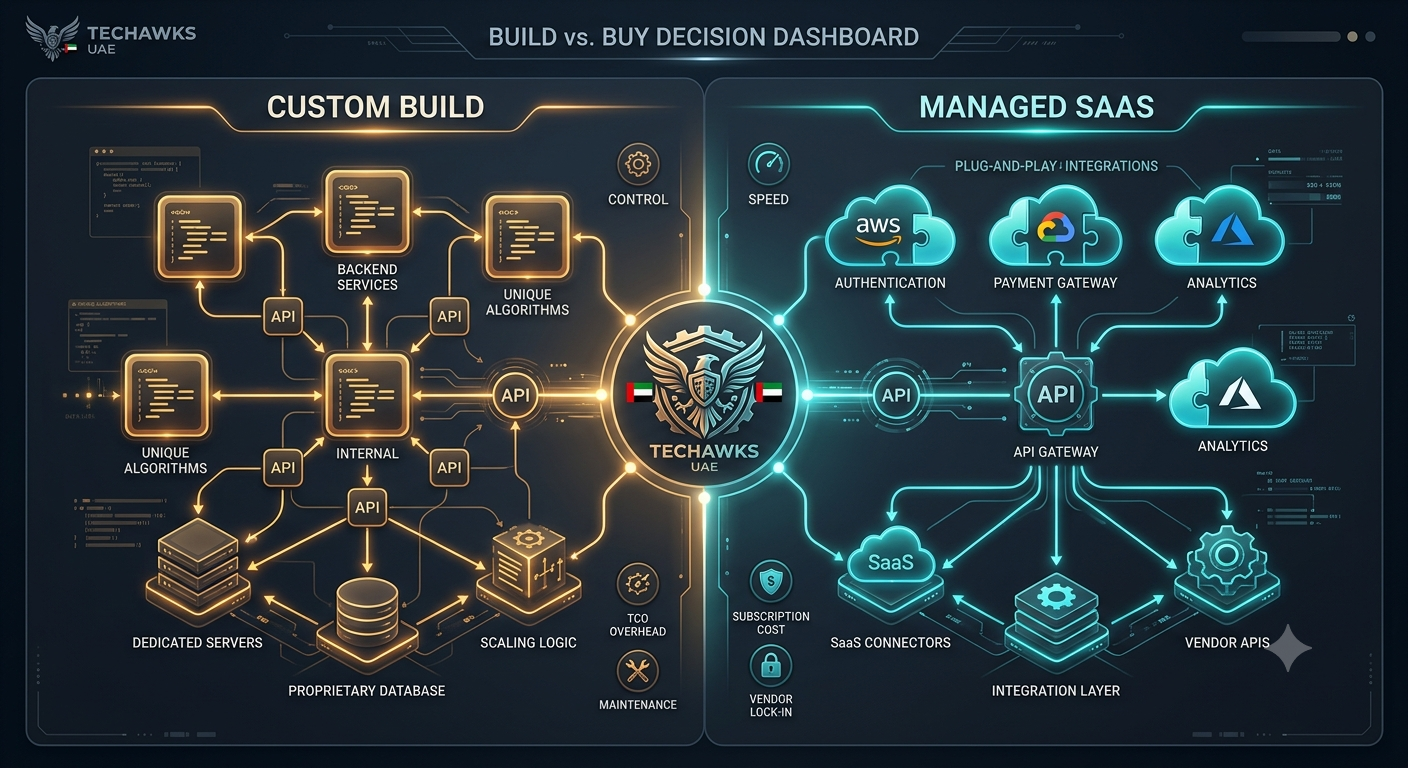
As tech hubs across Dubai and Abu Dhabi mature, engineering leaders face constant pressure to ship localized features quickly. While building custom systems offers complete control over data residency and integrations, it shifts valuable engineering bandwidth away from your core value proposition.
To navigate the Build vs. Buy debate effectively, UAE tech leaders need a pragmatic strategy that balances time-to-market, long-term operational costs, and local compliance.
Here is a practical decision framework for engineering teams in the region:
Apply the Core vs. Context Rule
Build only what drives your competitive advantage (e.g., proprietary algorithms, unique user experiences, or custom AI models).
Buy standard infrastructure and support functions (e.g., authentication, transactional email, logging, and APM tools) where commercial solutions are mature and secure.
Evaluate Local Compliance and Data Residency First
Before buying an international SaaS product, verify that its data processing nodes and storage align with UAE data protection standards.
If a third-party vendor cannot guarantee in-region data storage or local hosting options, building or adopting self-hosted open-source alternatives may be required.
Calculate Total Cost of Ownership (TCO), Not Just Initial Effort
Building custom tools isn't a one-time project—it creates long-term maintenance overhead, ongoing security updates, and technical debt.
Factor in the continuous engineering hours needed to maintain a custom build versus the subscription fee of a managed service.
Favor Composable, API-First Architectures
If you choose to buy, select modular, headless solutions with robust APIs. This allows you to swap out vendors easily as your scale grows or local market requirements evolve.
Key Takeaways
Focus on Differentiators: Reserve custom engineering efforts for your core product features that create real business value.
Audit for Compliance: Ensure third-party software meets local data residency requirements before committing.
Factor in Maintenance: Account for continuous maintenance costs when estimating the cost of building internal tools.
Modular First: Standardize on vendor-agnostic APIs to keep your stack flexible and prevent lock-in.
CTA
Where does your engineering team draw the line between building in-house and buying third-party tools? What challenges have you faced with local data compliance when integrating global SaaS platforms?
Join the conversation in the comments below! [Join Techawks UAE today] to connect and collaborate with CTOs, engineering managers, and tech leaders across the region.
As tech hubs across Dubai and Abu Dhabi mature, engineering leaders face constant pressure to ship localized features quickly. While building custom systems offers complete control over data residency and integrations, it shifts valuable engineering bandwidth away from your core value proposition.
To navigate the Build vs. Buy debate effectively, UAE tech leaders need a pragmatic strategy that balances time-to-market, long-term operational costs, and local compliance.
Here is a practical decision framework for engineering teams in the region:
Apply the Core vs. Context Rule
Build only what drives your competitive advantage (e.g., proprietary algorithms, unique user experiences, or custom AI models).
Buy standard infrastructure and support functions (e.g., authentication, transactional email, logging, and APM tools) where commercial solutions are mature and secure.
Evaluate Local Compliance and Data Residency First
Before buying an international SaaS product, verify that its data processing nodes and storage align with UAE data protection standards.
If a third-party vendor cannot guarantee in-region data storage or local hosting options, building or adopting self-hosted open-source alternatives may be required.
Calculate Total Cost of Ownership (TCO), Not Just Initial Effort
Building custom tools isn't a one-time project—it creates long-term maintenance overhead, ongoing security updates, and technical debt.
Factor in the continuous engineering hours needed to maintain a custom build versus the subscription fee of a managed service.
Favor Composable, API-First Architectures
If you choose to buy, select modular, headless solutions with robust APIs. This allows you to swap out vendors easily as your scale grows or local market requirements evolve.
Key Takeaways
Focus on Differentiators: Reserve custom engineering efforts for your core product features that create real business value.
Audit for Compliance: Ensure third-party software meets local data residency requirements before committing.
Factor in Maintenance: Account for continuous maintenance costs when estimating the cost of building internal tools.
Modular First: Standardize on vendor-agnostic APIs to keep your stack flexible and prevent lock-in.
CTA
Where does your engineering team draw the line between building in-house and buying third-party tools? What challenges have you faced with local data compliance when integrating global SaaS platforms?
Join the conversation in the comments below! [Join Techawks UAE today] to connect and collaborate with CTOs, engineering managers, and tech leaders across the region.
Build vs. Buy in the GCC: How to Scale Tech Infrastructure in the UAE
As tech hubs across Dubai and Abu Dhabi mature, engineering leaders face constant pressure to ship localized features quickly. While building custom systems offers complete control over data residency and integrations, it shifts valuable engineering bandwidth away from your core value proposition.
To navigate the Build vs. Buy debate effectively, UAE tech leaders need a pragmatic strategy that balances time-to-market, long-term operational costs, and local compliance.
Here is a practical decision framework for engineering teams in the region:
Apply the Core vs. Context Rule
Build only what drives your competitive advantage (e.g., proprietary algorithms, unique user experiences, or custom AI models).
Buy standard infrastructure and support functions (e.g., authentication, transactional email, logging, and APM tools) where commercial solutions are mature and secure.
Evaluate Local Compliance and Data Residency First
Before buying an international SaaS product, verify that its data processing nodes and storage align with UAE data protection standards.
If a third-party vendor cannot guarantee in-region data storage or local hosting options, building or adopting self-hosted open-source alternatives may be required.
Calculate Total Cost of Ownership (TCO), Not Just Initial Effort
Building custom tools isn't a one-time project—it creates long-term maintenance overhead, ongoing security updates, and technical debt.
Factor in the continuous engineering hours needed to maintain a custom build versus the subscription fee of a managed service.
Favor Composable, API-First Architectures
If you choose to buy, select modular, headless solutions with robust APIs. This allows you to swap out vendors easily as your scale grows or local market requirements evolve.
Key Takeaways
Focus on Differentiators: Reserve custom engineering efforts for your core product features that create real business value.
Audit for Compliance: Ensure third-party software meets local data residency requirements before committing.
Factor in Maintenance: Account for continuous maintenance costs when estimating the cost of building internal tools.
Modular First: Standardize on vendor-agnostic APIs to keep your stack flexible and prevent lock-in.
CTA
Where does your engineering team draw the line between building in-house and buying third-party tools? What challenges have you faced with local data compliance when integrating global SaaS platforms?
Join the conversation in the comments below! [Join Techawks UAE today] to connect and collaborate with CTOs, engineering managers, and tech leaders across the region.

 English
 Arabic
 French
 Spanish
 Portuguese
 Deutsch
 Turkish
 Dutch
Dutch
 Italiano
 Russian
 Romaian
 Greek
Greek