


Architecting for India Stack: How to Build Resilient SAGA Choreography for Population-Scale UPI Pipelines
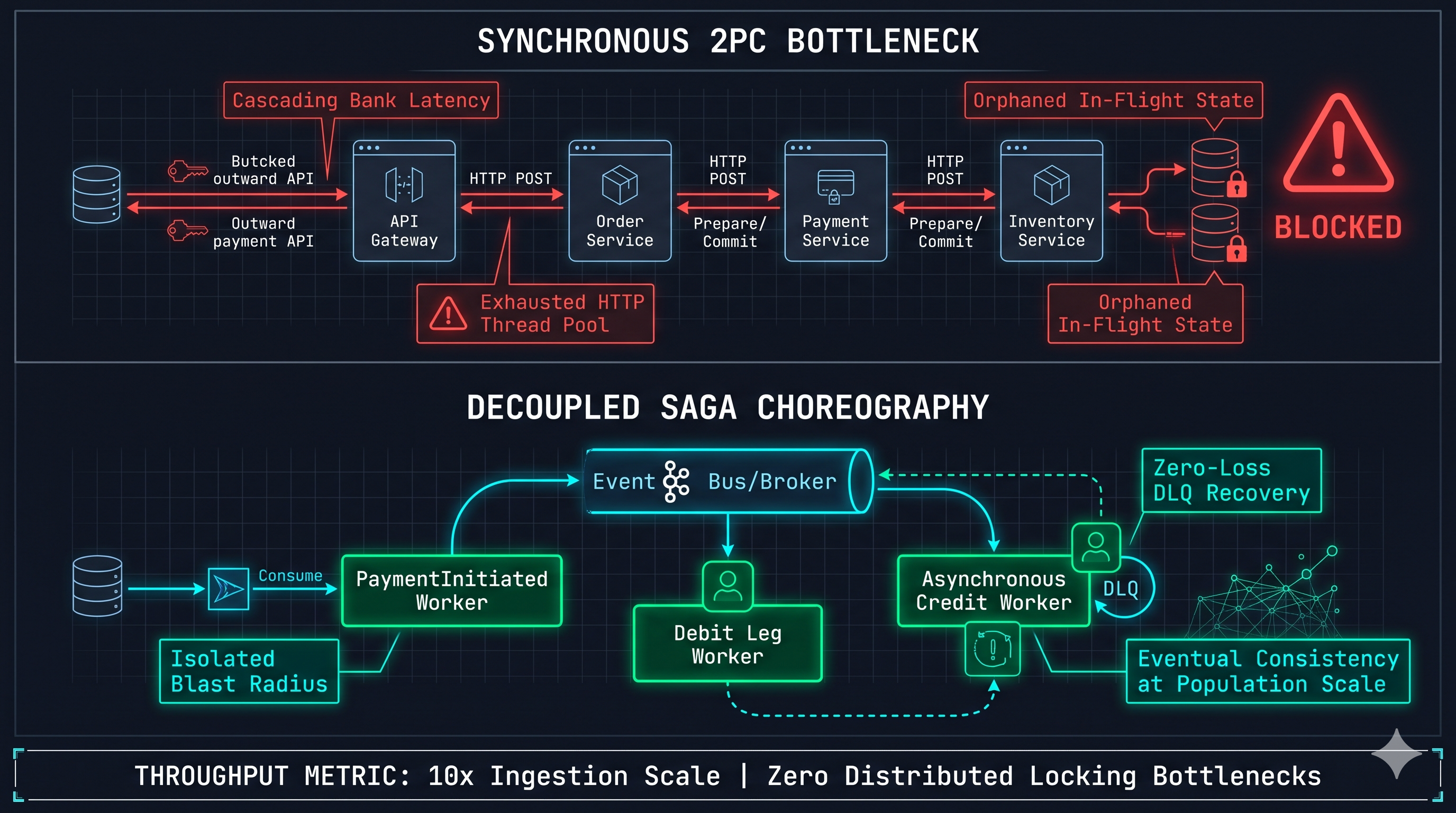
India's Unified Payments Interface (UPI) handles billions of monthly transactions across hundreds of disparate banking partners. At this volume, banking endpoints exhibit unpredictable latency: an issuer debit call might take 80ms during standard hours and suddenly spike to 12 seconds during festive flash sales.Traditional distributed transaction systems attempt Two-Phase Commit (2PC), locking database rows across both the debiting bank and the crediting bank until both confirm.In a distributed, multi-entity ecosystem like the India Stack, holding global locks across independent banking networks is an operational failure mode. Instead, resilient payment architectures implement an Event-Driven SAGA Choreography with Compensating Reversals.[❌ The Synchronous HTTP / 2PC Anti-Pattern]
User App ──(HTTP)──> Gateway ──(Sync)──> Issuer Bank (Debit) ──(Sync)──> Beneficiary Bank (Credit)
│ (Timeout / 10s hang)
▼
Outcome: Connection pools max out; upstream services crash; locks stay held indefinitely.
[✅ The Production SAGA Choreography Architecture]
Client Request ──> API Gateway ──> Orchestrator (Emits: 'PaymentInitiated')
│
┌───────────────────────┴───────────────────────┐
▼ ▼
[Debit Leg Worker] [Credit Leg Worker]
(Calls Issuer via NPCI Switch) (Listens for 'DebitConfirmed' Event)
│ │
(Timeout / Failure?) (Credit Timeout?)
▼ ▼
Emit 'DebitFailed' Event Trigger Auto-Reversal / Re-query
(Immediate User Response) (Zero-Loss Settlement Worker)
To engineer high-throughput payment rails that handle Indian peak load without transaction corruption, implement this 3-tier resilient pattern:
1. Split Debits and Credits into Independent Asynchronous LegsNever bundle the customer debit and merchant/beneficiary credit into a single atomic blocking step.Debit Leg: Deduct funds from the payer’s account and transition state to DEBITED. Emit a signed internal Kafka/event-broker message.Credit Leg: Consume the event and execute credit against the payee’s institution.If the debit succeeds but the credit fails, do not fail the entire transaction synchronously. Instead, route the credit task to an internal dead-letter queue (DLQ) with scheduled polling or initiate an automated refund compensation saga.
2. Implement Client-Side Idempotency and State MachinesBecause Indian networks face transient edge drops, consumers frequently mash retry buttons.Require every incoming payment request to carry a deterministic Transaction Reference ID (generated via UUIDv5 hashing the device binding, merchant order ID, and timestamp window).Enforce a strict Finite State Machine (FSM): INITIATED $\rightarrow$ PENDING_DEBIT $\rightarrow$ DEBITED $\rightarrow$ SETTLED (or REVERSED).Ensure state transitions are strictly monotonic so duplicate network webhooks cannot overwrite a terminal status.
3. Decouple Polling via Bank Status Re-Query QueuesWhen an NPCI or bank switch returns a PENDING or TIMEOUT response code, do not keep the user's mobile screen waiting on a blocking thread.Immediately return a PENDING receipt to the client.Dispatch an out-of-band asynchronous worker with exponential backoff (e.g., polling intervals at $T+5\text{s}$, $T+30\text{s}$, $T+2\text{m}$, $T+15\text{m}$) to query the transaction status API directly.This frees up application gateway threads to ingest new requests while long-tail bank delays resolve asynchronously in the background.Architecting for population scale in India requires accepting that network delays and banking timeouts are inevitable—and building decoupled, eventually consistent workflows that guarantee zero ledger drift.
Discussion Question
When handling delayed payment states during peak traffic events, how does your engineering team manage the threshold between running automated status re-queries versus triggering immediate user refund sagas?
CTA
Join Techawks India to dissect national-scale software architectures, fintech systems engineering, and distributed design patterns with developers across India.
Architecting for India Stack: How to Build Resilient SAGA Choreography for Population-Scale UPI Pipelines
India's Unified Payments Interface (UPI) handles billions of monthly transactions across hundreds of disparate banking partners. At this volume, banking endpoints exhibit unpredictable latency: an issuer debit call might take 80ms during standard hours and suddenly spike to 12 seconds during festive flash sales.Traditional distributed transaction systems attempt Two-Phase Commit (2PC), locking database rows across both the debiting bank and the crediting bank until both confirm.In a distributed, multi-entity ecosystem like the India Stack, holding global locks across independent banking networks is an operational failure mode. Instead, resilient payment architectures implement an Event-Driven SAGA Choreography with Compensating Reversals.[❌ The Synchronous HTTP / 2PC Anti-Pattern]
User App ──(HTTP)──> Gateway ──(Sync)──> Issuer Bank (Debit) ──(Sync)──> Beneficiary Bank (Credit)
│ (Timeout / 10s hang)
▼
Outcome: Connection pools max out; upstream services crash; locks stay held indefinitely.
[✅ The Production SAGA Choreography Architecture]
Client Request ──> API Gateway ──> Orchestrator (Emits: 'PaymentInitiated')
│
┌───────────────────────┴───────────────────────┐
▼ ▼
[Debit Leg Worker] [Credit Leg Worker]
(Calls Issuer via NPCI Switch) (Listens for 'DebitConfirmed' Event)
│ │
(Timeout / Failure?) (Credit Timeout?)
▼ ▼
Emit 'DebitFailed' Event Trigger Auto-Reversal / Re-query
(Immediate User Response) (Zero-Loss Settlement Worker)
To engineer high-throughput payment rails that handle Indian peak load without transaction corruption, implement this 3-tier resilient pattern:
1. Split Debits and Credits into Independent Asynchronous LegsNever bundle the customer debit and merchant/beneficiary credit into a single atomic blocking step.Debit Leg: Deduct funds from the payer’s account and transition state to DEBITED. Emit a signed internal Kafka/event-broker message.Credit Leg: Consume the event and execute credit against the payee’s institution.If the debit succeeds but the credit fails, do not fail the entire transaction synchronously. Instead, route the credit task to an internal dead-letter queue (DLQ) with scheduled polling or initiate an automated refund compensation saga.
2. Implement Client-Side Idempotency and State MachinesBecause Indian networks face transient edge drops, consumers frequently mash retry buttons.Require every incoming payment request to carry a deterministic Transaction Reference ID (generated via UUIDv5 hashing the device binding, merchant order ID, and timestamp window).Enforce a strict Finite State Machine (FSM): INITIATED $\rightarrow$ PENDING_DEBIT $\rightarrow$ DEBITED $\rightarrow$ SETTLED (or REVERSED).Ensure state transitions are strictly monotonic so duplicate network webhooks cannot overwrite a terminal status.
3. Decouple Polling via Bank Status Re-Query QueuesWhen an NPCI or bank switch returns a PENDING or TIMEOUT response code, do not keep the user's mobile screen waiting on a blocking thread.Immediately return a PENDING receipt to the client.Dispatch an out-of-band asynchronous worker with exponential backoff (e.g., polling intervals at $T+5\text{s}$, $T+30\text{s}$, $T+2\text{m}$, $T+15\text{m}$) to query the transaction status API directly.This frees up application gateway threads to ingest new requests while long-tail bank delays resolve asynchronously in the background.Architecting for population scale in India requires accepting that network delays and banking timeouts are inevitable—and building decoupled, eventually consistent workflows that guarantee zero ledger drift.
Discussion Question
When handling delayed payment states during peak traffic events, how does your engineering team manage the threshold between running automated status re-queries versus triggering immediate user refund sagas?
CTA
Join Techawks India to dissect national-scale software architectures, fintech systems engineering, and distributed design patterns with developers across India.

 English
 Arabic
 French
 Spanish
 Portuguese
 Deutsch
 Turkish
 Dutch
 Italiano
 Russian
 Romaian
 Greek