


Defeating "Harvest Now, Decrypt Later": How US Engineering Teams Must Architect Hybrid Post-Quantum TLS 1.3
Across the US tech landscape—from federal contractors and defense tech to health tech and cloud infrastructure—compliance and security baselines are shifting toward quantum resilience.
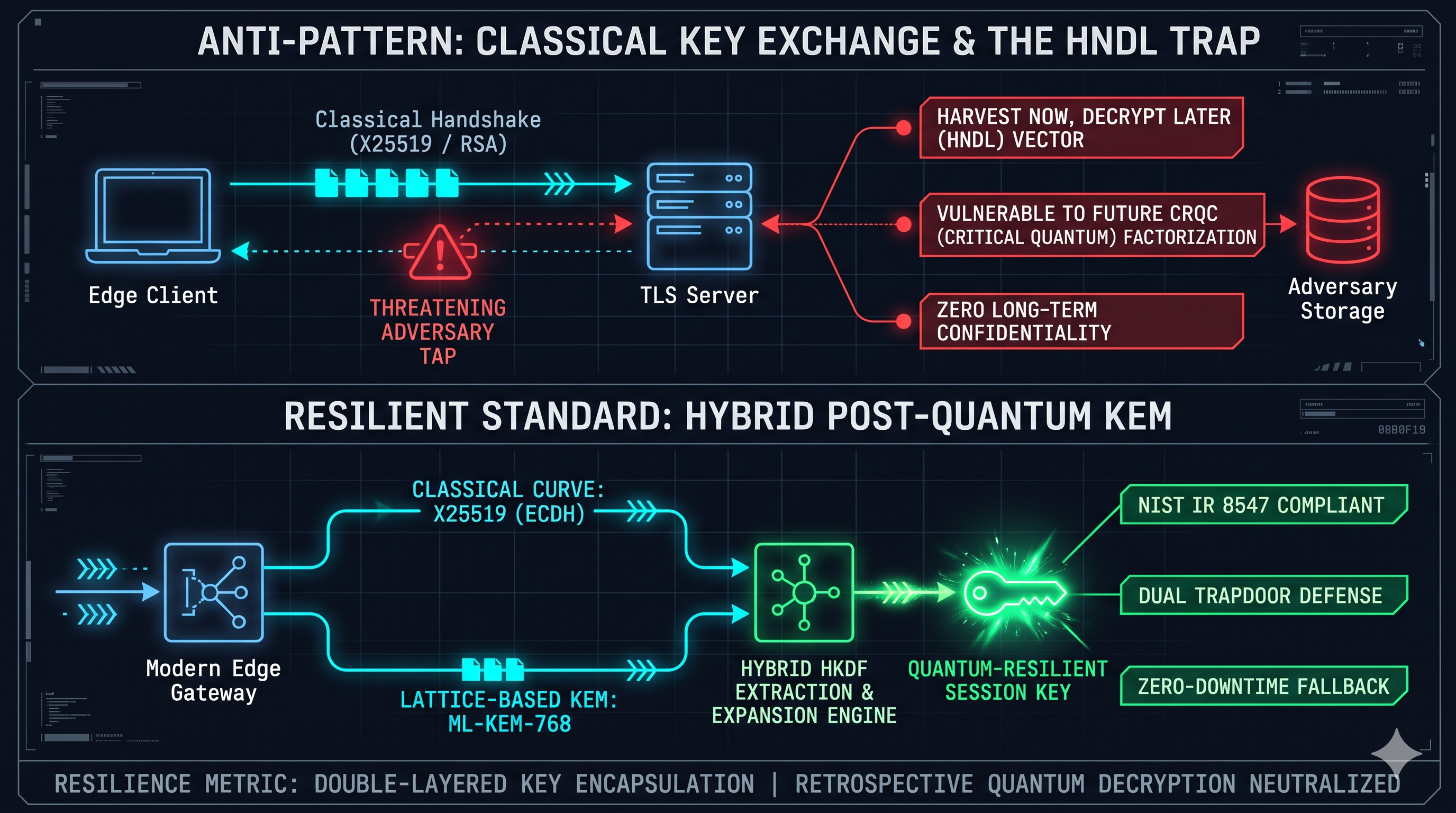
The primary vector is not an immediate quantum compromise of live systems today, but Harvest Now, Decrypt Later (HNDL): state-sponsored adversaries passively capturing encrypted transit traffic to decrypt once fault-tolerant cryptanalytically relevant quantum computers (CRQCs) come online.
Following the release of NIST IR 8547 (Transition to Post-Quantum Cryptography Standards), US technology providers and enterprise systems are transitioning from legacy key-exchange primitives toward hybrid post-quantum schemes.
The core architectural failure is assuming migration requires a complete rip-and-replace of your cryptographic stack:
[❌ Legacy Classical Ingress: Vulnerable to HNDL]
Client ──(Standard X25519 / P-256 Key Exchange)──> Edge Load Balancer
Adversary Action: Passive tap archives payload bytes.
Future State: Cryptanalytic quantum computer cracks discrete log -> Full retrospective plaintext.
[✅ Production Standard: Hybrid Post-Quantum Key Exchange (X25519 + ML-KEM)]
Client ──(Combined Key Exchange: X25519 + ML-KEM-768)──> Edge Gateway
│
┌───────────────┴───────────────┐
▼ ▼
Classical Secret (X25519) Quantum-Resistant Secret (ML-KEM)
│ │
└───────────────┬───────────────┘
▼
HKDF Extract-and-Expand (Hybrid Master Secret)
Result: Breaking the session requires breaking BOTH classical and quantum-safe algorithms.
To align your US cloud architectures with zero-trust quantum baselines without incurring operational downtime or breaking legacy clients, implement this 3-tier protocol:
1. Deploy Dual-Mechanism Hybrid Key Exchanges at the Edge
Do not abandon classical mathematics entirely. NIST and the Internet Engineering Task Force (IETF) recommend hybrid key encapsulation mechanisms (KEMs):
Pair standard X25519 with ML-KEM-768 (standardized from CRYSTALS-Kyber).
The shared master secret is derived via HKDF from both key agreements. If an unforeseen vulnerability is found in either algorithm, the complementary mathematical trapdoor preserves confidentiality.
Modern ingress proxies (Envoy, NGINX, Cloudflare edge workers, AWS ALB) support hybrid post-quantum cipher suites natively.
2. Mitigate Client Hello MTU Fragmentation
ML-KEM public keys and ciphertexts are substantially larger than classical elliptic curve keys (e.g., ~1,184 bytes for ML-KEM-768 vs. 32 bytes for X25519).
When the TLS ClientHello message exceeds the standard Network Maximum Transmission Unit (typically 1,500 bytes), intermediate network middleboxes or brittle corporate firewalls may drop fragmented packets.
Tune your ingress buffer pools and monitor TCP retransmissions during the initial TLS handshake to ensure downstream middleboxes do not penalize hybrid handshakes.
3. Establish Cryptographic Bill of Materials (CBOM) Observability
You cannot migrate what you cannot locate.
Instrument automated software composition analysis (SCA) to identify hard-coded cryptographic algorithms (RSA-2048, ECDSA P-256) across internal microservice communication and JWT signing routines.
Decouple cryptographic algorithms from business logic using crypto-agile wrapper libraries, enabling dynamic algorithm reconfiguration without redeploying microservice binaries.
Modern infrastructure engineering in the US demands recognizing that data with a 10-year confidentiality lifecycle is already insecure if protected solely by classical asymmetric keys.
Discussion Question
Has your platform or DevOps team started testing hybrid ML-KEM cipher suites on external load balancers, and did you run into any packet fragmentation issues with legacy corporate middleboxes?
CTA
Join Techawks USA to dissect federal cloud compliance, enterprise systems engineering, and frontier architecture patterns with builders across the United States.
Defeating "Harvest Now, Decrypt Later": How US Engineering Teams Must Architect Hybrid Post-Quantum TLS 1.3
Across the US tech landscape—from federal contractors and defense tech to health tech and cloud infrastructure—compliance and security baselines are shifting toward quantum resilience.
The primary vector is not an immediate quantum compromise of live systems today, but Harvest Now, Decrypt Later (HNDL): state-sponsored adversaries passively capturing encrypted transit traffic to decrypt once fault-tolerant cryptanalytically relevant quantum computers (CRQCs) come online.
Following the release of NIST IR 8547 (Transition to Post-Quantum Cryptography Standards), US technology providers and enterprise systems are transitioning from legacy key-exchange primitives toward hybrid post-quantum schemes.
The core architectural failure is assuming migration requires a complete rip-and-replace of your cryptographic stack:
[❌ Legacy Classical Ingress: Vulnerable to HNDL]
Client ──(Standard X25519 / P-256 Key Exchange)──> Edge Load Balancer
Adversary Action: Passive tap archives payload bytes.
Future State: Cryptanalytic quantum computer cracks discrete log -> Full retrospective plaintext.
[✅ Production Standard: Hybrid Post-Quantum Key Exchange (X25519 + ML-KEM)]
Client ──(Combined Key Exchange: X25519 + ML-KEM-768)──> Edge Gateway
│
┌───────────────┴───────────────┐
▼ ▼
Classical Secret (X25519) Quantum-Resistant Secret (ML-KEM)
│ │
└───────────────┬───────────────┘
▼
HKDF Extract-and-Expand (Hybrid Master Secret)
Result: Breaking the session requires breaking BOTH classical and quantum-safe algorithms.
To align your US cloud architectures with zero-trust quantum baselines without incurring operational downtime or breaking legacy clients, implement this 3-tier protocol:
1. Deploy Dual-Mechanism Hybrid Key Exchanges at the Edge
Do not abandon classical mathematics entirely. NIST and the Internet Engineering Task Force (IETF) recommend hybrid key encapsulation mechanisms (KEMs):
Pair standard X25519 with ML-KEM-768 (standardized from CRYSTALS-Kyber).
The shared master secret is derived via HKDF from both key agreements. If an unforeseen vulnerability is found in either algorithm, the complementary mathematical trapdoor preserves confidentiality.
Modern ingress proxies (Envoy, NGINX, Cloudflare edge workers, AWS ALB) support hybrid post-quantum cipher suites natively.
2. Mitigate Client Hello MTU Fragmentation
ML-KEM public keys and ciphertexts are substantially larger than classical elliptic curve keys (e.g., ~1,184 bytes for ML-KEM-768 vs. 32 bytes for X25519).
When the TLS ClientHello message exceeds the standard Network Maximum Transmission Unit (typically 1,500 bytes), intermediate network middleboxes or brittle corporate firewalls may drop fragmented packets.
Tune your ingress buffer pools and monitor TCP retransmissions during the initial TLS handshake to ensure downstream middleboxes do not penalize hybrid handshakes.
3. Establish Cryptographic Bill of Materials (CBOM) Observability
You cannot migrate what you cannot locate.
Instrument automated software composition analysis (SCA) to identify hard-coded cryptographic algorithms (RSA-2048, ECDSA P-256) across internal microservice communication and JWT signing routines.
Decouple cryptographic algorithms from business logic using crypto-agile wrapper libraries, enabling dynamic algorithm reconfiguration without redeploying microservice binaries.
Modern infrastructure engineering in the US demands recognizing that data with a 10-year confidentiality lifecycle is already insecure if protected solely by classical asymmetric keys.
Discussion Question
Has your platform or DevOps team started testing hybrid ML-KEM cipher suites on external load balancers, and did you run into any packet fragmentation issues with legacy corporate middleboxes?
CTA
Join Techawks USA to dissect federal cloud compliance, enterprise systems engineering, and frontier architecture patterns with builders across the United States.

 Arabic
 French
 Spanish
 Portuguese
 Deutsch
 Turkish
 Dutch
 Italiano
 Russian
 Romaian
 Portuguese (Brazil)
 Greek