


Beyond Static Uptime: How UK Engineering Teams Must Architect Impact Tolerances for FCA & PRA Operational Resilience
Under supervisory oversight across UK financial services and digital infrastructure (governed by the Bank of England, PRA, and FCA operational resilience supervisory regimes), engineering teams are audited not on theoretical uptime, but on whether critical services can remain within strict Impact Tolerances during severe, plausible disruptions.
Traditional disaster recovery focuses on infrastructure-level Recovery Point Objective (RPO) and Recovery Time Objective (RTO).
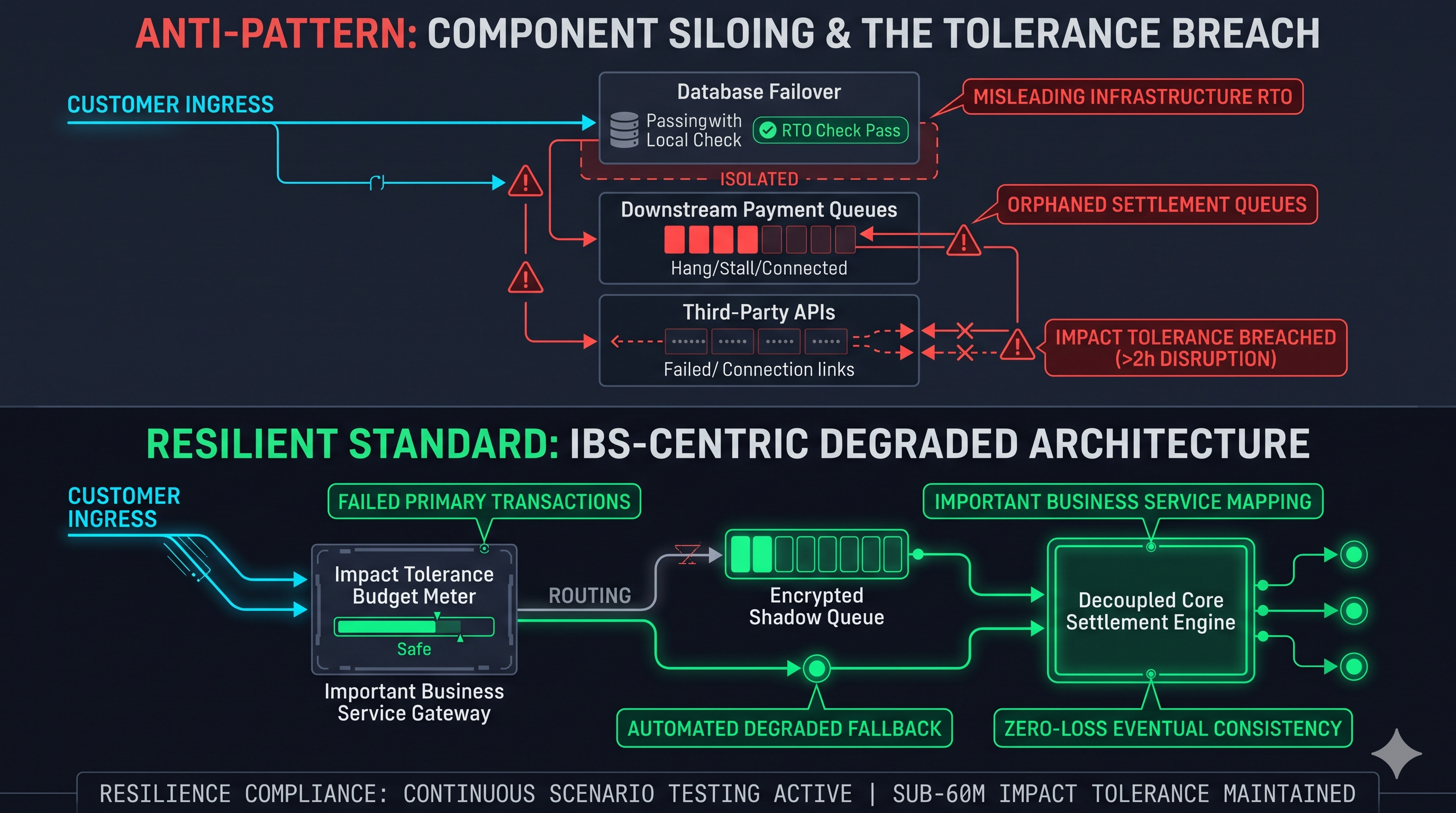
The systemic flaw in this approach is Component Siloing: an engineering team might restore an Amazon RDS cluster in 15 minutes, but downstream third-party identity providers, clearing house webhooks, and asynchronous reconciliation queues can remain broken for hours, causing intolerable harm to end consumers.
[❌ The Legacy Disaster Recovery Anti-Pattern: Component Siloing]
Failure: Primary AWS eu-west-2 Database Outage
DevOps Action: Restore DB snapshot in isolation (RTO met: 15m).
Hidden Reality: Payment settlement queue hung; Open Banking API rate-limited; IBS remains down.
Audit Finding: Impact Tolerance breached (Customer funds locked > 2h).
[✅ The Production UK Operational Resilience Architecture: IBS Mapping & Circuit Breakers]
Customer Ingress (Faster Payments / Open Banking)
│
▼
[IBS Gateway: Active Impact Tolerance Budget Meter]
│
┌───────────────┴───────────────┐
▼ ▼
[Primary Rails (eu-west-2)] [Warm Fallback / Degraded Mode]
│ (Partition / Lag) │
▼ ▼
[Circuit Breaker Trips] ──> [Deterministic Shadow Ledger (In-Memory)]
│
(Syncs within 45m Impact Cap)
▼
[Asynchronous Core Settlement]
To structure your UK cloud architectures around resilient service delivery rather than component uptime, implement this 3-tier engineering blueprint:
1. Map Dependencies Directly to Important Business Services (IBS)
Stop building dependency graphs grouped arbitrarily by microservice repositories.
Group systems around discrete, customer-facing business outcomes (e.g., "Same-Day Faster Payment Initiation" or "Mortgage Decisioning").
Tag every supporting asset: infrastructure, data stores, internal microservices, and external third-party SaaS vendors (BaaS providers, identity verification APIs).
Identify single points of failure (SPOFs) where an unannounced cloud region degradation or upstream vendor rate limit cascades across the entire customer journey.
2. Implement Automated Degradation Modes with Synthetic Shadow Queues
When a core clearing switch or database cluster fails, avoid returning generic HTTP 500 errors to customers.
Configure your edge gateways to trip into a Degraded Execution State the moment latency threatens the defined impact tolerance window (e.g., maximum allowable disruption of 60 minutes).
Once primary backing services recover, an automated reconciliation worker drains the buffer sequentially with zero data loss.
3. Transition from Passive DR Drills to Chaos Scenario Testing
Static runbooks and annual DR PDF reports are dead documents. Supervisory guidelines expect firms to run automated chaos experiments simulating severe but plausible events:
Simulate the complete sudden loss of an entire UK cloud availability zone alongside a concurrent third-party authentication API outage.
Validate that your distributed state machines automatically reconcile data without exceeding your end-to-end tolerance threshold.
Designing for operational resilience in the UK means accepting that individual microservices will experience outages—and engineering decoupled failover pathways that preserve customer outcomes under severe stress.
Discussion Question
How does your team define the technical boundary between an acceptable degraded mode and an official impact tolerance breach during third-party dependency outages?
CTA
Join Techawks UK to explore resilient systems engineering, cloud architecture patterns, and technical governance strategies with developers and platform leaders across the UK.
Beyond Static Uptime: How UK Engineering Teams Must Architect Impact Tolerances for FCA & PRA Operational Resilience
Under supervisory oversight across UK financial services and digital infrastructure (governed by the Bank of England, PRA, and FCA operational resilience supervisory regimes), engineering teams are audited not on theoretical uptime, but on whether critical services can remain within strict Impact Tolerances during severe, plausible disruptions.
Traditional disaster recovery focuses on infrastructure-level Recovery Point Objective (RPO) and Recovery Time Objective (RTO).
The systemic flaw in this approach is Component Siloing: an engineering team might restore an Amazon RDS cluster in 15 minutes, but downstream third-party identity providers, clearing house webhooks, and asynchronous reconciliation queues can remain broken for hours, causing intolerable harm to end consumers.
[❌ The Legacy Disaster Recovery Anti-Pattern: Component Siloing]
Failure: Primary AWS eu-west-2 Database Outage
DevOps Action: Restore DB snapshot in isolation (RTO met: 15m).
Hidden Reality: Payment settlement queue hung; Open Banking API rate-limited; IBS remains down.
Audit Finding: Impact Tolerance breached (Customer funds locked > 2h).
[✅ The Production UK Operational Resilience Architecture: IBS Mapping & Circuit Breakers]
Customer Ingress (Faster Payments / Open Banking)
│
▼
[IBS Gateway: Active Impact Tolerance Budget Meter]
│
┌───────────────┴───────────────┐
▼ ▼
[Primary Rails (eu-west-2)] [Warm Fallback / Degraded Mode]
│ (Partition / Lag) │
▼ ▼
[Circuit Breaker Trips] ──> [Deterministic Shadow Ledger (In-Memory)]
│
(Syncs within 45m Impact Cap)
▼
[Asynchronous Core Settlement]
To structure your UK cloud architectures around resilient service delivery rather than component uptime, implement this 3-tier engineering blueprint:
1. Map Dependencies Directly to Important Business Services (IBS)
Stop building dependency graphs grouped arbitrarily by microservice repositories.
Group systems around discrete, customer-facing business outcomes (e.g., "Same-Day Faster Payment Initiation" or "Mortgage Decisioning").
Tag every supporting asset: infrastructure, data stores, internal microservices, and external third-party SaaS vendors (BaaS providers, identity verification APIs).
Identify single points of failure (SPOFs) where an unannounced cloud region degradation or upstream vendor rate limit cascades across the entire customer journey.
2. Implement Automated Degradation Modes with Synthetic Shadow Queues
When a core clearing switch or database cluster fails, avoid returning generic HTTP 500 errors to customers.
Configure your edge gateways to trip into a Degraded Execution State the moment latency threatens the defined impact tolerance window (e.g., maximum allowable disruption of 60 minutes).
Once primary backing services recover, an automated reconciliation worker drains the buffer sequentially with zero data loss.
3. Transition from Passive DR Drills to Chaos Scenario Testing
Static runbooks and annual DR PDF reports are dead documents. Supervisory guidelines expect firms to run automated chaos experiments simulating severe but plausible events:
Simulate the complete sudden loss of an entire UK cloud availability zone alongside a concurrent third-party authentication API outage.
Validate that your distributed state machines automatically reconcile data without exceeding your end-to-end tolerance threshold.
Designing for operational resilience in the UK means accepting that individual microservices will experience outages—and engineering decoupled failover pathways that preserve customer outcomes under severe stress.
Discussion Question
How does your team define the technical boundary between an acceptable degraded mode and an official impact tolerance breach during third-party dependency outages?
CTA
Join Techawks UK to explore resilient systems engineering, cloud architecture patterns, and technical governance strategies with developers and platform leaders across the UK.

 Arabic
 French
 Spanish
 Portuguese
 Deutsch
 Turkish
 Dutch
 Italiano
 Russian
 Romaian
 Portuguese (Brazil)
 Greek