


Architecting Sovereign AI in the UAE: How to Enforce In-Country Data Residency Across LLM Inference Pipelines
As the UAE cements its position as a global capital for artificial intelligence, regulatory frameworks—specifically Federal Decree-Law No. 45 of 2021 on Personal Data Protection (PDPL) and the UAE Cyber Security Council National Cloud Security Policy—strictly enforce sovereign data residency and cross-border transfer controls.
The critical engineering failure in AI adoption is treating foundational models as geographically agnostic APIs.
When building Retrieval-Augmented Generation (RAG) or agentic loops, developers frequently send unstructured user context across international borders for external embedding generation and token completion. In regulated sectors (banking, government entities, critical infrastructure, and healthcare), this architecture breaches statutory compliance and risks heavy regulatory penalties.
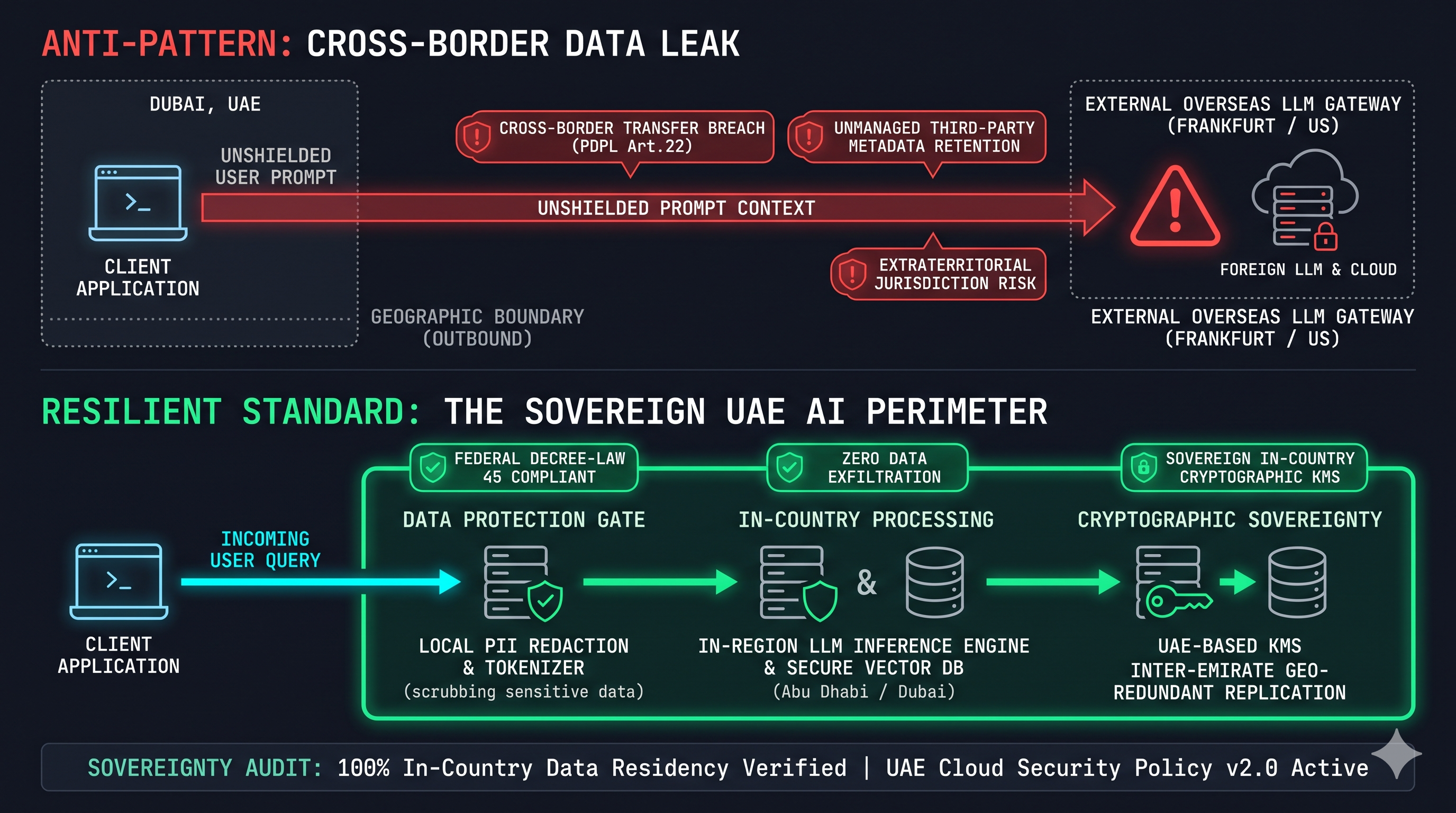
[❌ The Non-Compliant Cross-Border Anti-Pattern]
UAE Client (Dubai/AD) ──> Web App ──(Unsanitized Prompt)──> External LLM Gateway (Frankfurt/US)
│
(Exfiltrates PII & Metadata)
▼
Result: Direct violation of UAE PDPL Art. 22/23 & Sovereign Cloud Policy.
[✅ The Sovereign UAE In-Country AI Architecture]
UAE Client ──> In-Country API Gateway (Dubai / Abu Dhabi Cloud Region)
│
▼
[PII Redaction & Tokenization Guardrail]
│
┌─────────────┴─────────────┐
▼ ▼
[In-Country Vector DB] [Locally Hosted / Sovereign LLM]
(AES-256 with UAE KMS) (In-Region Inference: UAE VPC)
│ │
└─────────────┬─────────────┘
▼
[Encrypted In-Country Storage & Inter-Emirate Replica]
To build compliant, enterprise-grade AI systems in the UAE, implement this 3-tier sovereign architecture:
1. Pin Model Inference and Storage to Domestic Cloud Infrastructure
Under the National Cloud Security Policy and PDPL, data and associated consumer metadata must remain under domestic UAE jurisdiction.
Deploy model weights and vector indexes strictly within domestic cloud regions (e.g., UAE hyperscaler availability zones in Dubai and Abu Dhabi or sovereign infrastructure partners).
Ensure all disaster recovery replication is configured as Inter-Emirate Geo-Redundancy (e.g., primary cluster in Dubai with hot/warm standby in Abu Dhabi), avoiding failovers that silently replicate customer databases outside sovereign borders.
2. Implement Client-Side PII Masking and Deterministic Redaction
Before any user input reaches downstream reasoning pipelines, route payloads through an automated preprocessing guardrail:
Detect and tokenize sensitive national identifiers (Emirates ID numbers, passport strings, biometric tokens, contact records) using regex patterns and local named-entity recognition (NER) models.
Replace sensitive fields with synthetic surrogate tokens (<EID_TOKEN_UUID>), maintaining an encrypted local vault to map variables back on the response path.
3. Enforce In-Country Key Management (KMS Bring Your Own Key)
Cloud security standards mandate that foreign entities cannot be compelled to expose data via extraterritorial access requests.
Encrypt all persistent data at rest (database volumes, prompt logs, Parquet historical stores) using AES-256 with Customer-Managed Keys (CMK) managed inside UAE-resident Hardware Security Modules (HSMs).
Enforce strict IAM policies ensuring encryption keys never leave UAE borders and foreign cloud operators cannot decrypt stored context payloads.
Achieving enterprise AI scale in the UAE requires pairing frontier reasoning capabilities with strict sovereign isolation, ensuring your infrastructure is fully compliant with federal data protection laws.
Discussion Question
How is your engineering team solving the trade-off between accessing bleeding-edge frontier models and maintaining strict in-country data residency for regulated UAE workloads?
CTA
Join Techawks UAE to explore sovereign cloud engineering, regional AI architectures, and enterprise compliance patterns with builders and technology leaders across the UAE.
Architecting Sovereign AI in the UAE: How to Enforce In-Country Data Residency Across LLM Inference Pipelines
As the UAE cements its position as a global capital for artificial intelligence, regulatory frameworks—specifically Federal Decree-Law No. 45 of 2021 on Personal Data Protection (PDPL) and the UAE Cyber Security Council National Cloud Security Policy—strictly enforce sovereign data residency and cross-border transfer controls.
The critical engineering failure in AI adoption is treating foundational models as geographically agnostic APIs.
When building Retrieval-Augmented Generation (RAG) or agentic loops, developers frequently send unstructured user context across international borders for external embedding generation and token completion. In regulated sectors (banking, government entities, critical infrastructure, and healthcare), this architecture breaches statutory compliance and risks heavy regulatory penalties.
[❌ The Non-Compliant Cross-Border Anti-Pattern]
UAE Client (Dubai/AD) ──> Web App ──(Unsanitized Prompt)──> External LLM Gateway (Frankfurt/US)
│
(Exfiltrates PII & Metadata)
▼
Result: Direct violation of UAE PDPL Art. 22/23 & Sovereign Cloud Policy.
[✅ The Sovereign UAE In-Country AI Architecture]
UAE Client ──> In-Country API Gateway (Dubai / Abu Dhabi Cloud Region)
│
▼
[PII Redaction & Tokenization Guardrail]
│
┌─────────────┴─────────────┐
▼ ▼
[In-Country Vector DB] [Locally Hosted / Sovereign LLM]
(AES-256 with UAE KMS) (In-Region Inference: UAE VPC)
│ │
└─────────────┬─────────────┘
▼
[Encrypted In-Country Storage & Inter-Emirate Replica]
To build compliant, enterprise-grade AI systems in the UAE, implement this 3-tier sovereign architecture:
1. Pin Model Inference and Storage to Domestic Cloud Infrastructure
Under the National Cloud Security Policy and PDPL, data and associated consumer metadata must remain under domestic UAE jurisdiction.
Deploy model weights and vector indexes strictly within domestic cloud regions (e.g., UAE hyperscaler availability zones in Dubai and Abu Dhabi or sovereign infrastructure partners).
Ensure all disaster recovery replication is configured as Inter-Emirate Geo-Redundancy (e.g., primary cluster in Dubai with hot/warm standby in Abu Dhabi), avoiding failovers that silently replicate customer databases outside sovereign borders.
2. Implement Client-Side PII Masking and Deterministic Redaction
Before any user input reaches downstream reasoning pipelines, route payloads through an automated preprocessing guardrail:
Detect and tokenize sensitive national identifiers (Emirates ID numbers, passport strings, biometric tokens, contact records) using regex patterns and local named-entity recognition (NER) models.
Replace sensitive fields with synthetic surrogate tokens (<EID_TOKEN_UUID>), maintaining an encrypted local vault to map variables back on the response path.
3. Enforce In-Country Key Management (KMS Bring Your Own Key)
Cloud security standards mandate that foreign entities cannot be compelled to expose data via extraterritorial access requests.
Encrypt all persistent data at rest (database volumes, prompt logs, Parquet historical stores) using AES-256 with Customer-Managed Keys (CMK) managed inside UAE-resident Hardware Security Modules (HSMs).
Enforce strict IAM policies ensuring encryption keys never leave UAE borders and foreign cloud operators cannot decrypt stored context payloads.
Achieving enterprise AI scale in the UAE requires pairing frontier reasoning capabilities with strict sovereign isolation, ensuring your infrastructure is fully compliant with federal data protection laws.
Discussion Question
How is your engineering team solving the trade-off between accessing bleeding-edge frontier models and maintaining strict in-country data residency for regulated UAE workloads?
CTA
Join Techawks UAE to explore sovereign cloud engineering, regional AI architectures, and enterprise compliance patterns with builders and technology leaders across the UAE.

 English
 Arabic
 French
 Spanish
 Portuguese
 Deutsch
 Turkish
 Dutch
 Italiano
 Russian
 Romaian
 Greek