


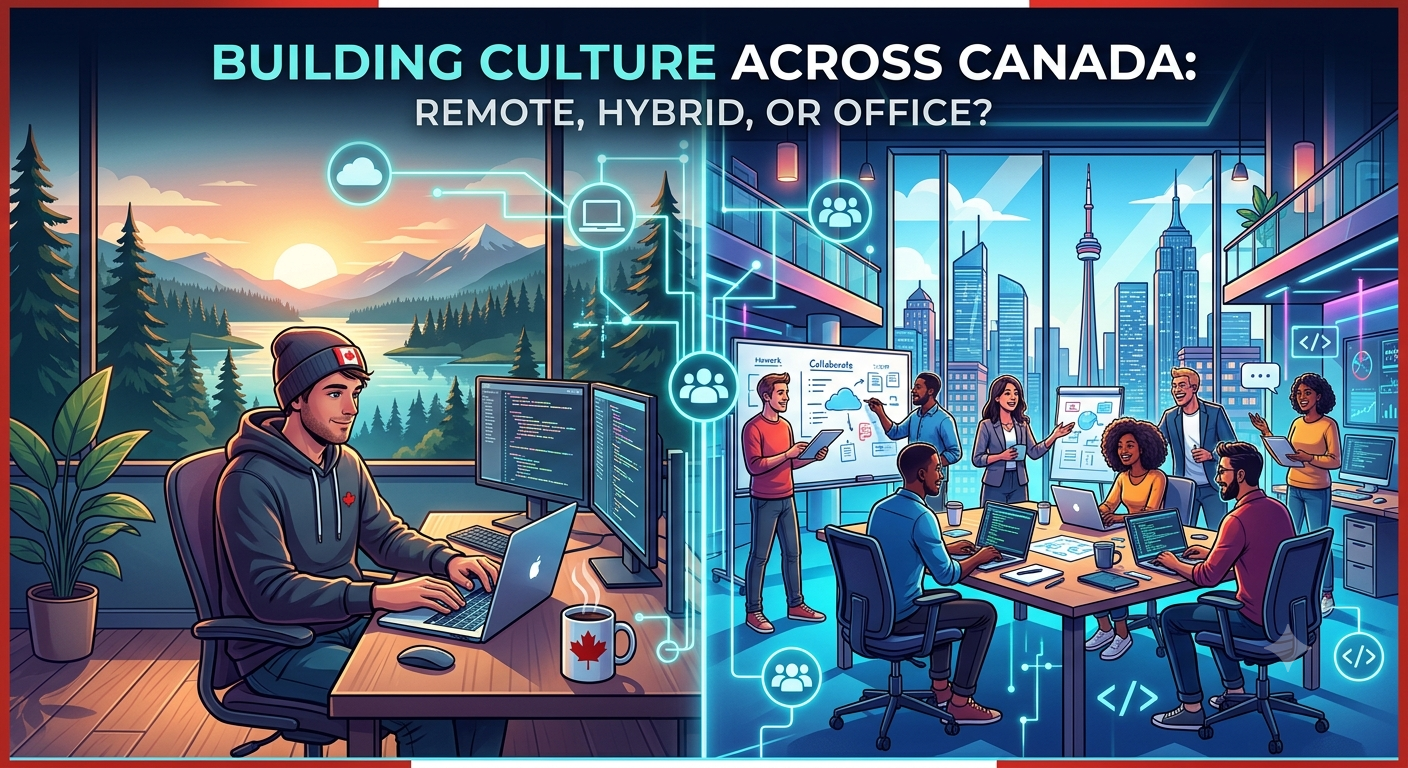
Remote vs. Hybrid vs. Office: What Is the Long-Term Play for Canadian Tech Teams?
Over the last few years, the Canadian tech landscape has fundamentally transformed. Distributed teams allow startups to hire top talent anywhere—from Calgary to Montreal—while saving on commercial overhead. However, maintaining spontaneous innovation, deep technical alignment, and retention in a purely remote environment presents real friction.
Many Canadian tech leaders are navigating three distinct operating models:
1. Fully Remote (Nationwide)
The Advantage: Unlocks the entire Canadian talent pool and reduces operational costs.
The Practical Advice: Requires heavy investment in asynchronous documentation (e.g., Notion, RFC processes) and intentional social touchpoints to prevent isolation.
2. Hub-and-Spoke Hybrid
The Advantage: Combines local collaboration with remote flexibility by anchoring teams around tech hubs (like Toronto, Waterloo, or Ottawa).
The Practical Advice: Establish structured "in-office days" dedicated solely to brainstorming, architecture reviews, and team building—not heads-down coding.
3. Co-located Centralization
The Advantage: Maximizes real-time problem solving and rapid iteration, particularly crucial for early-stage hardware or high-velocity startups.
The Practical Advice: Offsets physical office costs by leveraging local innovation spaces, co-working incubators, and provincial hiring incentives.
There is no one-size-fits-all model, but the decision directly impacts company culture, recruitment velocity, and employee retention across Canada.
Key Takeaways
Document First: A remote or hybrid setup only works if your technical documentation and decision-making processes are crystal clear and asynchronous.
Optimize Office Time: If using a hybrid model, bring people together for strategic alignment and relationship-building, not routine task execution.
Culture Drives Retention: Regardless of where your team sits, intentional communication is what keeps talent engaged long-term.
CTA
Join Techawks Canada — What working model is giving your team the best results? Join the conversation in our community, connect with tech leaders across the country, and share your perspective!
Over the last few years, the Canadian tech landscape has fundamentally transformed. Distributed teams allow startups to hire top talent anywhere—from Calgary to Montreal—while saving on commercial overhead. However, maintaining spontaneous innovation, deep technical alignment, and retention in a purely remote environment presents real friction.
Many Canadian tech leaders are navigating three distinct operating models:
1. Fully Remote (Nationwide)
The Advantage: Unlocks the entire Canadian talent pool and reduces operational costs.
The Practical Advice: Requires heavy investment in asynchronous documentation (e.g., Notion, RFC processes) and intentional social touchpoints to prevent isolation.
2. Hub-and-Spoke Hybrid
The Advantage: Combines local collaboration with remote flexibility by anchoring teams around tech hubs (like Toronto, Waterloo, or Ottawa).
The Practical Advice: Establish structured "in-office days" dedicated solely to brainstorming, architecture reviews, and team building—not heads-down coding.
3. Co-located Centralization
The Advantage: Maximizes real-time problem solving and rapid iteration, particularly crucial for early-stage hardware or high-velocity startups.
The Practical Advice: Offsets physical office costs by leveraging local innovation spaces, co-working incubators, and provincial hiring incentives.
There is no one-size-fits-all model, but the decision directly impacts company culture, recruitment velocity, and employee retention across Canada.
Key Takeaways
Document First: A remote or hybrid setup only works if your technical documentation and decision-making processes are crystal clear and asynchronous.
Optimize Office Time: If using a hybrid model, bring people together for strategic alignment and relationship-building, not routine task execution.
Culture Drives Retention: Regardless of where your team sits, intentional communication is what keeps talent engaged long-term.
CTA
Join Techawks Canada — What working model is giving your team the best results? Join the conversation in our community, connect with tech leaders across the country, and share your perspective!
Remote vs. Hybrid vs. Office: What Is the Long-Term Play for Canadian Tech Teams?
Over the last few years, the Canadian tech landscape has fundamentally transformed. Distributed teams allow startups to hire top talent anywhere—from Calgary to Montreal—while saving on commercial overhead. However, maintaining spontaneous innovation, deep technical alignment, and retention in a purely remote environment presents real friction.
Many Canadian tech leaders are navigating three distinct operating models:
1. Fully Remote (Nationwide)
The Advantage: Unlocks the entire Canadian talent pool and reduces operational costs.
The Practical Advice: Requires heavy investment in asynchronous documentation (e.g., Notion, RFC processes) and intentional social touchpoints to prevent isolation.
2. Hub-and-Spoke Hybrid
The Advantage: Combines local collaboration with remote flexibility by anchoring teams around tech hubs (like Toronto, Waterloo, or Ottawa).
The Practical Advice: Establish structured "in-office days" dedicated solely to brainstorming, architecture reviews, and team building—not heads-down coding.
3. Co-located Centralization
The Advantage: Maximizes real-time problem solving and rapid iteration, particularly crucial for early-stage hardware or high-velocity startups.
The Practical Advice: Offsets physical office costs by leveraging local innovation spaces, co-working incubators, and provincial hiring incentives.
There is no one-size-fits-all model, but the decision directly impacts company culture, recruitment velocity, and employee retention across Canada.
Key Takeaways
Document First: A remote or hybrid setup only works if your technical documentation and decision-making processes are crystal clear and asynchronous.
Optimize Office Time: If using a hybrid model, bring people together for strategic alignment and relationship-building, not routine task execution.
Culture Drives Retention: Regardless of where your team sits, intentional communication is what keeps talent engaged long-term.
CTA
Join Techawks Canada — What working model is giving your team the best results? Join the conversation in our community, connect with tech leaders across the country, and share your perspective!

 English
 Arabic
 French
 Spanish
 Portuguese
 Deutsch
 Turkish
 Dutch
Dutch
 Italiano
 Russian
 Romaian
 Portuguese (Brazil)