


Stop Brute-Forcing Context: Why Speculative Decoding & KV-Cache Partitioning Are Replacing Massive Prompt Stuffing
As frontier reasoning models and agent pipelines scale, the primary production bottleneck is no longer raw FLOPs—it is the memory bus.
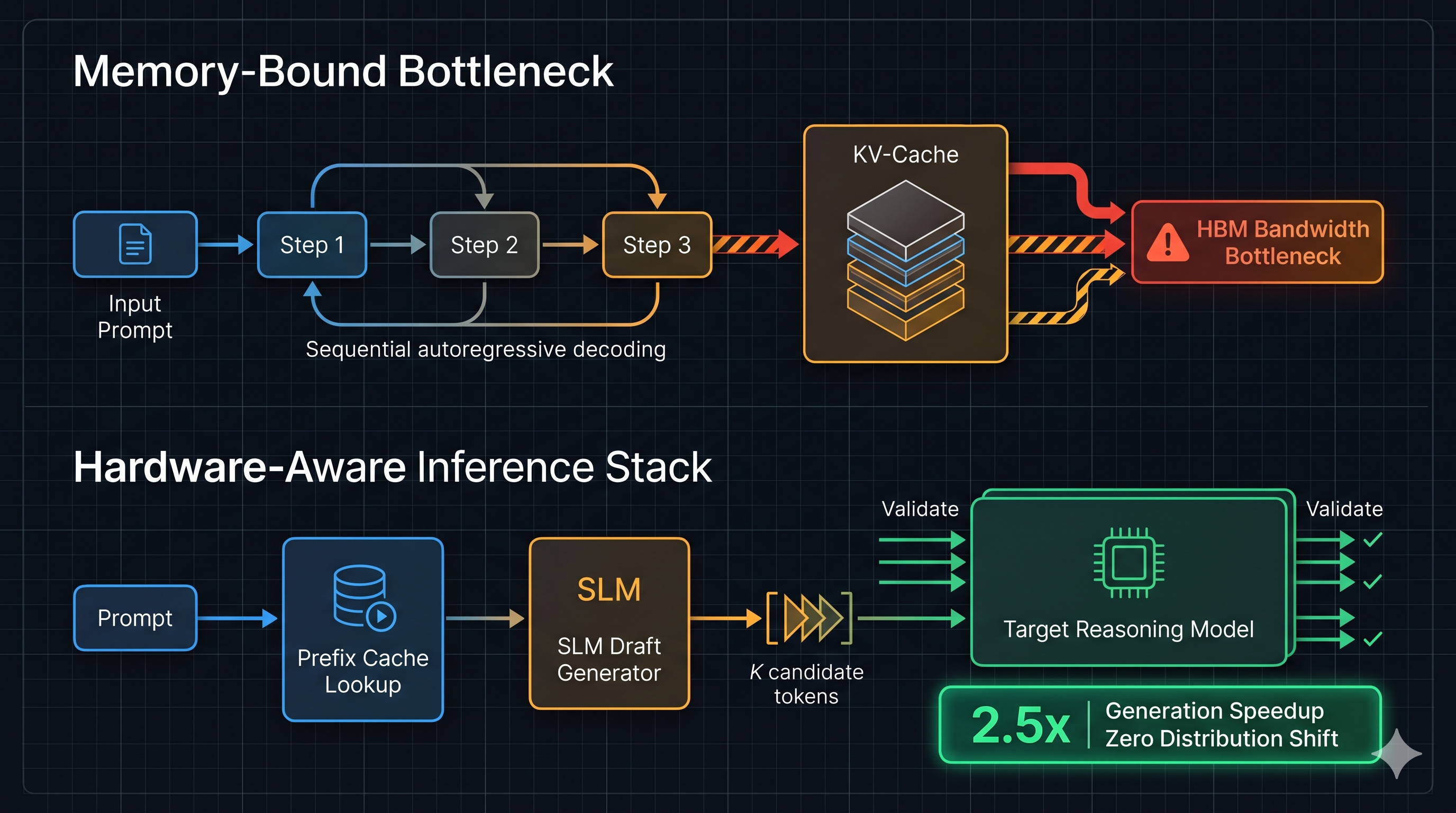
Every autoregressive token generated requires loading hundreds of billions of weights and reading an ever-expanding Key-Value (KV) cache from High Bandwidth Memory (HBM). When your context window balloons, GPU memory throughput stalls out, driving Time-To-First-Token (TTFT) and per-token generation latency into unacceptable SLA territory.
Building enterprise-grade AI applications requires transitioning from naive prompting to hardware-aware inference engineering:1. Speculative Decoding (Draft-Verify Architecture)Instead of forcing a 70B+ target model to sequentially compute predictable syntax, punctuation, and structural boilerplate, deploy a lightweight colocated draft model (e.g., 3B–7B).The small model drafts $K$ candidate tokens in parallel.
The large target model evaluates all $K$ tokens in a single forward pass.
Verified tokens are accepted; rejected tokens branch back without quality loss.
The payoff: High acceptance rates ($\alpha > 80\%$) in structured JSON generation, code synthesis, and retrieval-augmented workflows—effectively doubling generation speed without changing output distributions.2. Tiered KV-Cache Management & Prefix CachingDynamic agent loops often re-send identical system instructions, schema toolsets, and few-shot exemplars across multi-turn conversations.
Prefix Caching: Hash common system prefixes so downstream turns read pre-computed KV tensors directly from GPU cache rather than recomputing prompt attention.
Cache Eviction Strategies: Ditch sliding windows. Implement attention-guided retention (pruning tokens with historically low cumulative attention weights) to cap HBM usage on long-running worker loops.3. Shift from Retrieval "Dumping" to Structured Context HydrationDo not treat the context window as a bottomless database. Route routine structural checks through edge small language models (SLMs) and feed the central reasoning engine only validated, high-signal state diffs.
Optimizing your system boundaries yields bigger performance and cost dividends than simply upgrading your base model tier.
Discussion Question
For teams running high-throughput production LLM pipelines: have you benchmarked Speculative Decoding or dynamic KV-cache eviction against native continuous batching, and what acceptance rate ($\alpha$) threshold justified the added orchestrator complexity in your stack?
CTA
Join AI Builders & Enthusiasts: Dive deep into low-latency inference patterns, LLM system architecture, and production deployment designs with fellow engineers inside the Techawks AI community. Link in bio/comments.
As frontier reasoning models and agent pipelines scale, the primary production bottleneck is no longer raw FLOPs—it is the memory bus.
Every autoregressive token generated requires loading hundreds of billions of weights and reading an ever-expanding Key-Value (KV) cache from High Bandwidth Memory (HBM). When your context window balloons, GPU memory throughput stalls out, driving Time-To-First-Token (TTFT) and per-token generation latency into unacceptable SLA territory.
Building enterprise-grade AI applications requires transitioning from naive prompting to hardware-aware inference engineering:1. Speculative Decoding (Draft-Verify Architecture)Instead of forcing a 70B+ target model to sequentially compute predictable syntax, punctuation, and structural boilerplate, deploy a lightweight colocated draft model (e.g., 3B–7B).The small model drafts $K$ candidate tokens in parallel.
The large target model evaluates all $K$ tokens in a single forward pass.
Verified tokens are accepted; rejected tokens branch back without quality loss.
The payoff: High acceptance rates ($\alpha > 80\%$) in structured JSON generation, code synthesis, and retrieval-augmented workflows—effectively doubling generation speed without changing output distributions.2. Tiered KV-Cache Management & Prefix CachingDynamic agent loops often re-send identical system instructions, schema toolsets, and few-shot exemplars across multi-turn conversations.
Prefix Caching: Hash common system prefixes so downstream turns read pre-computed KV tensors directly from GPU cache rather than recomputing prompt attention.
Cache Eviction Strategies: Ditch sliding windows. Implement attention-guided retention (pruning tokens with historically low cumulative attention weights) to cap HBM usage on long-running worker loops.3. Shift from Retrieval "Dumping" to Structured Context HydrationDo not treat the context window as a bottomless database. Route routine structural checks through edge small language models (SLMs) and feed the central reasoning engine only validated, high-signal state diffs.
Optimizing your system boundaries yields bigger performance and cost dividends than simply upgrading your base model tier.
Discussion Question
For teams running high-throughput production LLM pipelines: have you benchmarked Speculative Decoding or dynamic KV-cache eviction against native continuous batching, and what acceptance rate ($\alpha$) threshold justified the added orchestrator complexity in your stack?
CTA
Join AI Builders & Enthusiasts: Dive deep into low-latency inference patterns, LLM system architecture, and production deployment designs with fellow engineers inside the Techawks AI community. Link in bio/comments.
Stop Brute-Forcing Context: Why Speculative Decoding & KV-Cache Partitioning Are Replacing Massive Prompt Stuffing
As frontier reasoning models and agent pipelines scale, the primary production bottleneck is no longer raw FLOPs—it is the memory bus.
Every autoregressive token generated requires loading hundreds of billions of weights and reading an ever-expanding Key-Value (KV) cache from High Bandwidth Memory (HBM). When your context window balloons, GPU memory throughput stalls out, driving Time-To-First-Token (TTFT) and per-token generation latency into unacceptable SLA territory.
Building enterprise-grade AI applications requires transitioning from naive prompting to hardware-aware inference engineering:1. Speculative Decoding (Draft-Verify Architecture)Instead of forcing a 70B+ target model to sequentially compute predictable syntax, punctuation, and structural boilerplate, deploy a lightweight colocated draft model (e.g., 3B–7B).The small model drafts $K$ candidate tokens in parallel.
The large target model evaluates all $K$ tokens in a single forward pass.
Verified tokens are accepted; rejected tokens branch back without quality loss.
The payoff: High acceptance rates ($\alpha > 80\%$) in structured JSON generation, code synthesis, and retrieval-augmented workflows—effectively doubling generation speed without changing output distributions.2. Tiered KV-Cache Management & Prefix CachingDynamic agent loops often re-send identical system instructions, schema toolsets, and few-shot exemplars across multi-turn conversations.
Prefix Caching: Hash common system prefixes so downstream turns read pre-computed KV tensors directly from GPU cache rather than recomputing prompt attention.
Cache Eviction Strategies: Ditch sliding windows. Implement attention-guided retention (pruning tokens with historically low cumulative attention weights) to cap HBM usage on long-running worker loops.3. Shift from Retrieval "Dumping" to Structured Context HydrationDo not treat the context window as a bottomless database. Route routine structural checks through edge small language models (SLMs) and feed the central reasoning engine only validated, high-signal state diffs.
Optimizing your system boundaries yields bigger performance and cost dividends than simply upgrading your base model tier.
Discussion Question
For teams running high-throughput production LLM pipelines: have you benchmarked Speculative Decoding or dynamic KV-cache eviction against native continuous batching, and what acceptance rate ($\alpha$) threshold justified the added orchestrator complexity in your stack?
CTA
Join AI Builders & Enthusiasts: Dive deep into low-latency inference patterns, LLM system architecture, and production deployment designs with fellow engineers inside the Techawks AI community. Link in bio/comments.

 English
 Arabic
 French
 Spanish
 Portuguese
 Deutsch
 Turkish
 Italiano
 Russian
 Romaian
 Portuguese (Brazil)
 Greek