


The Death of the LeetCode Grind: Why "Code Review & Trade-off Defense" Is the New Technical Interview Bar
With over 80% of professional developers actively pairing with AI coding assistants and agentic IDEs, writing syntactically correct boilerplate is no longer a differentiator. Engineering teams already know an LLM can invert a binary tree or write an unoptimized CRUD endpoint in 1.2 seconds.
What engineering leaders actually struggle with right now is evaluating judgment.
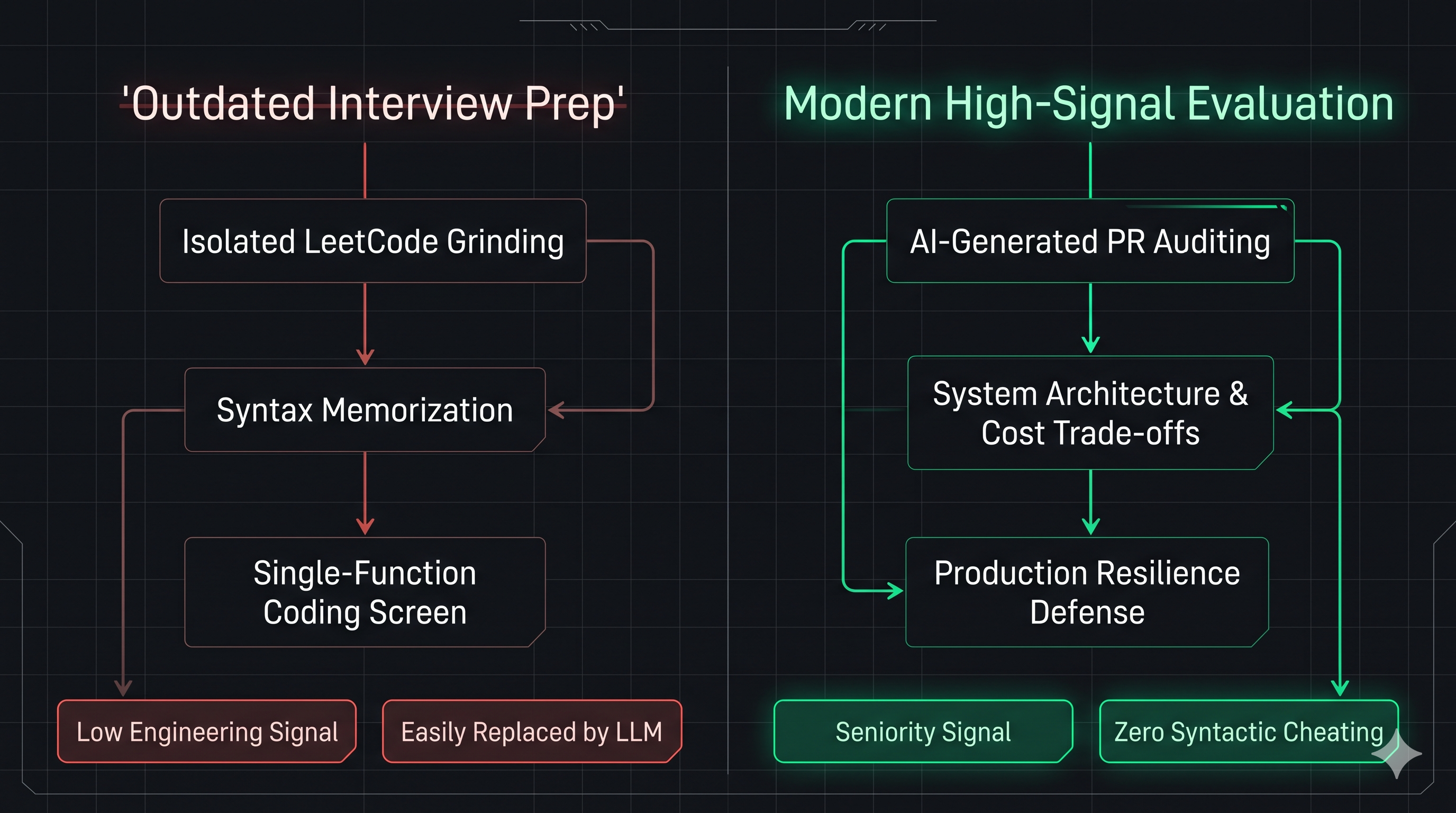
Technical interview loops across top-tier tech companies are aggressively pivoting away from isolated coding screens toward two new assessment formats:
The AI-Generated PR Review Screen: Instead of starting from a blank editor, candidates are handed a 400-line pull request produced by an agent or LLM containing subtle concurrency bugs, silent data mutations, and unhandled edge cases. Interviewers aren’t checking if you can write syntax—they are checking if you can catch what AI misses.
System Design & Cost-Aware Trade-off Defense: System design rounds have expanded from senior staff roles down into mid-level evaluations. Teams evaluate whether you can justify state boundaries, database consistency models, telemetry, and compute cost ceilings under real traffic constraints.
How to Pivot Your Career Preparation:
Shift from Memorization to Debugging: Practice opening open-source pull requests and auditing them for race conditions, memory leaks, and leaky abstractions. Articulating why an implementation will degrade under load carries 5x more signal than rewriting it from scratch.
Defend Architectural Trade-offs Out Loud: Don't just recommend an architectural pattern (e.g., Redis caching or an event-driven queue). State the exact trade-off upfront: "We gain sub-10ms read latency, but we introduce cache invalidation complexity and transient eventual consistency risk."
Demonstrate AI Orchestration, Not Avoidance: Interviewers respect candidates who know how to prompt, steer, and sanity-check LLM outputs while catching security and architecture pitfalls before merge.
In modern engineering hiring, you aren't evaluated on whether you can out-code the model. You are evaluated on whether you have the technical seniority to guide, audit, and take ownership of what gets deployed to production.
Discussion Question
For engineers currently interviewing or hiring managers running loops: what interview format has given you the clearest signal of a candidate's actual day-one engineering judgment?
CTA
Join Tech Jobs & Opportunities: Connect with senior hiring managers, access vetted job referrals, and master modern interview strategies inside the Techawks Careers community. Link in bio/comments.
The Death of the LeetCode Grind: Why "Code Review & Trade-off Defense" Is the New Technical Interview Bar
With over 80% of professional developers actively pairing with AI coding assistants and agentic IDEs, writing syntactically correct boilerplate is no longer a differentiator. Engineering teams already know an LLM can invert a binary tree or write an unoptimized CRUD endpoint in 1.2 seconds.
What engineering leaders actually struggle with right now is evaluating judgment.
Technical interview loops across top-tier tech companies are aggressively pivoting away from isolated coding screens toward two new assessment formats:
The AI-Generated PR Review Screen: Instead of starting from a blank editor, candidates are handed a 400-line pull request produced by an agent or LLM containing subtle concurrency bugs, silent data mutations, and unhandled edge cases. Interviewers aren’t checking if you can write syntax—they are checking if you can catch what AI misses.
System Design & Cost-Aware Trade-off Defense: System design rounds have expanded from senior staff roles down into mid-level evaluations. Teams evaluate whether you can justify state boundaries, database consistency models, telemetry, and compute cost ceilings under real traffic constraints.
How to Pivot Your Career Preparation:
Shift from Memorization to Debugging: Practice opening open-source pull requests and auditing them for race conditions, memory leaks, and leaky abstractions. Articulating why an implementation will degrade under load carries 5x more signal than rewriting it from scratch.
Defend Architectural Trade-offs Out Loud: Don't just recommend an architectural pattern (e.g., Redis caching or an event-driven queue). State the exact trade-off upfront: "We gain sub-10ms read latency, but we introduce cache invalidation complexity and transient eventual consistency risk."
Demonstrate AI Orchestration, Not Avoidance: Interviewers respect candidates who know how to prompt, steer, and sanity-check LLM outputs while catching security and architecture pitfalls before merge.
In modern engineering hiring, you aren't evaluated on whether you can out-code the model. You are evaluated on whether you have the technical seniority to guide, audit, and take ownership of what gets deployed to production.
Discussion Question
For engineers currently interviewing or hiring managers running loops: what interview format has given you the clearest signal of a candidate's actual day-one engineering judgment?
CTA
Join Tech Jobs & Opportunities: Connect with senior hiring managers, access vetted job referrals, and master modern interview strategies inside the Techawks Careers community. Link in bio/comments.

 English
 Arabic
 French
 Spanish
 Portuguese
 Deutsch
 Dutch
 Italiano
 Russian
 Romaian
 Portuguese (Brazil)
 Greek