


The UK-EU AI Divide: Why Engineering Teams Must Architect Dual-Regime Model Governance
The United Kingdom and the European Union have taken fundamentally opposing paths to artificial intelligence oversight:
The UK’s Sectoral, Principles-Led Model: The UK deliberately avoided an omnibus horizontal AI statute, instead distributing oversight across established statutory regulators (FCA, ICO, CMA, Ofcom) coordinated via the Digital Regulation Cooperation Forum (DRCF) and DSIT’s central risk functions. It prioritizes outcomes, contextual safety, and sandboxes over blanket technical mandates.
The EU AI Act’s Strict Classification: The EU enforces horizontal risk tiers with severe penalties (up to €35 million or 7% of global turnover) for high-risk and general-purpose AI (GPAI) systems.
Here is the engineering reality for UK tech companies: regulatory jurisdiction attaches to user impact, not deployment origin.
If a UK-headquartered fintech, healthtech, or SaaS product processes inputs or delivers automated decisions impacting users inside the EU single market, your pipeline immediately falls under the EU AI Act’s high-risk obligations. Treating compliance as an afterthought handled by legal teams creates architectural gridlock.
The Technical Solution: Dual-Regime Telemetry & Lineage Gates
Forward-thinking UK software architects are decoupling regional compliance into deterministic system abstractions:
Deterministic Data Lineage & Training Governance:
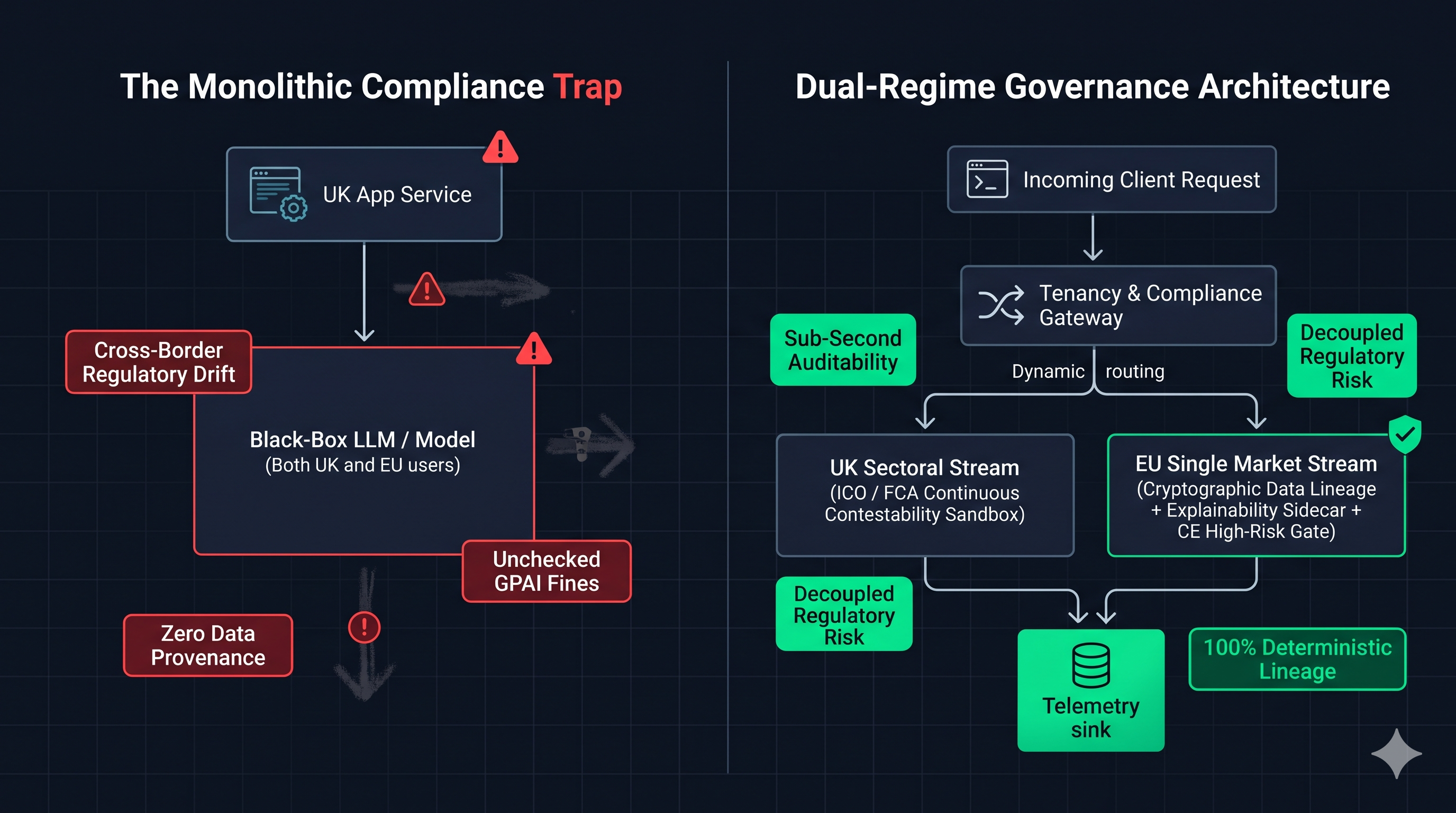
High-risk classifications require rigorous data provenance. Implement cryptographic data hashing and metadata tracing across datasets (capturing demographic distribution, synthetic data ratios, and curation flags).
If a model variant serves an EU endpoint, the ingestion pipeline must deterministically verify that training data governance meets strict accuracy, statistical representation, and bias audits before inference promotion.
Decoupled Explainability & Continuous Drift Probes:
The UK's ICO guidelines and the FCA’s AI experimentation frameworks emphasize contestability and transparency—requiring clear auditability for automated financial and identity profiling.
Do not rely on black-box model outputs. Integrate decoupled feature attribution modules (e.g., integrated gradients or TreeSHAP sidecars) that emit machine-readable rationale logs for every automated classification, enabling sub-second audit reconstruction.
Runtime Geo-Partitioning & Model Tiering:
Route user queries through an API gateway middleware that evaluates geographic tenancy and regulatory classification.
An identical user request originating from Manchester vs. Dublin can be dynamically routed to different backend model checkpoints or policy-enforced guardrail nodes—satisfying strict EU CE-marking and technical documentation gates while taking full advantage of UK sandbox iterations.
In modern systems engineering, compliance cannot be a periodic manual audit. It must be built directly into your CI/CD pipelines, telemetry schemas, and routing layers.
Discussion Question
For UK software teams serving both domestic and European users: are you maintaining unified model pipelines with the strictest common denominator compliance, or have you architected dual-regime routing and automated data lineage gates?
CTA
Join Techawks UK: Connect with leading British software architects, fintech engineering leads, and technical founders discussing resilient distributed architectures, AI governance, and UK-global scaling inside the Techawks UK community. Link in bio/comments.
The United Kingdom and the European Union have taken fundamentally opposing paths to artificial intelligence oversight:
The UK’s Sectoral, Principles-Led Model: The UK deliberately avoided an omnibus horizontal AI statute, instead distributing oversight across established statutory regulators (FCA, ICO, CMA, Ofcom) coordinated via the Digital Regulation Cooperation Forum (DRCF) and DSIT’s central risk functions. It prioritizes outcomes, contextual safety, and sandboxes over blanket technical mandates.
The EU AI Act’s Strict Classification: The EU enforces horizontal risk tiers with severe penalties (up to €35 million or 7% of global turnover) for high-risk and general-purpose AI (GPAI) systems.
Here is the engineering reality for UK tech companies: regulatory jurisdiction attaches to user impact, not deployment origin.
If a UK-headquartered fintech, healthtech, or SaaS product processes inputs or delivers automated decisions impacting users inside the EU single market, your pipeline immediately falls under the EU AI Act’s high-risk obligations. Treating compliance as an afterthought handled by legal teams creates architectural gridlock.
The Technical Solution: Dual-Regime Telemetry & Lineage Gates
Forward-thinking UK software architects are decoupling regional compliance into deterministic system abstractions:
Deterministic Data Lineage & Training Governance:
High-risk classifications require rigorous data provenance. Implement cryptographic data hashing and metadata tracing across datasets (capturing demographic distribution, synthetic data ratios, and curation flags).
If a model variant serves an EU endpoint, the ingestion pipeline must deterministically verify that training data governance meets strict accuracy, statistical representation, and bias audits before inference promotion.
Decoupled Explainability & Continuous Drift Probes:
The UK's ICO guidelines and the FCA’s AI experimentation frameworks emphasize contestability and transparency—requiring clear auditability for automated financial and identity profiling.
Do not rely on black-box model outputs. Integrate decoupled feature attribution modules (e.g., integrated gradients or TreeSHAP sidecars) that emit machine-readable rationale logs for every automated classification, enabling sub-second audit reconstruction.
Runtime Geo-Partitioning & Model Tiering:
Route user queries through an API gateway middleware that evaluates geographic tenancy and regulatory classification.
An identical user request originating from Manchester vs. Dublin can be dynamically routed to different backend model checkpoints or policy-enforced guardrail nodes—satisfying strict EU CE-marking and technical documentation gates while taking full advantage of UK sandbox iterations.
In modern systems engineering, compliance cannot be a periodic manual audit. It must be built directly into your CI/CD pipelines, telemetry schemas, and routing layers.
Discussion Question
For UK software teams serving both domestic and European users: are you maintaining unified model pipelines with the strictest common denominator compliance, or have you architected dual-regime routing and automated data lineage gates?
CTA
Join Techawks UK: Connect with leading British software architects, fintech engineering leads, and technical founders discussing resilient distributed architectures, AI governance, and UK-global scaling inside the Techawks UK community. Link in bio/comments.
The UK-EU AI Divide: Why Engineering Teams Must Architect Dual-Regime Model Governance
The United Kingdom and the European Union have taken fundamentally opposing paths to artificial intelligence oversight:
The UK’s Sectoral, Principles-Led Model: The UK deliberately avoided an omnibus horizontal AI statute, instead distributing oversight across established statutory regulators (FCA, ICO, CMA, Ofcom) coordinated via the Digital Regulation Cooperation Forum (DRCF) and DSIT’s central risk functions. It prioritizes outcomes, contextual safety, and sandboxes over blanket technical mandates.
The EU AI Act’s Strict Classification: The EU enforces horizontal risk tiers with severe penalties (up to €35 million or 7% of global turnover) for high-risk and general-purpose AI (GPAI) systems.
Here is the engineering reality for UK tech companies: regulatory jurisdiction attaches to user impact, not deployment origin.
If a UK-headquartered fintech, healthtech, or SaaS product processes inputs or delivers automated decisions impacting users inside the EU single market, your pipeline immediately falls under the EU AI Act’s high-risk obligations. Treating compliance as an afterthought handled by legal teams creates architectural gridlock.
The Technical Solution: Dual-Regime Telemetry & Lineage Gates
Forward-thinking UK software architects are decoupling regional compliance into deterministic system abstractions:
Deterministic Data Lineage & Training Governance:
High-risk classifications require rigorous data provenance. Implement cryptographic data hashing and metadata tracing across datasets (capturing demographic distribution, synthetic data ratios, and curation flags).
If a model variant serves an EU endpoint, the ingestion pipeline must deterministically verify that training data governance meets strict accuracy, statistical representation, and bias audits before inference promotion.
Decoupled Explainability & Continuous Drift Probes:
The UK's ICO guidelines and the FCA’s AI experimentation frameworks emphasize contestability and transparency—requiring clear auditability for automated financial and identity profiling.
Do not rely on black-box model outputs. Integrate decoupled feature attribution modules (e.g., integrated gradients or TreeSHAP sidecars) that emit machine-readable rationale logs for every automated classification, enabling sub-second audit reconstruction.
Runtime Geo-Partitioning & Model Tiering:
Route user queries through an API gateway middleware that evaluates geographic tenancy and regulatory classification.
An identical user request originating from Manchester vs. Dublin can be dynamically routed to different backend model checkpoints or policy-enforced guardrail nodes—satisfying strict EU CE-marking and technical documentation gates while taking full advantage of UK sandbox iterations.
In modern systems engineering, compliance cannot be a periodic manual audit. It must be built directly into your CI/CD pipelines, telemetry schemas, and routing layers.
Discussion Question
For UK software teams serving both domestic and European users: are you maintaining unified model pipelines with the strictest common denominator compliance, or have you architected dual-regime routing and automated data lineage gates?
CTA
Join Techawks UK: Connect with leading British software architects, fintech engineering leads, and technical founders discussing resilient distributed architectures, AI governance, and UK-global scaling inside the Techawks UK community. Link in bio/comments.

 English
 Arabic
 French
 Spanish
 Portuguese
 Deutsch
 Turkish
 Dutch
 Russian
 Romaian
 Portuguese (Brazil)
 Greek