


The Data Residency Illusion: Why Canadian Cloud Architects Are Redesigning Pipelines for Cryptographic Data Sovereignty
As Canadian financial institutions, healthcare networks, and public-sector enterprises accelerate generative AI adoption, data residency has become the baseline compliance checkbox. Most teams satisfy this by selecting Canadian cloud regions (Montreal, Toronto, Calgary) and checking the box.
However, in modern distributed systems, data residency and data sovereignty are fundamentally different controls:
Data Residency: Deals with geography—where data bits sit at rest.
Data Sovereignty: Deals with jurisdictional authority—who controls the infrastructure, who owns the encryption keys, where operational telemetry travels, and what foreign legal frameworks (such as the US CLOUD Act) can compel your provider to disclose.
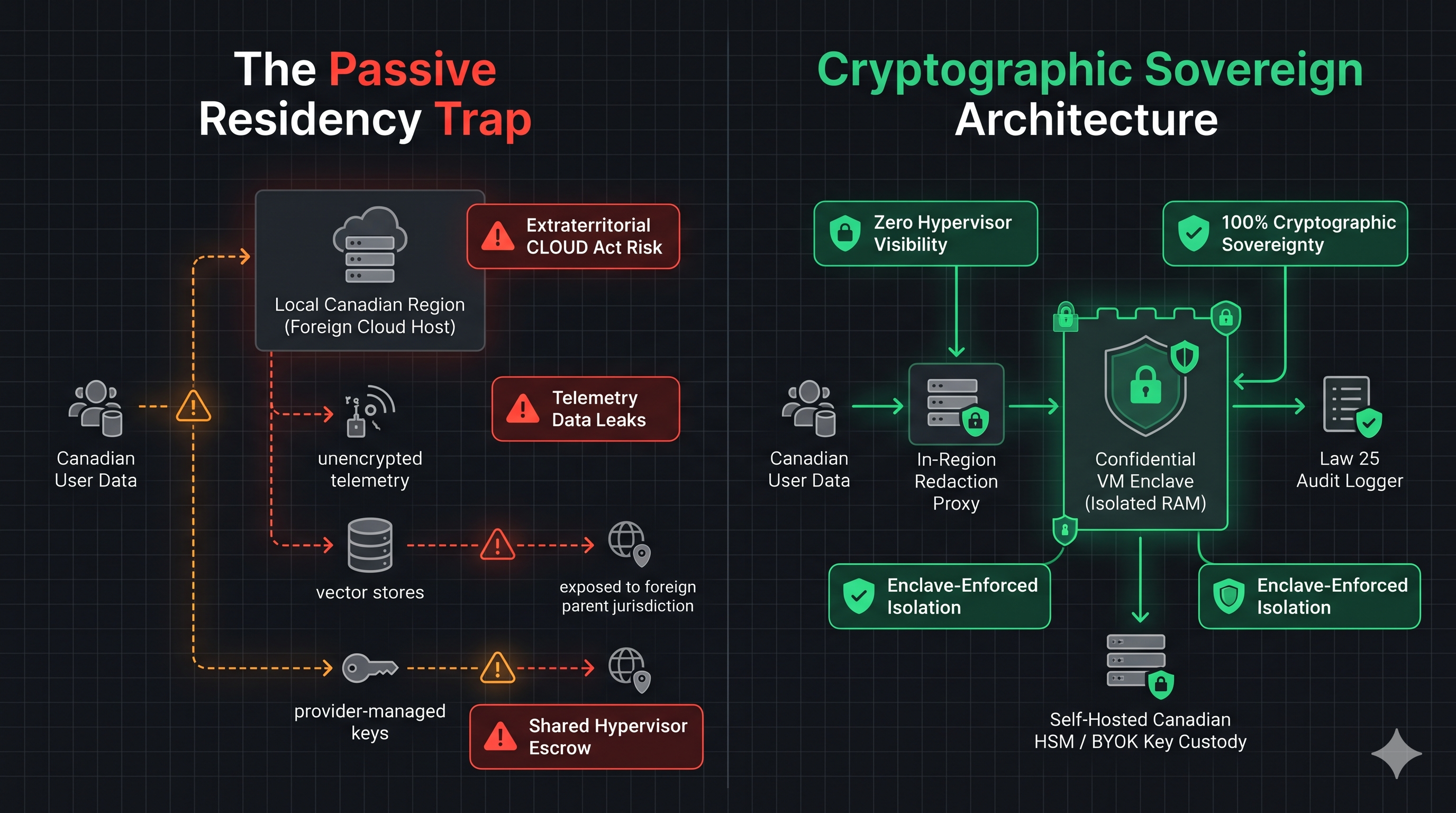
In typical multi-tenant AI pipelines, sensitive artifacts do not stay stationary inside your primary Canadian database. Prompts, embeddings, vector indices, model context caches, and observability traces regularly route through foreign parent control planes, support workflows, and third-party API gateways. If a foreign parent entity administers the underlying compute or holds root encryption keys, residency in Canada does not prevent extraterritorial legal exposure.
With Canada aggressively backing sovereign AI compute (including multi-billion-dollar sovereign compute initiatives) and provinces like Quebec strictly enforcing Law 25 for automated processing, technical teams must transition from passive geographic hosting to Zero-Trust Sovereign Architecture:
1. Bring Your Own Key (BYOK) with External Key Management (HYOK)
Do not use cloud-provider managed keys where the provider retains root access in escrow.
Deploy an external Key Management Service (KMS) or hardware security module (HSM) residing on sovereign, Canadian-owned soil or dedicated private infrastructure.
Ensure data in transit and at rest is envelope-encrypted such that the hypervisor and host infrastructure cannot decrypt payloads without an ephemeral, runtime grant from your self-hosted KMS.
2. Localized Vector Indexing & Redaction Middleware
Never ship raw user context across public LLM APIs without pre-flight redaction.
Deploy an in-region semantic gateway (such as local small language models or regex-NER classifiers) that strips Canadian personal identifiers (SIN, provincial health numbers, financial account details) before routing prompts.
Maintain vector databases, context embeddings, and retrieval-augmented generation (RAG) stores strictly within sovereign cluster boundaries.
3. Ephemeral Enclaves & Confidential Computing
For high-risk inference (e.g., credit underwriting, healthcare diagnostic support), run model weights and data inside hardware-enforced Confidential VMs (AMD SEV-SNP or Intel TDX).
Even root cloud administrators and hypervisor processes cannot read memory contents or execution registers during active compute cycles.
Ensure automated processing decisions maintain immutable, local audit logs to satisfy Quebec Law 25 contestability mandates without leaking prompt telemetry into global SaaS dashboards.
Location answers where your files sit. Cryptographic key custody, memory isolation, and operational autonomy determine who actually controls them.
Discussion Question
For Canadian cloud and security architects: how does your organization handle cross-border telemetry and foreign-parent cloud jurisdiction—have you implemented external KMS (HYOK) and confidential enclaves, or is regional data residency still your team's primary benchmark?
CTA
Join Techawks Canada: Connect with Canadian cloud architects, security engineers, and software leaders discussing distributed systems, data sovereignty, and resilient cloud architecture. Link in bio/comments.
As Canadian financial institutions, healthcare networks, and public-sector enterprises accelerate generative AI adoption, data residency has become the baseline compliance checkbox. Most teams satisfy this by selecting Canadian cloud regions (Montreal, Toronto, Calgary) and checking the box.
However, in modern distributed systems, data residency and data sovereignty are fundamentally different controls:
Data Residency: Deals with geography—where data bits sit at rest.
Data Sovereignty: Deals with jurisdictional authority—who controls the infrastructure, who owns the encryption keys, where operational telemetry travels, and what foreign legal frameworks (such as the US CLOUD Act) can compel your provider to disclose.
In typical multi-tenant AI pipelines, sensitive artifacts do not stay stationary inside your primary Canadian database. Prompts, embeddings, vector indices, model context caches, and observability traces regularly route through foreign parent control planes, support workflows, and third-party API gateways. If a foreign parent entity administers the underlying compute or holds root encryption keys, residency in Canada does not prevent extraterritorial legal exposure.
With Canada aggressively backing sovereign AI compute (including multi-billion-dollar sovereign compute initiatives) and provinces like Quebec strictly enforcing Law 25 for automated processing, technical teams must transition from passive geographic hosting to Zero-Trust Sovereign Architecture:
1. Bring Your Own Key (BYOK) with External Key Management (HYOK)
Do not use cloud-provider managed keys where the provider retains root access in escrow.
Deploy an external Key Management Service (KMS) or hardware security module (HSM) residing on sovereign, Canadian-owned soil or dedicated private infrastructure.
Ensure data in transit and at rest is envelope-encrypted such that the hypervisor and host infrastructure cannot decrypt payloads without an ephemeral, runtime grant from your self-hosted KMS.
2. Localized Vector Indexing & Redaction Middleware
Never ship raw user context across public LLM APIs without pre-flight redaction.
Deploy an in-region semantic gateway (such as local small language models or regex-NER classifiers) that strips Canadian personal identifiers (SIN, provincial health numbers, financial account details) before routing prompts.
Maintain vector databases, context embeddings, and retrieval-augmented generation (RAG) stores strictly within sovereign cluster boundaries.
3. Ephemeral Enclaves & Confidential Computing
For high-risk inference (e.g., credit underwriting, healthcare diagnostic support), run model weights and data inside hardware-enforced Confidential VMs (AMD SEV-SNP or Intel TDX).
Even root cloud administrators and hypervisor processes cannot read memory contents or execution registers during active compute cycles.
Ensure automated processing decisions maintain immutable, local audit logs to satisfy Quebec Law 25 contestability mandates without leaking prompt telemetry into global SaaS dashboards.
Location answers where your files sit. Cryptographic key custody, memory isolation, and operational autonomy determine who actually controls them.
Discussion Question
For Canadian cloud and security architects: how does your organization handle cross-border telemetry and foreign-parent cloud jurisdiction—have you implemented external KMS (HYOK) and confidential enclaves, or is regional data residency still your team's primary benchmark?
CTA
Join Techawks Canada: Connect with Canadian cloud architects, security engineers, and software leaders discussing distributed systems, data sovereignty, and resilient cloud architecture. Link in bio/comments.
The Data Residency Illusion: Why Canadian Cloud Architects Are Redesigning Pipelines for Cryptographic Data Sovereignty
As Canadian financial institutions, healthcare networks, and public-sector enterprises accelerate generative AI adoption, data residency has become the baseline compliance checkbox. Most teams satisfy this by selecting Canadian cloud regions (Montreal, Toronto, Calgary) and checking the box.
However, in modern distributed systems, data residency and data sovereignty are fundamentally different controls:
Data Residency: Deals with geography—where data bits sit at rest.
Data Sovereignty: Deals with jurisdictional authority—who controls the infrastructure, who owns the encryption keys, where operational telemetry travels, and what foreign legal frameworks (such as the US CLOUD Act) can compel your provider to disclose.
In typical multi-tenant AI pipelines, sensitive artifacts do not stay stationary inside your primary Canadian database. Prompts, embeddings, vector indices, model context caches, and observability traces regularly route through foreign parent control planes, support workflows, and third-party API gateways. If a foreign parent entity administers the underlying compute or holds root encryption keys, residency in Canada does not prevent extraterritorial legal exposure.
With Canada aggressively backing sovereign AI compute (including multi-billion-dollar sovereign compute initiatives) and provinces like Quebec strictly enforcing Law 25 for automated processing, technical teams must transition from passive geographic hosting to Zero-Trust Sovereign Architecture:
1. Bring Your Own Key (BYOK) with External Key Management (HYOK)
Do not use cloud-provider managed keys where the provider retains root access in escrow.
Deploy an external Key Management Service (KMS) or hardware security module (HSM) residing on sovereign, Canadian-owned soil or dedicated private infrastructure.
Ensure data in transit and at rest is envelope-encrypted such that the hypervisor and host infrastructure cannot decrypt payloads without an ephemeral, runtime grant from your self-hosted KMS.
2. Localized Vector Indexing & Redaction Middleware
Never ship raw user context across public LLM APIs without pre-flight redaction.
Deploy an in-region semantic gateway (such as local small language models or regex-NER classifiers) that strips Canadian personal identifiers (SIN, provincial health numbers, financial account details) before routing prompts.
Maintain vector databases, context embeddings, and retrieval-augmented generation (RAG) stores strictly within sovereign cluster boundaries.
3. Ephemeral Enclaves & Confidential Computing
For high-risk inference (e.g., credit underwriting, healthcare diagnostic support), run model weights and data inside hardware-enforced Confidential VMs (AMD SEV-SNP or Intel TDX).
Even root cloud administrators and hypervisor processes cannot read memory contents or execution registers during active compute cycles.
Ensure automated processing decisions maintain immutable, local audit logs to satisfy Quebec Law 25 contestability mandates without leaking prompt telemetry into global SaaS dashboards.
Location answers where your files sit. Cryptographic key custody, memory isolation, and operational autonomy determine who actually controls them.
Discussion Question
For Canadian cloud and security architects: how does your organization handle cross-border telemetry and foreign-parent cloud jurisdiction—have you implemented external KMS (HYOK) and confidential enclaves, or is regional data residency still your team's primary benchmark?
CTA
Join Techawks Canada: Connect with Canadian cloud architects, security engineers, and software leaders discussing distributed systems, data sovereignty, and resilient cloud architecture. Link in bio/comments.

 English
 Arabic
 French
 Spanish
 Deutsch
 Turkish
 Dutch
 Italiano
 Russian
 Romaian
 Portuguese (Brazil)
 Greek