


The Synchronous Open Banking Bottleneck: Why the UK’s Open Finance Shift Demands Asynchronous Event-Driven Architectures
The UK pioneered modern fintech plumbing through the Open Banking Implementation Entity (OBL) and CMA9 mandates. For years, synchronous REST APIs over Mutual TLS (mTLS) with FAPI (Financial-grade API) profiles were sufficient for simple payment initiation (PIS) and read-only balance lookups (AIS).
However, as the Financial Conduct Authority (FCA) advances its roadmap toward Open Finance—expanding beyond basic current accounts into mortgages, SME lending pipelines, pensions, insurance, and investment portfolios—synchronous point-to-point architecture has hit an operational wall:
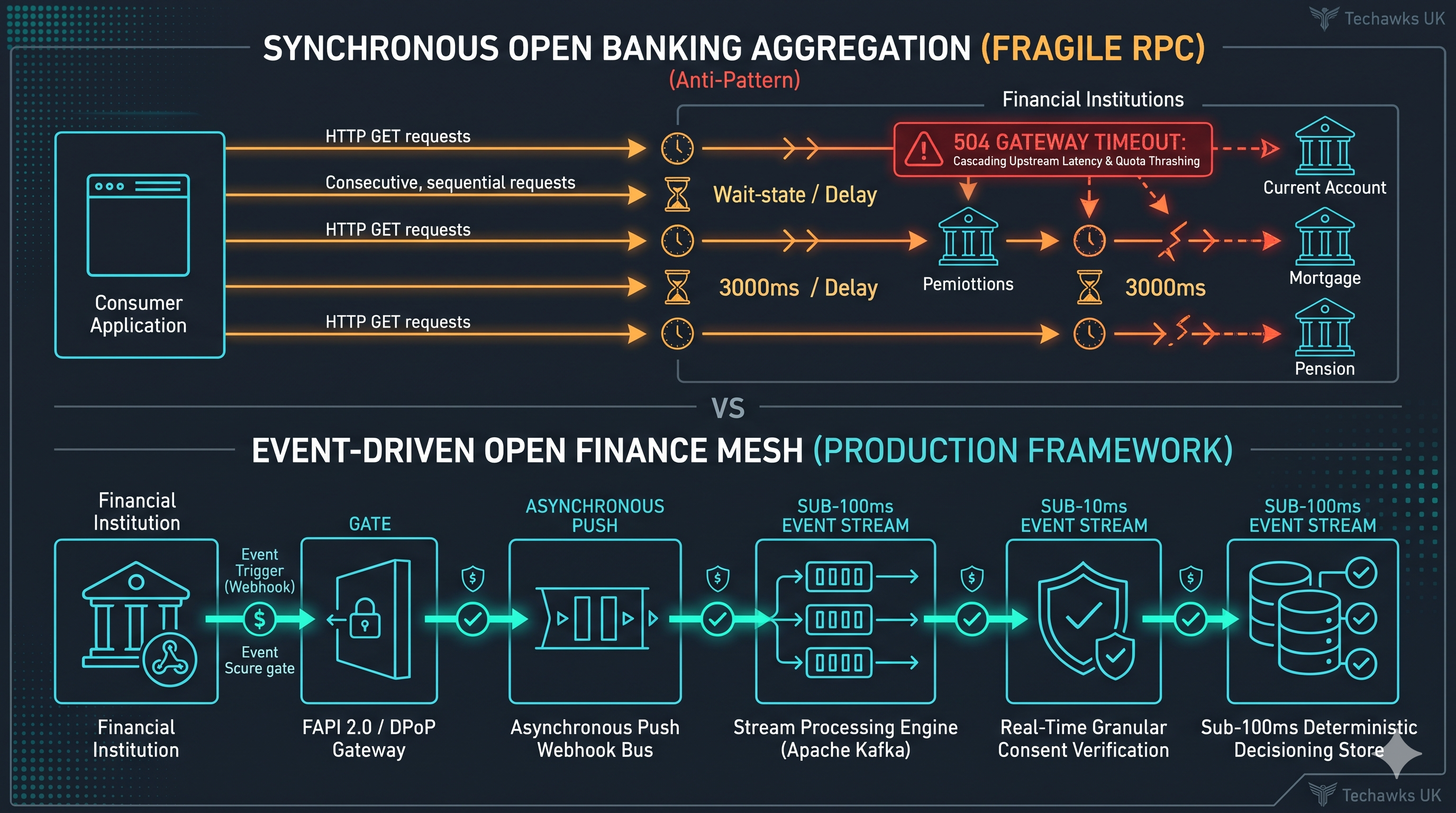
Cascading Timeout Cascades: Aggregating a consumer's complete financial posture across multiple institutions over synchronous HTTP creates fragile latency chains. If one legacy building society’s backend stalls on mortgage data extraction, the entire client request times out at the gateway.
Rate-Limit & Webhook Thrashing: As autonomous AI agents and automated underwriting systems continuously poll bank endpoints for real-time risk calculations, synchronous polling burns API quotas and degrades database connection pools.
The Granular Revocation Challenge: Under the UK’s evolving statutory data frameworks (including the Data (Use and Access) Act and ICO automated decision-making rules), data sharing consents are becoming itemized, time-bounded, and asynchronously revocable. A synchronous query architecture cannot broadcast instant revocation states across fragmented microservices.
To support high-throughput, multi-asset financial ecosystems, UK fintechs and Tier-1 banks are migrating from synchronous polling to Event-Driven Open Finance Pipelines backed by Event Streams and Push Notification Notifications (RFC 8935/8936).
Plaintext
[ ANTI-PATTERN: FRAGILE SYNCHRONOUS AGGREGATION ]
Fintech / Underwriter ──► Sync GET (Bank 1: Accounts) ──► Success (150ms)
├──► Sync GET (Bank 2: Mortgages) ──► Latency Spike / Timeout (5000ms+) ──► 504 Gateway Error
└──► Sync GET (Pension Provider) ──► Connection Pool Exhaustion
[ PRODUCTION PATTERN: ASYNCHRONOUS EVENT-DRIVEN OPEN FINANCE MESH ]
FCA/Open Finance Source ──► FAPI 2.0 / DCR Verification Gateway
│
▼
Asynchronous Event Ingress (Kafka / Webhooks)
│
┌───────────────────────┴───────────────────────┐
▼ ▼
Stream Processing Engine Granular Consent State Bus
(Enrichment, Normalisation) (Real-Time Token Revocation)
│ │
▼ ▼
Idempotent Consumer Cache Instant Access Sever (-403)
(Sub-50ms Decision Ready) (Zero PII Leak / ICO Compliant)
To build resilient, regulation-ready UK financial platforms, engineering teams are implementing three core architectural standards:
1. Transition to FAPI 2.0 and DPoP (Demonstrating Proof-of-Possession)
Legacy setups relying strictly on basic OAuth 2.0 bearer tokens are vulnerable if tokens are intercepted in transit.
The Standard: Adopt FAPI 2.0 Security Profiles paired with DPoP (RFC 9449).
2. Replace Endpoint Polling with Standardized Push Webhooks
Stop spamming bank core systems with recurring cron jobs to detect balance deltas or mortgage underwriting updates.
3. Decouple Aggregation from Decisioning via Read-Optimized Data Caches
Never perform live multi-bank network aggregation during a user-facing lending or credit check workflow.
Discussion Question
For UK fintech engineers and banking platform leads: How is your team architecting for the FCA's Open Finance scope—are you already adopting FAPI 2.0 and event-driven push webhooks, or are legacy core banking systems still locking you into synchronous REST aggregation?
CTA
Designing resilient financial infrastructure, navigating UK compliance standards, or scaling event-driven backends?
👉 Join the Techawks UK community to collaborate with leading software engineers, fintech founders, and cloud architects shaping the UK tech ecosystem!
The UK pioneered modern fintech plumbing through the Open Banking Implementation Entity (OBL) and CMA9 mandates. For years, synchronous REST APIs over Mutual TLS (mTLS) with FAPI (Financial-grade API) profiles were sufficient for simple payment initiation (PIS) and read-only balance lookups (AIS).
However, as the Financial Conduct Authority (FCA) advances its roadmap toward Open Finance—expanding beyond basic current accounts into mortgages, SME lending pipelines, pensions, insurance, and investment portfolios—synchronous point-to-point architecture has hit an operational wall:
Cascading Timeout Cascades: Aggregating a consumer's complete financial posture across multiple institutions over synchronous HTTP creates fragile latency chains. If one legacy building society’s backend stalls on mortgage data extraction, the entire client request times out at the gateway.
Rate-Limit & Webhook Thrashing: As autonomous AI agents and automated underwriting systems continuously poll bank endpoints for real-time risk calculations, synchronous polling burns API quotas and degrades database connection pools.
The Granular Revocation Challenge: Under the UK’s evolving statutory data frameworks (including the Data (Use and Access) Act and ICO automated decision-making rules), data sharing consents are becoming itemized, time-bounded, and asynchronously revocable. A synchronous query architecture cannot broadcast instant revocation states across fragmented microservices.
To support high-throughput, multi-asset financial ecosystems, UK fintechs and Tier-1 banks are migrating from synchronous polling to Event-Driven Open Finance Pipelines backed by Event Streams and Push Notification Notifications (RFC 8935/8936).
Plaintext
[ ANTI-PATTERN: FRAGILE SYNCHRONOUS AGGREGATION ]
Fintech / Underwriter ──► Sync GET (Bank 1: Accounts) ──► Success (150ms)
├──► Sync GET (Bank 2: Mortgages) ──► Latency Spike / Timeout (5000ms+) ──► 504 Gateway Error
└──► Sync GET (Pension Provider) ──► Connection Pool Exhaustion
[ PRODUCTION PATTERN: ASYNCHRONOUS EVENT-DRIVEN OPEN FINANCE MESH ]
FCA/Open Finance Source ──► FAPI 2.0 / DCR Verification Gateway
│
▼
Asynchronous Event Ingress (Kafka / Webhooks)
│
┌───────────────────────┴───────────────────────┐
▼ ▼
Stream Processing Engine Granular Consent State Bus
(Enrichment, Normalisation) (Real-Time Token Revocation)
│ │
▼ ▼
Idempotent Consumer Cache Instant Access Sever (-403)
(Sub-50ms Decision Ready) (Zero PII Leak / ICO Compliant)
To build resilient, regulation-ready UK financial platforms, engineering teams are implementing three core architectural standards:
1. Transition to FAPI 2.0 and DPoP (Demonstrating Proof-of-Possession)
Legacy setups relying strictly on basic OAuth 2.0 bearer tokens are vulnerable if tokens are intercepted in transit.
The Standard: Adopt FAPI 2.0 Security Profiles paired with DPoP (RFC 9449).
2. Replace Endpoint Polling with Standardized Push Webhooks
Stop spamming bank core systems with recurring cron jobs to detect balance deltas or mortgage underwriting updates.
3. Decouple Aggregation from Decisioning via Read-Optimized Data Caches
Never perform live multi-bank network aggregation during a user-facing lending or credit check workflow.
Discussion Question
For UK fintech engineers and banking platform leads: How is your team architecting for the FCA's Open Finance scope—are you already adopting FAPI 2.0 and event-driven push webhooks, or are legacy core banking systems still locking you into synchronous REST aggregation?
CTA
Designing resilient financial infrastructure, navigating UK compliance standards, or scaling event-driven backends?
👉 Join the Techawks UK community to collaborate with leading software engineers, fintech founders, and cloud architects shaping the UK tech ecosystem!
The Synchronous Open Banking Bottleneck: Why the UK’s Open Finance Shift Demands Asynchronous Event-Driven Architectures
The UK pioneered modern fintech plumbing through the Open Banking Implementation Entity (OBL) and CMA9 mandates. For years, synchronous REST APIs over Mutual TLS (mTLS) with FAPI (Financial-grade API) profiles were sufficient for simple payment initiation (PIS) and read-only balance lookups (AIS).
However, as the Financial Conduct Authority (FCA) advances its roadmap toward Open Finance—expanding beyond basic current accounts into mortgages, SME lending pipelines, pensions, insurance, and investment portfolios—synchronous point-to-point architecture has hit an operational wall:
Cascading Timeout Cascades: Aggregating a consumer's complete financial posture across multiple institutions over synchronous HTTP creates fragile latency chains. If one legacy building society’s backend stalls on mortgage data extraction, the entire client request times out at the gateway.
Rate-Limit & Webhook Thrashing: As autonomous AI agents and automated underwriting systems continuously poll bank endpoints for real-time risk calculations, synchronous polling burns API quotas and degrades database connection pools.
The Granular Revocation Challenge: Under the UK’s evolving statutory data frameworks (including the Data (Use and Access) Act and ICO automated decision-making rules), data sharing consents are becoming itemized, time-bounded, and asynchronously revocable. A synchronous query architecture cannot broadcast instant revocation states across fragmented microservices.
To support high-throughput, multi-asset financial ecosystems, UK fintechs and Tier-1 banks are migrating from synchronous polling to Event-Driven Open Finance Pipelines backed by Event Streams and Push Notification Notifications (RFC 8935/8936).
Plaintext
[ ANTI-PATTERN: FRAGILE SYNCHRONOUS AGGREGATION ]
Fintech / Underwriter ──► Sync GET (Bank 1: Accounts) ──► Success (150ms)
├──► Sync GET (Bank 2: Mortgages) ──► Latency Spike / Timeout (5000ms+) ──► 504 Gateway Error
└──► Sync GET (Pension Provider) ──► Connection Pool Exhaustion
[ PRODUCTION PATTERN: ASYNCHRONOUS EVENT-DRIVEN OPEN FINANCE MESH ]
FCA/Open Finance Source ──► FAPI 2.0 / DCR Verification Gateway
│
▼
Asynchronous Event Ingress (Kafka / Webhooks)
│
┌───────────────────────┴───────────────────────┐
▼ ▼
Stream Processing Engine Granular Consent State Bus
(Enrichment, Normalisation) (Real-Time Token Revocation)
│ │
▼ ▼
Idempotent Consumer Cache Instant Access Sever (-403)
(Sub-50ms Decision Ready) (Zero PII Leak / ICO Compliant)
To build resilient, regulation-ready UK financial platforms, engineering teams are implementing three core architectural standards:
1. Transition to FAPI 2.0 and DPoP (Demonstrating Proof-of-Possession)
Legacy setups relying strictly on basic OAuth 2.0 bearer tokens are vulnerable if tokens are intercepted in transit.
The Standard: Adopt FAPI 2.0 Security Profiles paired with DPoP (RFC 9449).
2. Replace Endpoint Polling with Standardized Push Webhooks
Stop spamming bank core systems with recurring cron jobs to detect balance deltas or mortgage underwriting updates.
3. Decouple Aggregation from Decisioning via Read-Optimized Data Caches
Never perform live multi-bank network aggregation during a user-facing lending or credit check workflow.
Discussion Question
For UK fintech engineers and banking platform leads: How is your team architecting for the FCA's Open Finance scope—are you already adopting FAPI 2.0 and event-driven push webhooks, or are legacy core banking systems still locking you into synchronous REST aggregation?
CTA
Designing resilient financial infrastructure, navigating UK compliance standards, or scaling event-driven backends?
👉 Join the Techawks UK community to collaborate with leading software engineers, fintech founders, and cloud architects shaping the UK tech ecosystem!

 English
 French
 Spanish
 Portuguese
 Deutsch
 Turkish
 Dutch
 Italiano
 Russian
 Romaian
 Portuguese (Brazil)
 Greek