


The Sovereign AI Ingress Dilemma: Why UAE Enterprise Stacks Require Localized Inference Enclaves and Key Custody
The UAE is accelerating AI adoption faster than nearly any global market, led by the UAE National AI Strategy, Falcon foundation model breakthroughs, and substantial regional data center investments across Abu Dhabi and Dubai.
Yet, engineering teams building enterprise and public-sector software across the Emirates face a critical architectural trap: The Extraterritorial Inference Leak.
Many development squads assume that hosting their PostgreSQL database or application containers inside local cloud regions (e.g., me-central-1 or uae-north) satisfies data residency requirements.
However, when their application forwards unstructured prompts, documents, or context-window chunks to external managed LLM endpoints:
Sovereignty Breach: Customer PII, Arabic dialect transcripts, and internal enterprise metadata exit the UAE jurisdiction without adequacy mechanisms or explicit authorization under Federal Decree-Law No. 45 of 2021 (UAE PDPL).
Control Plane & Key Vulnerability: If your encryption keys reside in a global, foreign-managed Hardware Security Module (HSM), foreign legal warrants (such as the US CLOUD Act) can legally compel data access regardless of physical server location.
Government & Critical Infrastructure Restrictions: Under Dubai Electronic Security Center (DESC) Information Security Regulations (ISR) and NESA/UAE IAS standards, transferring government, banking, or healthcare data to external cloud networks risks immediate regulatory shutdown and loss of operating licenses.
To build resilient, enterprise-ready systems in the region, tech architects must migrate to In-Country Sovereign Inference Enclaves backed by Hold-Your-Own-Key (HYOK) Vaults.
Plaintext
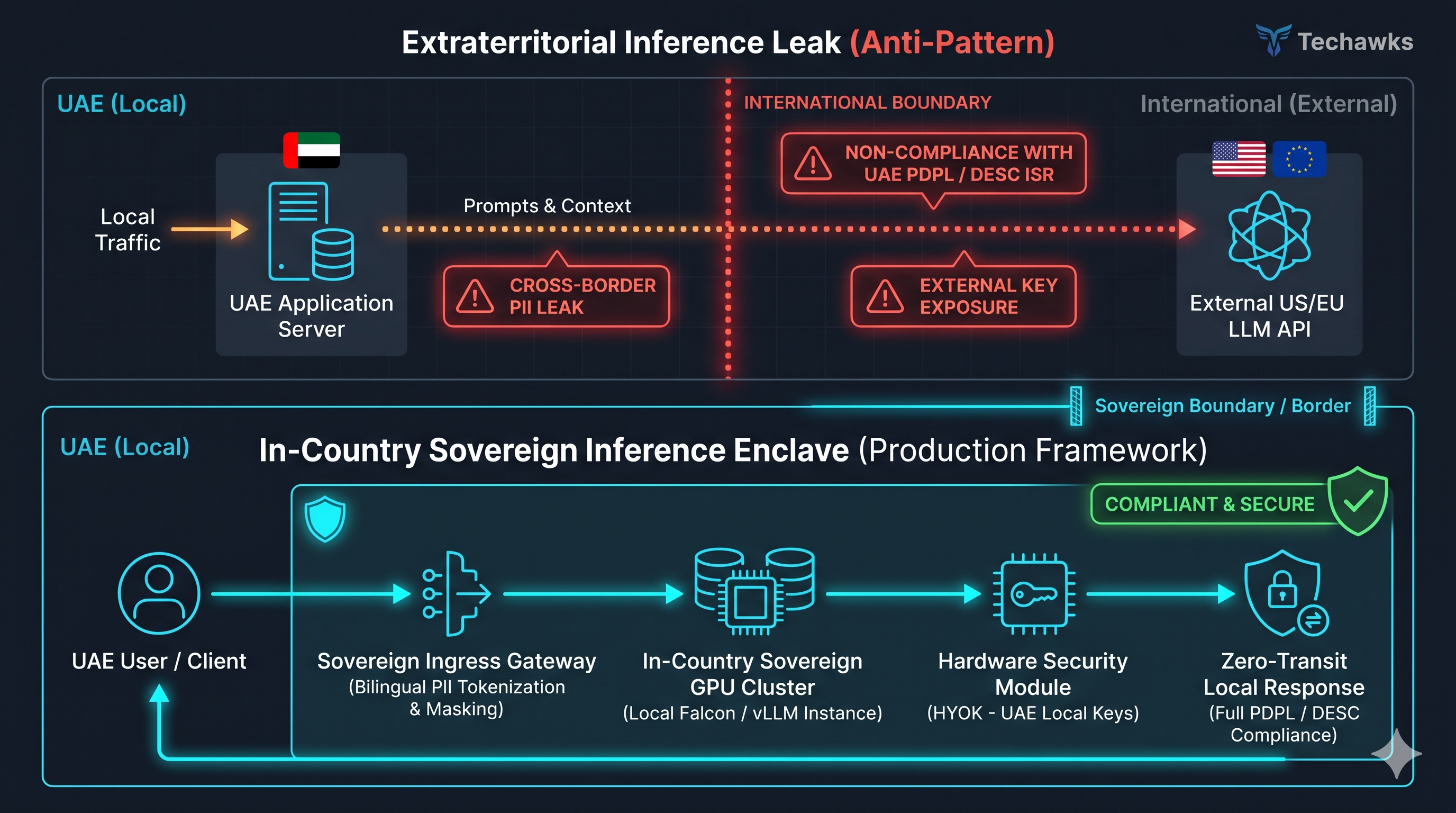
[ ANTI-PATTERN: EXTRATERRITORIAL INFERENCE LEAK ]
UAE Client ──► UAE App Server (Local DB) ──► External LLM API (US/EU Ingress) ──► Cross-Border PII Leak & Regulatory Violation (DESC / PDPL Non-Compliant)
[ PRODUCTION ARCHITECTURE: IN-COUNTRY SOVEREIGN INFERENCE PIPELINE ]
UAE Ingress ──► Sovereign Ingress Gateway (ADGM / DIFC / Federal PDPL Filter)
│
▼
Presidio PII Redaction & PII Tokeniser
│
▼
UAE Cloud Region / In-Country Sovereign Pod (e.g., Core42 / G42 Cloud)
├── Local Hardware Security Module (HYOK / UAE Root-of-Trust)
├── In-Country Self-Hosted Inference (vLLM / Triton / Falcon Weights)
└── Air-Gapped Vector Database (Milvus / Qdrant)
│
▼
Deterministic, Governed Response (Zero Cross-Border Exfiltration)
Here are three foundational patterns engineering teams in the UAE must adopt:
1. Implement Localized Self-Hosted Inference or In-Country Sovereign APIs
Stop routing enterprise context windows to offshore endpoints:
The Architecture: Host open-source or open-weight models (such as Falcon or Llama variants optimized for bilingual Arabic/English inference) on bare-metal GPU nodes or localized sovereign cloud providers (such as Core42/G42 or sovereign hyperscaler partitions located strictly within the UAE).
By running inference frameworks (like vLLM or NVIDIA Triton) within national borders, raw prompts, embeddings, and KV caches never touch transit networks that cross international boundaries.
2. Enforce "Hold Your Own Key" (HYOK) with In-Country HSMs
Data residency means nothing if foreign jurisdictions control the master cryptographic keys:
Decouple your encryption keys from global provider root accounts.
3. Deploy PII Tokenization at the Sovereign Ingress Gateway
Before context data is formatted for retrieval-augmented generation (RAG):
Discussion Question
For UAE-based engineering leads, CTOs, and cloud architects: How is your team tackling the balance between frontier AI reasoning capabilities and strict UAE data sovereignty mandates—are you self-hosting local bilingual models, using localized hyperscaler instances, or relying on strict client-side PII tokenization?
CTA
Scaling sovereign AI architectures, navigating UAE cloud regulations, or building high-concurrency systems across the Emirates?
👉 Join the Techawks UAE community to connect with elite engineers, enterprise architects, and tech innovators driving the region's digital future!
The UAE is accelerating AI adoption faster than nearly any global market, led by the UAE National AI Strategy, Falcon foundation model breakthroughs, and substantial regional data center investments across Abu Dhabi and Dubai.
Yet, engineering teams building enterprise and public-sector software across the Emirates face a critical architectural trap: The Extraterritorial Inference Leak.
Many development squads assume that hosting their PostgreSQL database or application containers inside local cloud regions (e.g., me-central-1 or uae-north) satisfies data residency requirements.
However, when their application forwards unstructured prompts, documents, or context-window chunks to external managed LLM endpoints:
Sovereignty Breach: Customer PII, Arabic dialect transcripts, and internal enterprise metadata exit the UAE jurisdiction without adequacy mechanisms or explicit authorization under Federal Decree-Law No. 45 of 2021 (UAE PDPL).
Control Plane & Key Vulnerability: If your encryption keys reside in a global, foreign-managed Hardware Security Module (HSM), foreign legal warrants (such as the US CLOUD Act) can legally compel data access regardless of physical server location.
Government & Critical Infrastructure Restrictions: Under Dubai Electronic Security Center (DESC) Information Security Regulations (ISR) and NESA/UAE IAS standards, transferring government, banking, or healthcare data to external cloud networks risks immediate regulatory shutdown and loss of operating licenses.
To build resilient, enterprise-ready systems in the region, tech architects must migrate to In-Country Sovereign Inference Enclaves backed by Hold-Your-Own-Key (HYOK) Vaults.
Plaintext
[ ANTI-PATTERN: EXTRATERRITORIAL INFERENCE LEAK ]
UAE Client ──► UAE App Server (Local DB) ──► External LLM API (US/EU Ingress) ──► Cross-Border PII Leak & Regulatory Violation (DESC / PDPL Non-Compliant)
[ PRODUCTION ARCHITECTURE: IN-COUNTRY SOVEREIGN INFERENCE PIPELINE ]
UAE Ingress ──► Sovereign Ingress Gateway (ADGM / DIFC / Federal PDPL Filter)
│
▼
Presidio PII Redaction & PII Tokeniser
│
▼
UAE Cloud Region / In-Country Sovereign Pod (e.g., Core42 / G42 Cloud)
├── Local Hardware Security Module (HYOK / UAE Root-of-Trust)
├── In-Country Self-Hosted Inference (vLLM / Triton / Falcon Weights)
└── Air-Gapped Vector Database (Milvus / Qdrant)
│
▼
Deterministic, Governed Response (Zero Cross-Border Exfiltration)
Here are three foundational patterns engineering teams in the UAE must adopt:
1. Implement Localized Self-Hosted Inference or In-Country Sovereign APIs
Stop routing enterprise context windows to offshore endpoints:
The Architecture: Host open-source or open-weight models (such as Falcon or Llama variants optimized for bilingual Arabic/English inference) on bare-metal GPU nodes or localized sovereign cloud providers (such as Core42/G42 or sovereign hyperscaler partitions located strictly within the UAE).
By running inference frameworks (like vLLM or NVIDIA Triton) within national borders, raw prompts, embeddings, and KV caches never touch transit networks that cross international boundaries.
2. Enforce "Hold Your Own Key" (HYOK) with In-Country HSMs
Data residency means nothing if foreign jurisdictions control the master cryptographic keys:
Decouple your encryption keys from global provider root accounts.
3. Deploy PII Tokenization at the Sovereign Ingress Gateway
Before context data is formatted for retrieval-augmented generation (RAG):
Discussion Question
For UAE-based engineering leads, CTOs, and cloud architects: How is your team tackling the balance between frontier AI reasoning capabilities and strict UAE data sovereignty mandates—are you self-hosting local bilingual models, using localized hyperscaler instances, or relying on strict client-side PII tokenization?
CTA
Scaling sovereign AI architectures, navigating UAE cloud regulations, or building high-concurrency systems across the Emirates?
👉 Join the Techawks UAE community to connect with elite engineers, enterprise architects, and tech innovators driving the region's digital future!
The Sovereign AI Ingress Dilemma: Why UAE Enterprise Stacks Require Localized Inference Enclaves and Key Custody
The UAE is accelerating AI adoption faster than nearly any global market, led by the UAE National AI Strategy, Falcon foundation model breakthroughs, and substantial regional data center investments across Abu Dhabi and Dubai.
Yet, engineering teams building enterprise and public-sector software across the Emirates face a critical architectural trap: The Extraterritorial Inference Leak.
Many development squads assume that hosting their PostgreSQL database or application containers inside local cloud regions (e.g., me-central-1 or uae-north) satisfies data residency requirements.
However, when their application forwards unstructured prompts, documents, or context-window chunks to external managed LLM endpoints:
Sovereignty Breach: Customer PII, Arabic dialect transcripts, and internal enterprise metadata exit the UAE jurisdiction without adequacy mechanisms or explicit authorization under Federal Decree-Law No. 45 of 2021 (UAE PDPL).
Control Plane & Key Vulnerability: If your encryption keys reside in a global, foreign-managed Hardware Security Module (HSM), foreign legal warrants (such as the US CLOUD Act) can legally compel data access regardless of physical server location.
Government & Critical Infrastructure Restrictions: Under Dubai Electronic Security Center (DESC) Information Security Regulations (ISR) and NESA/UAE IAS standards, transferring government, banking, or healthcare data to external cloud networks risks immediate regulatory shutdown and loss of operating licenses.
To build resilient, enterprise-ready systems in the region, tech architects must migrate to In-Country Sovereign Inference Enclaves backed by Hold-Your-Own-Key (HYOK) Vaults.
Plaintext
[ ANTI-PATTERN: EXTRATERRITORIAL INFERENCE LEAK ]
UAE Client ──► UAE App Server (Local DB) ──► External LLM API (US/EU Ingress) ──► Cross-Border PII Leak & Regulatory Violation (DESC / PDPL Non-Compliant)
[ PRODUCTION ARCHITECTURE: IN-COUNTRY SOVEREIGN INFERENCE PIPELINE ]
UAE Ingress ──► Sovereign Ingress Gateway (ADGM / DIFC / Federal PDPL Filter)
│
▼
Presidio PII Redaction & PII Tokeniser
│
▼
UAE Cloud Region / In-Country Sovereign Pod (e.g., Core42 / G42 Cloud)
├── Local Hardware Security Module (HYOK / UAE Root-of-Trust)
├── In-Country Self-Hosted Inference (vLLM / Triton / Falcon Weights)
└── Air-Gapped Vector Database (Milvus / Qdrant)
│
▼
Deterministic, Governed Response (Zero Cross-Border Exfiltration)
Here are three foundational patterns engineering teams in the UAE must adopt:
1. Implement Localized Self-Hosted Inference or In-Country Sovereign APIs
Stop routing enterprise context windows to offshore endpoints:
The Architecture: Host open-source or open-weight models (such as Falcon or Llama variants optimized for bilingual Arabic/English inference) on bare-metal GPU nodes or localized sovereign cloud providers (such as Core42/G42 or sovereign hyperscaler partitions located strictly within the UAE).
By running inference frameworks (like vLLM or NVIDIA Triton) within national borders, raw prompts, embeddings, and KV caches never touch transit networks that cross international boundaries.
2. Enforce "Hold Your Own Key" (HYOK) with In-Country HSMs
Data residency means nothing if foreign jurisdictions control the master cryptographic keys:
Decouple your encryption keys from global provider root accounts.
3. Deploy PII Tokenization at the Sovereign Ingress Gateway
Before context data is formatted for retrieval-augmented generation (RAG):
Discussion Question
For UAE-based engineering leads, CTOs, and cloud architects: How is your team tackling the balance between frontier AI reasoning capabilities and strict UAE data sovereignty mandates—are you self-hosting local bilingual models, using localized hyperscaler instances, or relying on strict client-side PII tokenization?
CTA
Scaling sovereign AI architectures, navigating UAE cloud regulations, or building high-concurrency systems across the Emirates?
👉 Join the Techawks UAE community to connect with elite engineers, enterprise architects, and tech innovators driving the region's digital future!

 English
 Arabic
 French
 Spanish
 Portuguese
 Deutsch
 Turkish
 Dutch
 Russian
 Romaian
 Portuguese (Brazil)
 Greek