


The Cross-Border Cloud Egress Trap: Why Canadian Architecture Stacks Require Data Residency Air-Gaps and Quebec Law 25 Compliance
Across the Canadian tech landscape—from the Toronto-Waterloo corridor to Montreal's AI ecosystem and Vancouver's cloud hubs—engineering teams are navigating a dual challenge: aggressive AI product velocity and the strictest regional privacy compliance standards in North America.
Many development teams still operate under The Passive Cloud Residency Anti-Pattern:
They provision databases in a Canadian cloud region.
They assume that as long as the primary RDS or S3 bucket is hosted in Canada, compliance is satisfied.
However, when microservices invoke external vector search engines, fraud scoring systems, or LLM inference providers hosted south of the border, unmasked Canadian customer data is transmitted into foreign jurisdictions without explicit cross-border privacy assessments or transfer safeguards.
Under Quebec Law 25 (and the regulatory trajectory set by federal enforcement and provincial PIPAs), this cross-border egress represents immediate legal liability:
Mandatory Privacy Impact Assessments (PIAs): Before transferring personal information outside Quebec or Canada, organizations are legally mandated to conduct and document a comprehensive assessment verifying that the recipient jurisdiction provides equivalent statutory protection.
Foreign Interception Risk: Routing Canadian data through US-based compute infrastructure exposes unencrypted payloads to foreign extraterritorial subpoenas (such as the US CLOUD Act or FISA 702), directly undermining provincial public-sector, financial, and healthcare contractual covenants.
Automated Decision-Making & Transparency: Canadian regulators mandate that when automated or algorithmic systems make consequential decisions about individuals, systems must provide transparent, explainable rationales and preserve human review checkpoints.
Plaintext
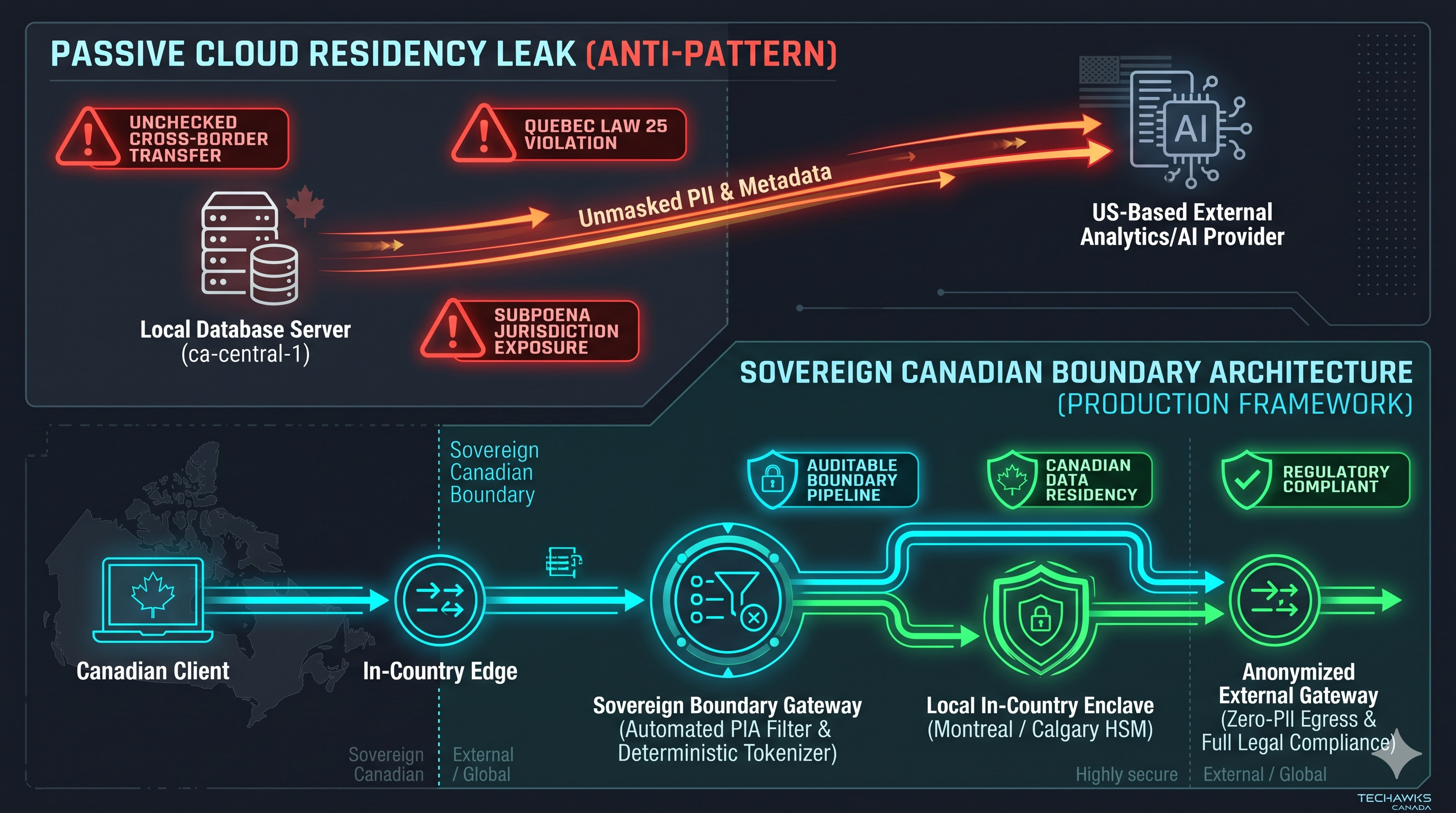
[ ANTI-PATTERN: PASSIVE "LOCAL BUCKET" DATA ESCAPE ]
Canadian Client ──► Local Canadian DB (ca-central-1) ──► Unmasked Sync RPC / AI Call ──► US-Hosted Provider / Vector Index ──► Unmonitored Cross-Border Leak (Law 25 / PIPEDA Non-Compliance)
[ PRODUCTION PATTERN: SOVEREIGN CANADIAN EGRESS GATEWAY ]
User Request ──► In-Country Canadian Edge (TLS 1.3 Termination)
│
▼
Sovereign Boundary Gateway (Envoy / OPA)
├── Automated Cross-Border PIA Verification
├── Purpose-Limited Tokenizer & Deterministic Pseudonymization
└── Local HSM Token Vault (Montreal / Calgary Root-of-Trust)
│
┌───────────┴───────────┐
▼ ▼
Local Compute Pipeline External AI / Model Ingress
(In-Country vLLM / Triton) (Anonymized Tokens ONLY / Zero PII)
│ │
▼ ▼
Audit-Ready Telemetry Secure Downstream Ingress
(Immutable Lineage Log) (Compliant S2S Transit)
1. Implement Purpose-Limited Pseudonymization at the Boundary
Never allow raw Canadian personal identity records (e.g., provincial health numbers, Social Insurance Numbers, credit profiles, or Quebec resident metadata) to traverse network boundaries unscrubbed:
2. Enforce Policy-as-Code for Cross-Border Egress
Do not rely on developer discipline to prevent unauthorized cross-border network calls.
3. Log Deterministic Audit Trails for Automated Decisions
If your software uses machine learning models or heuristic scoring engines to screen candidates, allocate credit, or adjust pricing:
Store input feature snapshots, model weights versions, and inference output states immutably in an audit lakehouse.
Discussion Question
For Canadian platform architects, DevOps leads, and backend engineers: How is your team handling data localization and cross-border API dependencies—are you running privacy impact assessments on every third-party SaaS integration, and how are you managing external AI inference gateways under Law 25?
CTA
Designing resilient, cloud-native architectures, mastering data residency, or building production AI systems across Canada?
👉 Join the Techawks Canada community to connect with top software engineers, system architects, and tech leaders shaping the future of Canadian tech!
Across the Canadian tech landscape—from the Toronto-Waterloo corridor to Montreal's AI ecosystem and Vancouver's cloud hubs—engineering teams are navigating a dual challenge: aggressive AI product velocity and the strictest regional privacy compliance standards in North America.
Many development teams still operate under The Passive Cloud Residency Anti-Pattern:
They provision databases in a Canadian cloud region.
They assume that as long as the primary RDS or S3 bucket is hosted in Canada, compliance is satisfied.
However, when microservices invoke external vector search engines, fraud scoring systems, or LLM inference providers hosted south of the border, unmasked Canadian customer data is transmitted into foreign jurisdictions without explicit cross-border privacy assessments or transfer safeguards.
Under Quebec Law 25 (and the regulatory trajectory set by federal enforcement and provincial PIPAs), this cross-border egress represents immediate legal liability:
Mandatory Privacy Impact Assessments (PIAs): Before transferring personal information outside Quebec or Canada, organizations are legally mandated to conduct and document a comprehensive assessment verifying that the recipient jurisdiction provides equivalent statutory protection.
Foreign Interception Risk: Routing Canadian data through US-based compute infrastructure exposes unencrypted payloads to foreign extraterritorial subpoenas (such as the US CLOUD Act or FISA 702), directly undermining provincial public-sector, financial, and healthcare contractual covenants.
Automated Decision-Making & Transparency: Canadian regulators mandate that when automated or algorithmic systems make consequential decisions about individuals, systems must provide transparent, explainable rationales and preserve human review checkpoints.
Plaintext
[ ANTI-PATTERN: PASSIVE "LOCAL BUCKET" DATA ESCAPE ]
Canadian Client ──► Local Canadian DB (ca-central-1) ──► Unmasked Sync RPC / AI Call ──► US-Hosted Provider / Vector Index ──► Unmonitored Cross-Border Leak (Law 25 / PIPEDA Non-Compliance)
[ PRODUCTION PATTERN: SOVEREIGN CANADIAN EGRESS GATEWAY ]
User Request ──► In-Country Canadian Edge (TLS 1.3 Termination)
│
▼
Sovereign Boundary Gateway (Envoy / OPA)
├── Automated Cross-Border PIA Verification
├── Purpose-Limited Tokenizer & Deterministic Pseudonymization
└── Local HSM Token Vault (Montreal / Calgary Root-of-Trust)
│
┌───────────┴───────────┐
▼ ▼
Local Compute Pipeline External AI / Model Ingress
(In-Country vLLM / Triton) (Anonymized Tokens ONLY / Zero PII)
│ │
▼ ▼
Audit-Ready Telemetry Secure Downstream Ingress
(Immutable Lineage Log) (Compliant S2S Transit)
1. Implement Purpose-Limited Pseudonymization at the Boundary
Never allow raw Canadian personal identity records (e.g., provincial health numbers, Social Insurance Numbers, credit profiles, or Quebec resident metadata) to traverse network boundaries unscrubbed:
2. Enforce Policy-as-Code for Cross-Border Egress
Do not rely on developer discipline to prevent unauthorized cross-border network calls.
3. Log Deterministic Audit Trails for Automated Decisions
If your software uses machine learning models or heuristic scoring engines to screen candidates, allocate credit, or adjust pricing:
Store input feature snapshots, model weights versions, and inference output states immutably in an audit lakehouse.
Discussion Question
For Canadian platform architects, DevOps leads, and backend engineers: How is your team handling data localization and cross-border API dependencies—are you running privacy impact assessments on every third-party SaaS integration, and how are you managing external AI inference gateways under Law 25?
CTA
Designing resilient, cloud-native architectures, mastering data residency, or building production AI systems across Canada?
👉 Join the Techawks Canada community to connect with top software engineers, system architects, and tech leaders shaping the future of Canadian tech!
The Cross-Border Cloud Egress Trap: Why Canadian Architecture Stacks Require Data Residency Air-Gaps and Quebec Law 25 Compliance
Across the Canadian tech landscape—from the Toronto-Waterloo corridor to Montreal's AI ecosystem and Vancouver's cloud hubs—engineering teams are navigating a dual challenge: aggressive AI product velocity and the strictest regional privacy compliance standards in North America.
Many development teams still operate under The Passive Cloud Residency Anti-Pattern:
They provision databases in a Canadian cloud region.
They assume that as long as the primary RDS or S3 bucket is hosted in Canada, compliance is satisfied.
However, when microservices invoke external vector search engines, fraud scoring systems, or LLM inference providers hosted south of the border, unmasked Canadian customer data is transmitted into foreign jurisdictions without explicit cross-border privacy assessments or transfer safeguards.
Under Quebec Law 25 (and the regulatory trajectory set by federal enforcement and provincial PIPAs), this cross-border egress represents immediate legal liability:
Mandatory Privacy Impact Assessments (PIAs): Before transferring personal information outside Quebec or Canada, organizations are legally mandated to conduct and document a comprehensive assessment verifying that the recipient jurisdiction provides equivalent statutory protection.
Foreign Interception Risk: Routing Canadian data through US-based compute infrastructure exposes unencrypted payloads to foreign extraterritorial subpoenas (such as the US CLOUD Act or FISA 702), directly undermining provincial public-sector, financial, and healthcare contractual covenants.
Automated Decision-Making & Transparency: Canadian regulators mandate that when automated or algorithmic systems make consequential decisions about individuals, systems must provide transparent, explainable rationales and preserve human review checkpoints.
Plaintext
[ ANTI-PATTERN: PASSIVE "LOCAL BUCKET" DATA ESCAPE ]
Canadian Client ──► Local Canadian DB (ca-central-1) ──► Unmasked Sync RPC / AI Call ──► US-Hosted Provider / Vector Index ──► Unmonitored Cross-Border Leak (Law 25 / PIPEDA Non-Compliance)
[ PRODUCTION PATTERN: SOVEREIGN CANADIAN EGRESS GATEWAY ]
User Request ──► In-Country Canadian Edge (TLS 1.3 Termination)
│
▼
Sovereign Boundary Gateway (Envoy / OPA)
├── Automated Cross-Border PIA Verification
├── Purpose-Limited Tokenizer & Deterministic Pseudonymization
└── Local HSM Token Vault (Montreal / Calgary Root-of-Trust)
│
┌───────────┴───────────┐
▼ ▼
Local Compute Pipeline External AI / Model Ingress
(In-Country vLLM / Triton) (Anonymized Tokens ONLY / Zero PII)
│ │
▼ ▼
Audit-Ready Telemetry Secure Downstream Ingress
(Immutable Lineage Log) (Compliant S2S Transit)
1. Implement Purpose-Limited Pseudonymization at the Boundary
Never allow raw Canadian personal identity records (e.g., provincial health numbers, Social Insurance Numbers, credit profiles, or Quebec resident metadata) to traverse network boundaries unscrubbed:
2. Enforce Policy-as-Code for Cross-Border Egress
Do not rely on developer discipline to prevent unauthorized cross-border network calls.
3. Log Deterministic Audit Trails for Automated Decisions
If your software uses machine learning models or heuristic scoring engines to screen candidates, allocate credit, or adjust pricing:
Store input feature snapshots, model weights versions, and inference output states immutably in an audit lakehouse.
Discussion Question
For Canadian platform architects, DevOps leads, and backend engineers: How is your team handling data localization and cross-border API dependencies—are you running privacy impact assessments on every third-party SaaS integration, and how are you managing external AI inference gateways under Law 25?
CTA
Designing resilient, cloud-native architectures, mastering data residency, or building production AI systems across Canada?
👉 Join the Techawks Canada community to connect with top software engineers, system architects, and tech leaders shaping the future of Canadian tech!

 Arabic
 French
 Spanish
 Portuguese
 Deutsch
 Turkish
 Dutch
 Italiano
 Russian
 Romaian
 Portuguese (Brazil)
 Greek