


Architecting for India's DPDP Act: Why Your Consent Layer Can't Just Be an Afterthought in a Modal
As India solidifies its compliance roadmap for the DPDP Act alongside sectoral mandates (RBI payment localization, SEBI frameworks, and UIDAI data vaults), engineering orgs across Bengaluru, Hyderabad, Pune, and NCR are facing a major architectural overhaul.
Consent under DPDP must be free, specific, informed, unconditional, and unambiguously revocable with an easy withdrawal mechanism. For developers building high-throughput consumer tech, fintech, or SaaS platforms, this makes treating user consent as a static boolean flag (is_consented: true) in your SQL users table completely obsolete.
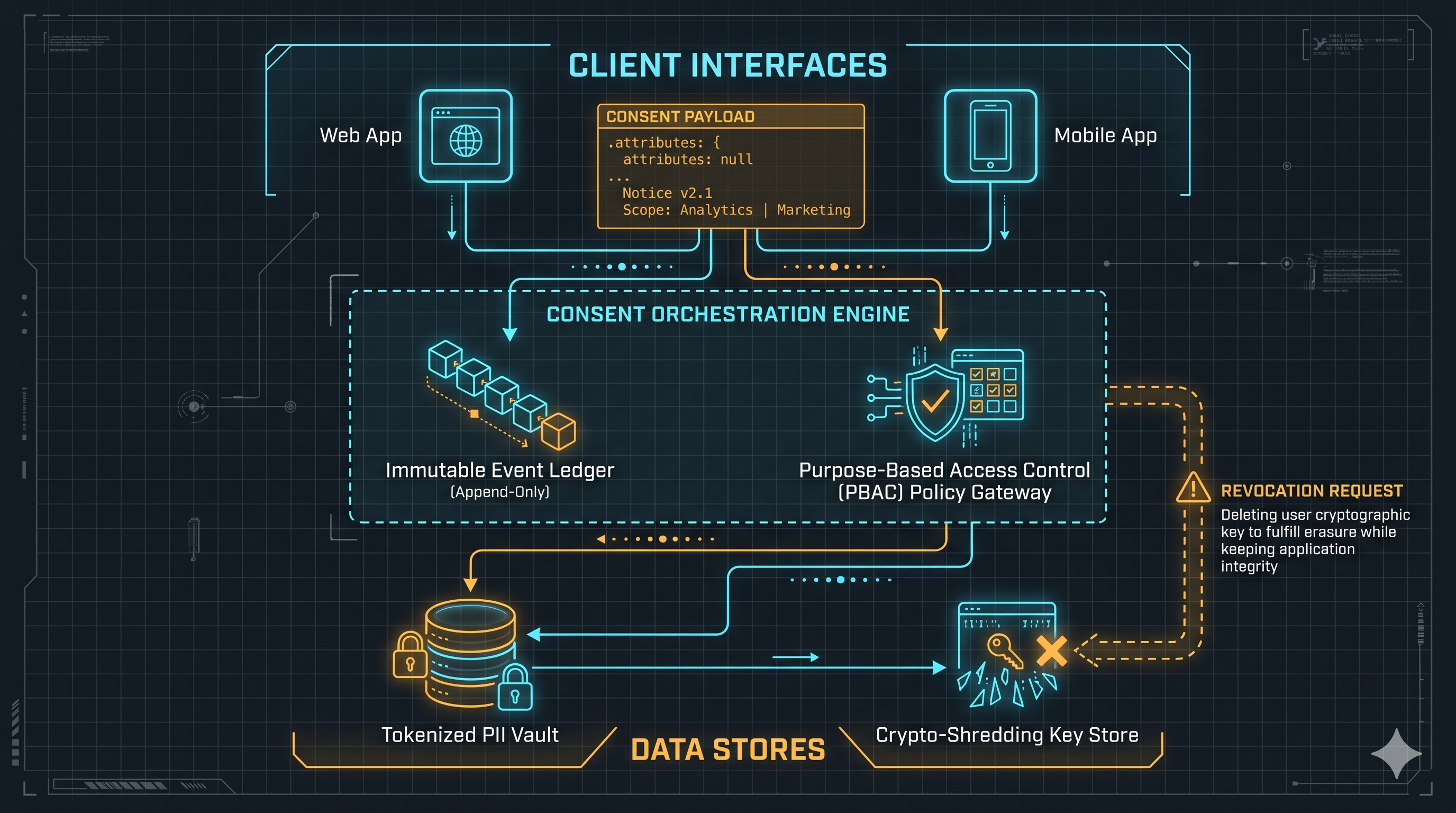
Here is how systems architects are structuring a modern Consent-Aware Data Pipeline:
Decouple Consent into an Event-Driven Audit Ledger:
Treat consent as an immutable time-series event, not mutable user state.
When a user opts in or revokes consent for a specific processing purpose (e.g., promotional profiling vs. transactional telemetry), publish an event (ConsentUpdatedEvent) to an event stream (such as Kafka or Redpanda).
Persist every state change with the exact notice version, scope timestamp, and identity hash into an append-only consent registry.
Downstream Tokenization & Purpose-Based Access Control (PBAC):
Decouple raw PII from application processing layers using internal tokenization services.
Inject purpose context into your data access calls:
Python
# Enforce purpose-scoped retrieval at the data gateway
def get_user_profile(user_id, purpose="order_fulfillment"):
consent_status = consent_service.verify(user_id, purpose)
if not consent_status.is_valid():
raise PermissionError("DPDP: Purpose consent missing or revoked")
return token_vault.resolve_pii(user_id, fields=consent_status.permitted_fields)
Handling the "Right to Erasure" Across Distributed Systems:
When an Indian data principal requests data deletion or withdraws consent, your architecture must reliably propagate that deletion to replica stores, analytics data lakes, and vector indices.
Avoid full table rebuilds by employing cryptographic erasure (crypto-shredding): encrypt individual user records with unique per-user keys. Deleting the specific user's encryption key renders their distributed data unrecoverable, fulfilling compliance without breaking immutable event stores.
Discussion Question
For engineering teams and CTOs building for the Indian ecosystem: How is your team handling consent revocation downstream in your analytics lakes and caching layers? Have you opted for crypto-shredding, modular microservices with dedicated consent tokens, or external consent management platforms?
CTA
Join Techawks India: Connect with our nationwide network of engineering leads, security researchers, and systems architects as we break down deep-dive engineering patterns, compliance blueprints, and tech innovations shaping the Indian ecosystem. Drop your thoughts below and subscribe to the page!
As India solidifies its compliance roadmap for the DPDP Act alongside sectoral mandates (RBI payment localization, SEBI frameworks, and UIDAI data vaults), engineering orgs across Bengaluru, Hyderabad, Pune, and NCR are facing a major architectural overhaul.
Consent under DPDP must be free, specific, informed, unconditional, and unambiguously revocable with an easy withdrawal mechanism. For developers building high-throughput consumer tech, fintech, or SaaS platforms, this makes treating user consent as a static boolean flag (is_consented: true) in your SQL users table completely obsolete.
Here is how systems architects are structuring a modern Consent-Aware Data Pipeline:
Decouple Consent into an Event-Driven Audit Ledger:
Treat consent as an immutable time-series event, not mutable user state.
When a user opts in or revokes consent for a specific processing purpose (e.g., promotional profiling vs. transactional telemetry), publish an event (ConsentUpdatedEvent) to an event stream (such as Kafka or Redpanda).
Persist every state change with the exact notice version, scope timestamp, and identity hash into an append-only consent registry.
Downstream Tokenization & Purpose-Based Access Control (PBAC):
Decouple raw PII from application processing layers using internal tokenization services.
Inject purpose context into your data access calls:
Python
# Enforce purpose-scoped retrieval at the data gateway
def get_user_profile(user_id, purpose="order_fulfillment"):
consent_status = consent_service.verify(user_id, purpose)
if not consent_status.is_valid():
raise PermissionError("DPDP: Purpose consent missing or revoked")
return token_vault.resolve_pii(user_id, fields=consent_status.permitted_fields)
Handling the "Right to Erasure" Across Distributed Systems:
When an Indian data principal requests data deletion or withdraws consent, your architecture must reliably propagate that deletion to replica stores, analytics data lakes, and vector indices.
Avoid full table rebuilds by employing cryptographic erasure (crypto-shredding): encrypt individual user records with unique per-user keys. Deleting the specific user's encryption key renders their distributed data unrecoverable, fulfilling compliance without breaking immutable event stores.
Discussion Question
For engineering teams and CTOs building for the Indian ecosystem: How is your team handling consent revocation downstream in your analytics lakes and caching layers? Have you opted for crypto-shredding, modular microservices with dedicated consent tokens, or external consent management platforms?
CTA
Join Techawks India: Connect with our nationwide network of engineering leads, security researchers, and systems architects as we break down deep-dive engineering patterns, compliance blueprints, and tech innovations shaping the Indian ecosystem. Drop your thoughts below and subscribe to the page!
Architecting for India's DPDP Act: Why Your Consent Layer Can't Just Be an Afterthought in a Modal
As India solidifies its compliance roadmap for the DPDP Act alongside sectoral mandates (RBI payment localization, SEBI frameworks, and UIDAI data vaults), engineering orgs across Bengaluru, Hyderabad, Pune, and NCR are facing a major architectural overhaul.
Consent under DPDP must be free, specific, informed, unconditional, and unambiguously revocable with an easy withdrawal mechanism. For developers building high-throughput consumer tech, fintech, or SaaS platforms, this makes treating user consent as a static boolean flag (is_consented: true) in your SQL users table completely obsolete.
Here is how systems architects are structuring a modern Consent-Aware Data Pipeline:
Decouple Consent into an Event-Driven Audit Ledger:
Treat consent as an immutable time-series event, not mutable user state.
When a user opts in or revokes consent for a specific processing purpose (e.g., promotional profiling vs. transactional telemetry), publish an event (ConsentUpdatedEvent) to an event stream (such as Kafka or Redpanda).
Persist every state change with the exact notice version, scope timestamp, and identity hash into an append-only consent registry.
Downstream Tokenization & Purpose-Based Access Control (PBAC):
Decouple raw PII from application processing layers using internal tokenization services.
Inject purpose context into your data access calls:
Python
# Enforce purpose-scoped retrieval at the data gateway
def get_user_profile(user_id, purpose="order_fulfillment"):
consent_status = consent_service.verify(user_id, purpose)
if not consent_status.is_valid():
raise PermissionError("DPDP: Purpose consent missing or revoked")
return token_vault.resolve_pii(user_id, fields=consent_status.permitted_fields)
Handling the "Right to Erasure" Across Distributed Systems:
When an Indian data principal requests data deletion or withdraws consent, your architecture must reliably propagate that deletion to replica stores, analytics data lakes, and vector indices.
Avoid full table rebuilds by employing cryptographic erasure (crypto-shredding): encrypt individual user records with unique per-user keys. Deleting the specific user's encryption key renders their distributed data unrecoverable, fulfilling compliance without breaking immutable event stores.
Discussion Question
For engineering teams and CTOs building for the Indian ecosystem: How is your team handling consent revocation downstream in your analytics lakes and caching layers? Have you opted for crypto-shredding, modular microservices with dedicated consent tokens, or external consent management platforms?
CTA
Join Techawks India: Connect with our nationwide network of engineering leads, security researchers, and systems architects as we break down deep-dive engineering patterns, compliance blueprints, and tech innovations shaping the Indian ecosystem. Drop your thoughts below and subscribe to the page!

 Arabic
 French
 Spanish
 Portuguese
 Deutsch
 Turkish
 Dutch
 Italiano
 Russian
 Romaian
 Portuguese (Brazil)
 Greek