


The Code Review Checklist: 10 Things to Audit Before You Approve That PR
Effective code reviews balance strict quality standards with practical velocity. You aren't just checking if the code works—you are ensuring it is readable, performant, and easy to maintain long after it's merged.
Bookmark this checklist for your next peer code review:
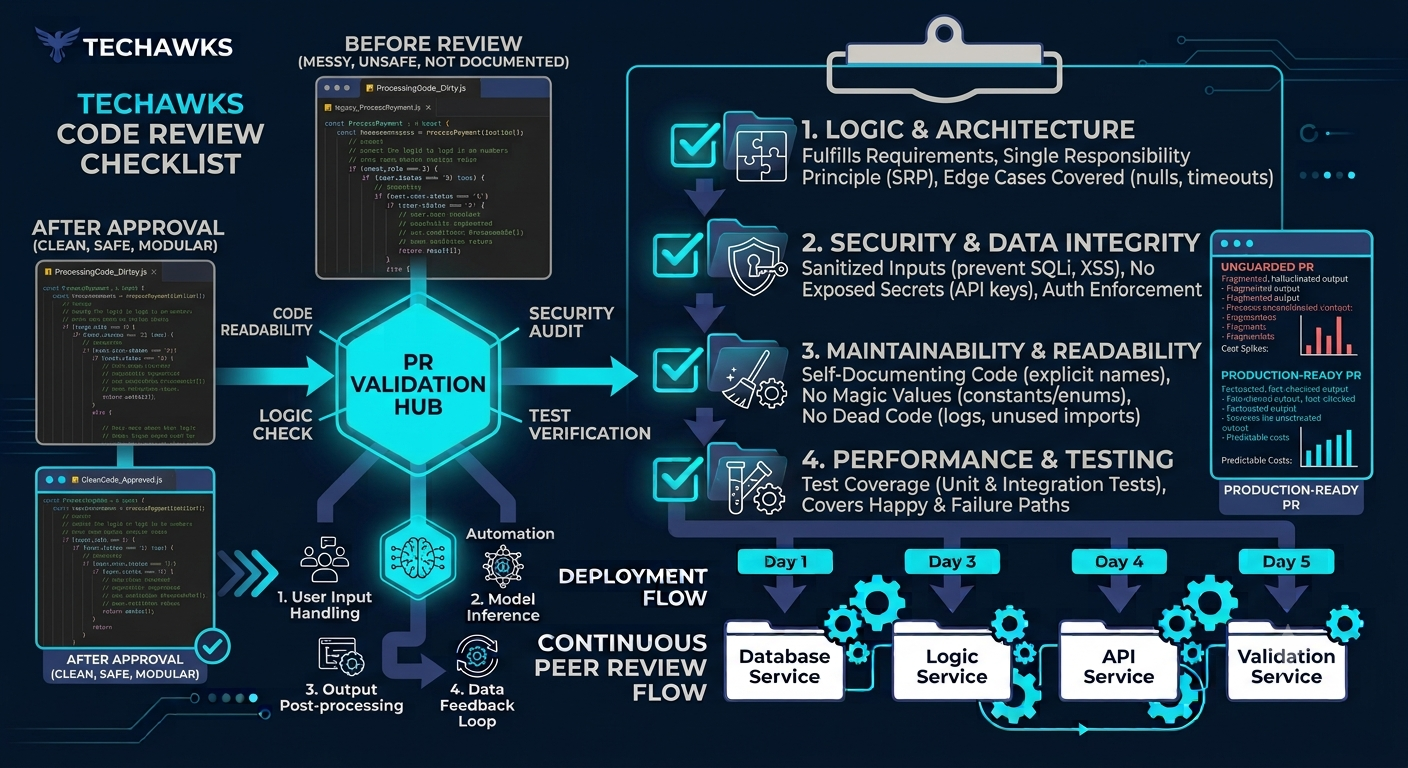
🧩 1. Logic & Architecture
Fulfills Requirements: Does the implementation directly address the task goals without adding scope creep or unnecessary features?
Single Responsibility: Are functions and classes small, focused, and handling only one clear task?
Edge Cases Covered: Does the logic handle missing parameters, empty arrays, unexpected null values, or network timeouts gracefully?
🛡️ 2. Security & Data Integrity
Sanitized Inputs: Are all user inputs escaped or validated to prevent SQL injection, XSS, or remote code execution?
No Exposed Secrets: Are API keys, passwords, or sensitive environment tokens completely absent from the code and commit history?
Auth Enforcement: Do newly added routes or endpoints enforce correct authentication and authorization checks?
🧹 3. Maintainability & Readability
Self-Documenting Code: Are variable and function names explicit enough that they explain their purpose without requiring inline comments?
No Magic Values: Are hardcoded strings and status numbers refactored into named constants or configuration enums?
No Dead Code: Is commented-out code, unused import statements, and debugging console.log/print statements removed?
⚡ 4. Performance & Testing
Test Coverage: Are unit or integration tests included that cover both the happy path and key failure scenarios?
Key Takeaways
Look Beyond Functionality: Ensure code is secure, scalable, and readable—not just working.
Protect the Codebase: Catch security risks like unsanitized inputs and leaked secrets during review.
Keep It Clean: Enforce clear naming conventions and eliminate dead code to keep technical debt low.
Verify Tests: A PR isn't complete until relevant tests cover new logic and potential edge cases.
CTA
Want to level up your engineering standards? Join thousands of developers, software architects, and coders sharing code review habits, refactoring guides, and language-specific patterns. Join Developers & Coding today!
Effective code reviews balance strict quality standards with practical velocity. You aren't just checking if the code works—you are ensuring it is readable, performant, and easy to maintain long after it's merged.
Bookmark this checklist for your next peer code review:
🧩 1. Logic & Architecture
Fulfills Requirements: Does the implementation directly address the task goals without adding scope creep or unnecessary features?
Single Responsibility: Are functions and classes small, focused, and handling only one clear task?
Edge Cases Covered: Does the logic handle missing parameters, empty arrays, unexpected null values, or network timeouts gracefully?
🛡️ 2. Security & Data Integrity
Sanitized Inputs: Are all user inputs escaped or validated to prevent SQL injection, XSS, or remote code execution?
No Exposed Secrets: Are API keys, passwords, or sensitive environment tokens completely absent from the code and commit history?
Auth Enforcement: Do newly added routes or endpoints enforce correct authentication and authorization checks?
🧹 3. Maintainability & Readability
Self-Documenting Code: Are variable and function names explicit enough that they explain their purpose without requiring inline comments?
No Magic Values: Are hardcoded strings and status numbers refactored into named constants or configuration enums?
No Dead Code: Is commented-out code, unused import statements, and debugging console.log/print statements removed?
⚡ 4. Performance & Testing
Test Coverage: Are unit or integration tests included that cover both the happy path and key failure scenarios?
Key Takeaways
Look Beyond Functionality: Ensure code is secure, scalable, and readable—not just working.
Protect the Codebase: Catch security risks like unsanitized inputs and leaked secrets during review.
Keep It Clean: Enforce clear naming conventions and eliminate dead code to keep technical debt low.
Verify Tests: A PR isn't complete until relevant tests cover new logic and potential edge cases.
CTA
Want to level up your engineering standards? Join thousands of developers, software architects, and coders sharing code review habits, refactoring guides, and language-specific patterns. Join Developers & Coding today!
The Code Review Checklist: 10 Things to Audit Before You Approve That PR
Effective code reviews balance strict quality standards with practical velocity. You aren't just checking if the code works—you are ensuring it is readable, performant, and easy to maintain long after it's merged.
Bookmark this checklist for your next peer code review:
🧩 1. Logic & Architecture
Fulfills Requirements: Does the implementation directly address the task goals without adding scope creep or unnecessary features?
Single Responsibility: Are functions and classes small, focused, and handling only one clear task?
Edge Cases Covered: Does the logic handle missing parameters, empty arrays, unexpected null values, or network timeouts gracefully?
🛡️ 2. Security & Data Integrity
Sanitized Inputs: Are all user inputs escaped or validated to prevent SQL injection, XSS, or remote code execution?
No Exposed Secrets: Are API keys, passwords, or sensitive environment tokens completely absent from the code and commit history?
Auth Enforcement: Do newly added routes or endpoints enforce correct authentication and authorization checks?
🧹 3. Maintainability & Readability
Self-Documenting Code: Are variable and function names explicit enough that they explain their purpose without requiring inline comments?
No Magic Values: Are hardcoded strings and status numbers refactored into named constants or configuration enums?
No Dead Code: Is commented-out code, unused import statements, and debugging console.log/print statements removed?
⚡ 4. Performance & Testing
Test Coverage: Are unit or integration tests included that cover both the happy path and key failure scenarios?
Key Takeaways
Look Beyond Functionality: Ensure code is secure, scalable, and readable—not just working.
Protect the Codebase: Catch security risks like unsanitized inputs and leaked secrets during review.
Keep It Clean: Enforce clear naming conventions and eliminate dead code to keep technical debt low.
Verify Tests: A PR isn't complete until relevant tests cover new logic and potential edge cases.
CTA
Want to level up your engineering standards? Join thousands of developers, software architects, and coders sharing code review habits, refactoring guides, and language-specific patterns. Join Developers & Coding today!

 English
 French
 Spanish
 Portuguese
 Deutsch
 Turkish
 Dutch
Dutch
 Italiano
 Russian
 Romaian
 Portuguese (Brazil)
 Greek
Greek