


How to Build a High-Impact Tech Resume: A 4-Step Actionable Guide
Landing technical interviews isn't about fitting as many buzzwords as possible onto a single page. It's about demonstrating impact, ownership, and problem-solving ability.
Whether you are a software engineer, data analyst, or product manager, follow this 4-step framework to optimize your technical resume today:
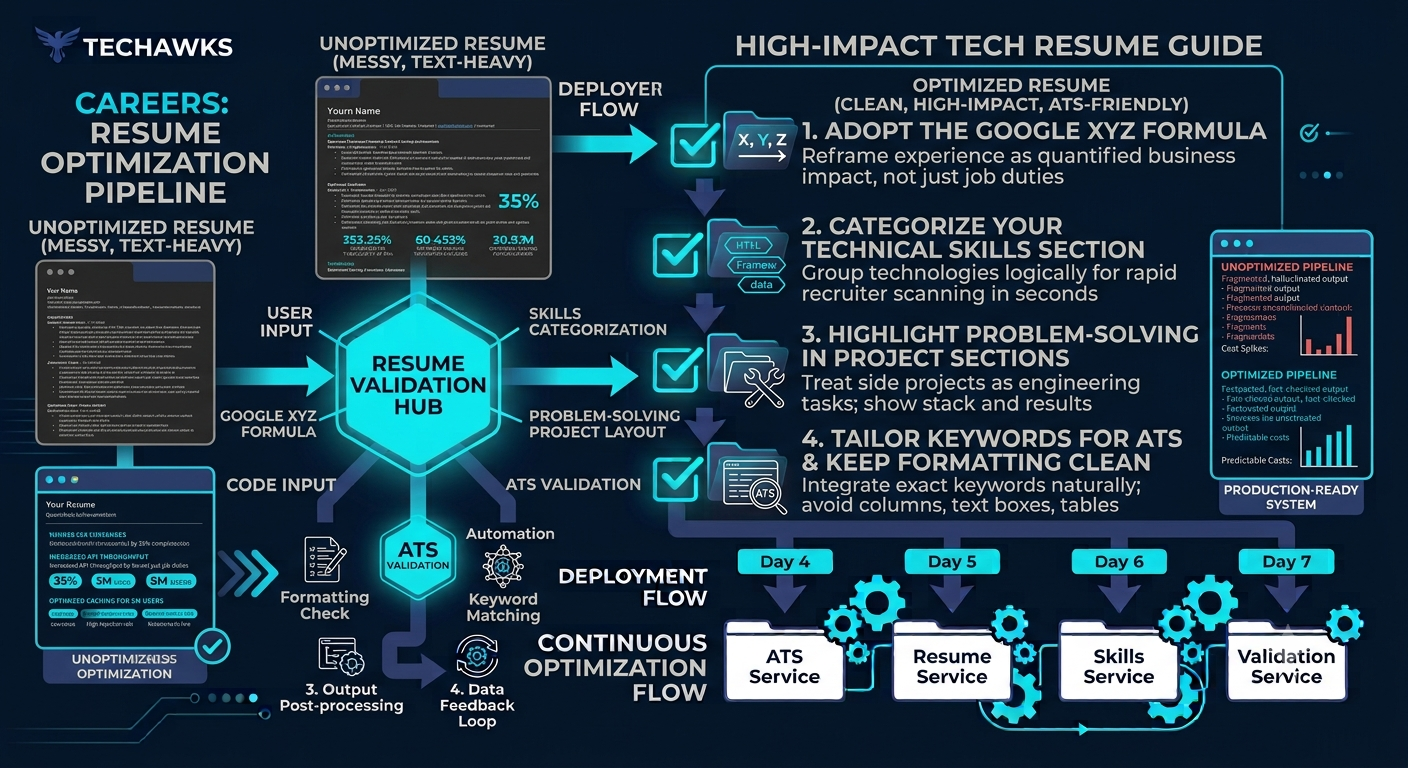
Step 1: Adopt the Google XYZ Formula for Bullet Points
Never list job duties (e.g., "Responsible for writing backend APIs"). Instead, reframe every achievement using the XYZ formula:
"Accomplished [X], as measured by [Y], by doing [Z]."
Before: "Maintained microservices and fixed performance bugs."
After: "Optimized core checkout microservices, reducing API response latency by 35% and increasing system throughput during high-traffic events by implementing Redis caching."
Step 2: Categorize Your Technical Skills Section
Dense walls of uncategorized skill tags make it hard for hiring managers to identify your primary focus. Group your stack logically so it's scannable in seconds:
Languages: JavaScript, TypeScript, Python, SQL
Frameworks & Libraries: React, Node.js, Express, FastAPI
Databases & Tools: PostgreSQL, Redis, Docker, Git, AWS (EC2, S3)
Step 3: Highlight Problem-Solving in Project Sections
If you are an entry-level candidate or transitioning roles, your project section is your strongest proof of skill. For each project, include three elements:
Problem Statement: What real-world issue were you solving?
Technical Architecture: Which tools and design patterns did you use?
Outcome / Metric: What were the results (e.g., benchmark score, user count, or performance improvement)?
Step 4: Tailor Keywords for ATS Without Keyword Stuffing
Applicant Tracking Systems (ATS) scan resumes for core competencies mentioned in the job description.
Highlight the top 5 technical requirements in the target job posting.
Ensure those exact terms naturally appear in your experience bullet points and skills section.
Keep formatting clean—avoid complex multi-column tables, text boxes, or embedded graphics that confuse ATS parsers.
Key Takeaways
Focus on Impact: Frame work achievements using actionable metrics and quantifiable outcomes.
Make It Scannable: Group technical skills cleanly by category for instant readability.
Showcase Projects: Treat side projects like real engineering tasks by explaining problem context, stack choices, and results.
Keep Formatting Clean: Use simple single-column layouts that pass through ATS screeners seamlessly.
CTA
Looking for your next big role in tech? Connect with hiring managers, recruiters, and fellow job seekers sharing open roles, interview prep guides, and career growth strategies. Join Tech Jobs & Opportunities today!
Landing technical interviews isn't about fitting as many buzzwords as possible onto a single page. It's about demonstrating impact, ownership, and problem-solving ability.
Whether you are a software engineer, data analyst, or product manager, follow this 4-step framework to optimize your technical resume today:
Step 1: Adopt the Google XYZ Formula for Bullet Points
Never list job duties (e.g., "Responsible for writing backend APIs"). Instead, reframe every achievement using the XYZ formula:
"Accomplished [X], as measured by [Y], by doing [Z]."
Before: "Maintained microservices and fixed performance bugs."
After: "Optimized core checkout microservices, reducing API response latency by 35% and increasing system throughput during high-traffic events by implementing Redis caching."
Step 2: Categorize Your Technical Skills Section
Dense walls of uncategorized skill tags make it hard for hiring managers to identify your primary focus. Group your stack logically so it's scannable in seconds:
Languages: JavaScript, TypeScript, Python, SQL
Frameworks & Libraries: React, Node.js, Express, FastAPI
Databases & Tools: PostgreSQL, Redis, Docker, Git, AWS (EC2, S3)
Step 3: Highlight Problem-Solving in Project Sections
If you are an entry-level candidate or transitioning roles, your project section is your strongest proof of skill. For each project, include three elements:
Problem Statement: What real-world issue were you solving?
Technical Architecture: Which tools and design patterns did you use?
Outcome / Metric: What were the results (e.g., benchmark score, user count, or performance improvement)?
Step 4: Tailor Keywords for ATS Without Keyword Stuffing
Applicant Tracking Systems (ATS) scan resumes for core competencies mentioned in the job description.
Highlight the top 5 technical requirements in the target job posting.
Ensure those exact terms naturally appear in your experience bullet points and skills section.
Keep formatting clean—avoid complex multi-column tables, text boxes, or embedded graphics that confuse ATS parsers.
Key Takeaways
Focus on Impact: Frame work achievements using actionable metrics and quantifiable outcomes.
Make It Scannable: Group technical skills cleanly by category for instant readability.
Showcase Projects: Treat side projects like real engineering tasks by explaining problem context, stack choices, and results.
Keep Formatting Clean: Use simple single-column layouts that pass through ATS screeners seamlessly.
CTA
Looking for your next big role in tech? Connect with hiring managers, recruiters, and fellow job seekers sharing open roles, interview prep guides, and career growth strategies. Join Tech Jobs & Opportunities today!
How to Build a High-Impact Tech Resume: A 4-Step Actionable Guide
Landing technical interviews isn't about fitting as many buzzwords as possible onto a single page. It's about demonstrating impact, ownership, and problem-solving ability.
Whether you are a software engineer, data analyst, or product manager, follow this 4-step framework to optimize your technical resume today:
Step 1: Adopt the Google XYZ Formula for Bullet Points
Never list job duties (e.g., "Responsible for writing backend APIs"). Instead, reframe every achievement using the XYZ formula:
"Accomplished [X], as measured by [Y], by doing [Z]."
Before: "Maintained microservices and fixed performance bugs."
After: "Optimized core checkout microservices, reducing API response latency by 35% and increasing system throughput during high-traffic events by implementing Redis caching."
Step 2: Categorize Your Technical Skills Section
Dense walls of uncategorized skill tags make it hard for hiring managers to identify your primary focus. Group your stack logically so it's scannable in seconds:
Languages: JavaScript, TypeScript, Python, SQL
Frameworks & Libraries: React, Node.js, Express, FastAPI
Databases & Tools: PostgreSQL, Redis, Docker, Git, AWS (EC2, S3)
Step 3: Highlight Problem-Solving in Project Sections
If you are an entry-level candidate or transitioning roles, your project section is your strongest proof of skill. For each project, include three elements:
Problem Statement: What real-world issue were you solving?
Technical Architecture: Which tools and design patterns did you use?
Outcome / Metric: What were the results (e.g., benchmark score, user count, or performance improvement)?
Step 4: Tailor Keywords for ATS Without Keyword Stuffing
Applicant Tracking Systems (ATS) scan resumes for core competencies mentioned in the job description.
Highlight the top 5 technical requirements in the target job posting.
Ensure those exact terms naturally appear in your experience bullet points and skills section.
Keep formatting clean—avoid complex multi-column tables, text boxes, or embedded graphics that confuse ATS parsers.
Key Takeaways
Focus on Impact: Frame work achievements using actionable metrics and quantifiable outcomes.
Make It Scannable: Group technical skills cleanly by category for instant readability.
Showcase Projects: Treat side projects like real engineering tasks by explaining problem context, stack choices, and results.
Keep Formatting Clean: Use simple single-column layouts that pass through ATS screeners seamlessly.
CTA
Looking for your next big role in tech? Connect with hiring managers, recruiters, and fellow job seekers sharing open roles, interview prep guides, and career growth strategies. Join Tech Jobs & Opportunities today!

 English
 Arabic
 French
 Portuguese
 Deutsch
 Turkish
 Dutch
Dutch
 Italiano
 Russian
 Romaian
 Portuguese (Brazil)
 Greek
Greek