


Beyond Global Models: Why 'Hinglish' RAG is the New Gold Standard for Indian Enterprise AI
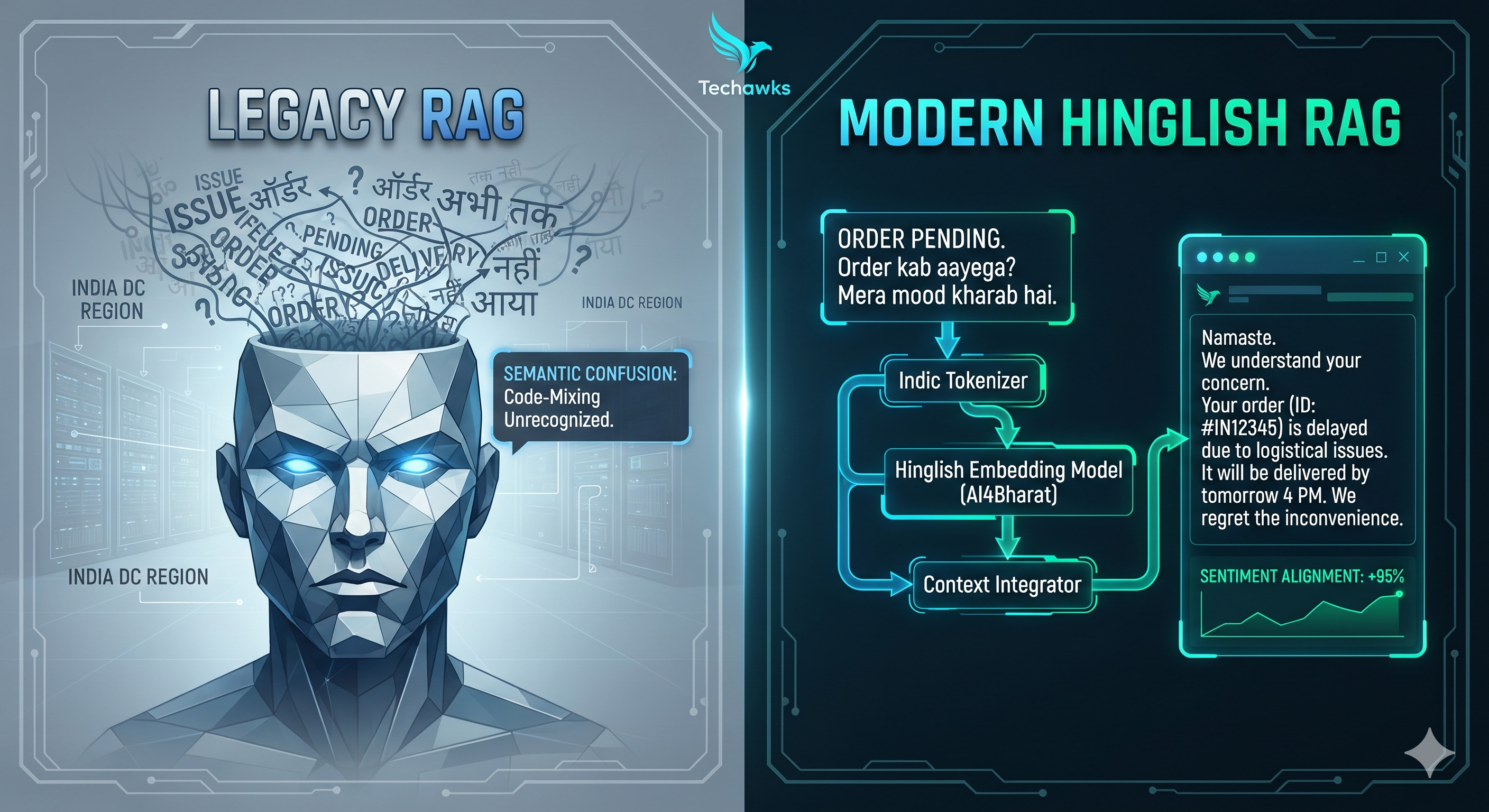
Stop trying to force your internal enterprise data into English-only vector databases if your users communicate in Hinglish. When a customer asks, "Order kab deliver hoga? Mera mood kharab ho raha hai," a standard GPT-4 or Llama 3 RAG pipeline might retrieve the correct delivery status, but it completely misses the urgency sentiment because it treats the Hindi and English tokens as noise rather than semantic context.
Why this matters in India:
Semantic Fidelity: In Indian enterprise contexts, critical information (intent, sentiment, entities) is often embedded in the non-English code-switched words.
The User Experience Gap: Customers using voice or chat interfaces expect AI to understand them naturally. If the AI replies only in formal English to a colloquial Hinglish query, trust plummets.
Reducing Hallucination: When models don't understand the query language mix, they are far more likely to hallucinate irrelevant answers from your knowledge base.
How to fix it (Teach Something Useful):
Don't just rely on base models. You must adapt your RAG stack for the Indian linguistic landscape:
Indic-Aware Embedding Models: Use embedding models specifically fine-tuned for Indian languages and code-switching (e.g., models from the AI4Bharat initiative or specific Indic variants on Hugging Face) to build your vector index.
Preprocessing Pipelines: Implement robust normalization that treats Hinglish input not as an error, but as a distinct input profile. This might involve transliteration or specialized tokenization.
Prompt Engineering for Context: Your system prompts must explicitly instruct the model to recognize and respond to the detected language mix, maintaining the tone (e.g., professional Hinglish) of the user query.
Discussion Question
Are your current RAG implementations struggling with Indian language queries or code-mixing? What specific strategies (e.g., custom embeddings, specialized models) have you tested to improve semantic retrieval for Hinglish?
CTA (Join Techawks India)
Want to dive deeper into the practical challenges of building localized AI for India? Connect with fellow senior engineers and architects in the Techawks India group to share real-world benchmarks and solutions. [Link to Techawks India Group]
Stop trying to force your internal enterprise data into English-only vector databases if your users communicate in Hinglish. When a customer asks, "Order kab deliver hoga? Mera mood kharab ho raha hai," a standard GPT-4 or Llama 3 RAG pipeline might retrieve the correct delivery status, but it completely misses the urgency sentiment because it treats the Hindi and English tokens as noise rather than semantic context.
Why this matters in India:
Semantic Fidelity: In Indian enterprise contexts, critical information (intent, sentiment, entities) is often embedded in the non-English code-switched words.
The User Experience Gap: Customers using voice or chat interfaces expect AI to understand them naturally. If the AI replies only in formal English to a colloquial Hinglish query, trust plummets.
Reducing Hallucination: When models don't understand the query language mix, they are far more likely to hallucinate irrelevant answers from your knowledge base.
How to fix it (Teach Something Useful):
Don't just rely on base models. You must adapt your RAG stack for the Indian linguistic landscape:
Indic-Aware Embedding Models: Use embedding models specifically fine-tuned for Indian languages and code-switching (e.g., models from the AI4Bharat initiative or specific Indic variants on Hugging Face) to build your vector index.
Preprocessing Pipelines: Implement robust normalization that treats Hinglish input not as an error, but as a distinct input profile. This might involve transliteration or specialized tokenization.
Prompt Engineering for Context: Your system prompts must explicitly instruct the model to recognize and respond to the detected language mix, maintaining the tone (e.g., professional Hinglish) of the user query.
Discussion Question
Are your current RAG implementations struggling with Indian language queries or code-mixing? What specific strategies (e.g., custom embeddings, specialized models) have you tested to improve semantic retrieval for Hinglish?
CTA (Join Techawks India)
Want to dive deeper into the practical challenges of building localized AI for India? Connect with fellow senior engineers and architects in the Techawks India group to share real-world benchmarks and solutions. [Link to Techawks India Group]
Beyond Global Models: Why 'Hinglish' RAG is the New Gold Standard for Indian Enterprise AI
Stop trying to force your internal enterprise data into English-only vector databases if your users communicate in Hinglish. When a customer asks, "Order kab deliver hoga? Mera mood kharab ho raha hai," a standard GPT-4 or Llama 3 RAG pipeline might retrieve the correct delivery status, but it completely misses the urgency sentiment because it treats the Hindi and English tokens as noise rather than semantic context.
Why this matters in India:
Semantic Fidelity: In Indian enterprise contexts, critical information (intent, sentiment, entities) is often embedded in the non-English code-switched words.
The User Experience Gap: Customers using voice or chat interfaces expect AI to understand them naturally. If the AI replies only in formal English to a colloquial Hinglish query, trust plummets.
Reducing Hallucination: When models don't understand the query language mix, they are far more likely to hallucinate irrelevant answers from your knowledge base.
How to fix it (Teach Something Useful):
Don't just rely on base models. You must adapt your RAG stack for the Indian linguistic landscape:
Indic-Aware Embedding Models: Use embedding models specifically fine-tuned for Indian languages and code-switching (e.g., models from the AI4Bharat initiative or specific Indic variants on Hugging Face) to build your vector index.
Preprocessing Pipelines: Implement robust normalization that treats Hinglish input not as an error, but as a distinct input profile. This might involve transliteration or specialized tokenization.
Prompt Engineering for Context: Your system prompts must explicitly instruct the model to recognize and respond to the detected language mix, maintaining the tone (e.g., professional Hinglish) of the user query.
Discussion Question
Are your current RAG implementations struggling with Indian language queries or code-mixing? What specific strategies (e.g., custom embeddings, specialized models) have you tested to improve semantic retrieval for Hinglish?
CTA (Join Techawks India)
Want to dive deeper into the practical challenges of building localized AI for India? Connect with fellow senior engineers and architects in the Techawks India group to share real-world benchmarks and solutions. [Link to Techawks India Group]

 English
 French
 Spanish
 Portuguese
 Deutsch
 Turkish
 Dutch
 Italiano
 Russian
 Romaian
 Portuguese (Brazil)
 Greek