


The Sovereign Cloud Pivot: Why UK Engineering Teams Are Rethinking Multi-Region Data Residencies
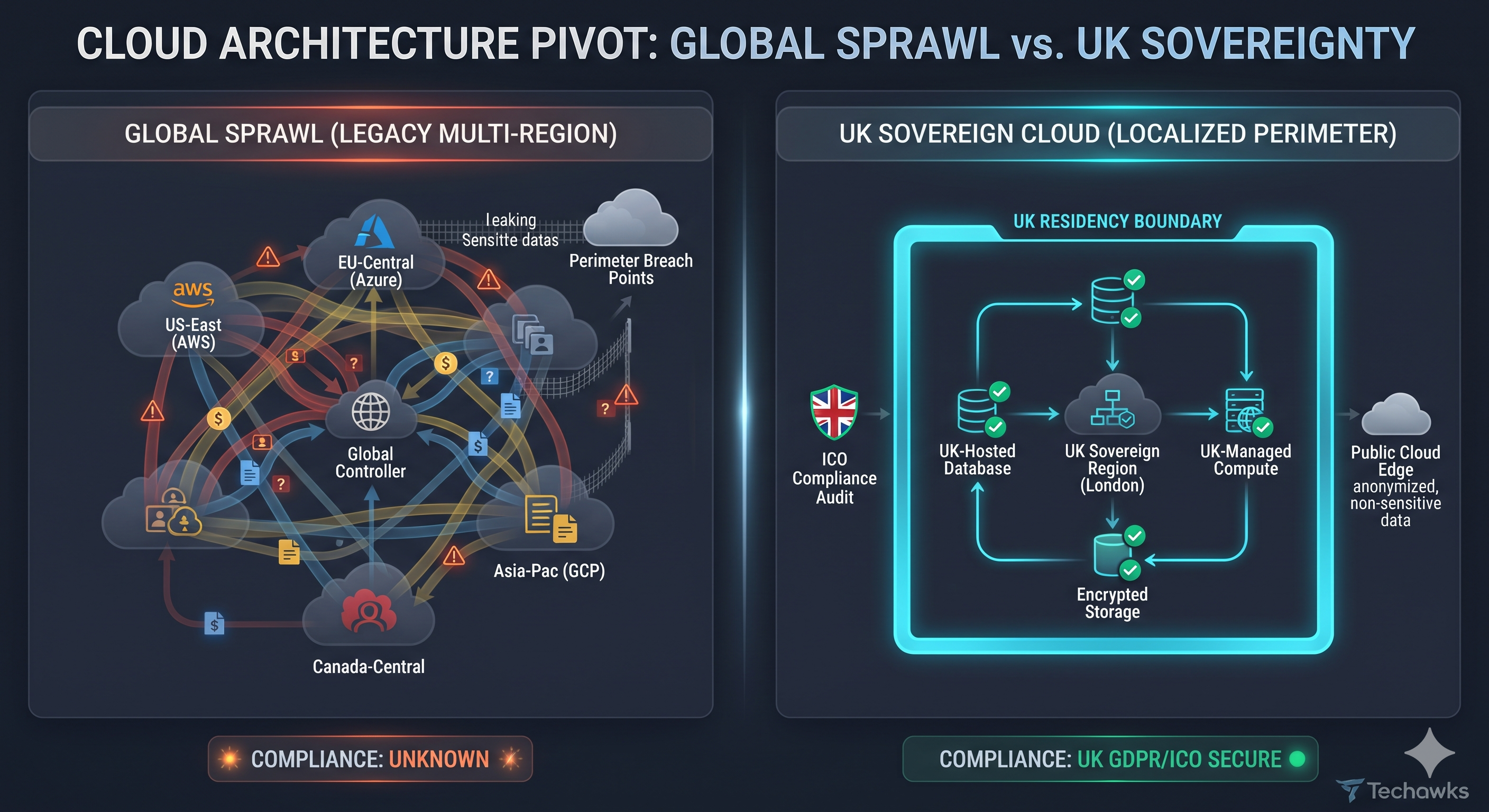
British enterprises across FinTech, HealthTech, and critical infrastructure are shifting away from sprawling, decentralized cloud footprints. With the rise of autonomous agentic workflows and large-scale data processing under the UK GDPR framework, teams are auditing where their compute actually lives and where third-party model inference calls send sensitive telemetry.
When data crosses borders unchecked, you risk compliance drift, unexpected egress fee spikes, and complex data governance bottlenecks.
Why this matters for UK tech builders:
Regulatory Alignment: Aligning your architecture with UK-specific data protection laws ensures compliance from day one, rather than trying to retrofit governance onto an existing global pipeline.
Cost Control & FinOps: Localized cloud strategies force teams to look closely at resource utilization, eliminating redundant data replication across international availability zones.
Deterministic Latency: Keeping your application stacks and inference endpoints within UK-based data centre regions drastically reduces latency for domestic users.
Teach Something Useful: Implementing Hybrid Cloud Segmentation
To achieve true cloud sovereignty without sacrificing the elasticity of public cloud ecosystems, modern platform teams are adopting a hybrid segmentation pattern:
Isolate Sensitive PII: Keep customer PII, financial records, and proprietary training datasets anchored on secure, UK-hosted private cloud or sovereign regional infrastructure.
Federated Compute Workloads: Use public cloud resources strictly for stateless, non-sensitive edge processing or scalable front-end delivery, maintaining a strict firewall boundary against raw data egress.
Automated Compliance Auditing: Embed policy-as-code tools (like Open Policy Agent) directly into your CI/CD pipelines to automatically flag any misconfigured storage buckets that lack proper regional locking.
Discussion Question
Is your organization shifting toward localized UK-hosted cloud environments, or are you still relying on traditional global multi-region deployments? How are you handling compliance pressures from the latest ICO guidance?
CTA (Join Techawks UK)
Want to debate architecture choices, cloud repatriation strategies, and local compliance standards with fellow senior engineers across Britain? Join the conversation in the Techawks UK community group.
British enterprises across FinTech, HealthTech, and critical infrastructure are shifting away from sprawling, decentralized cloud footprints. With the rise of autonomous agentic workflows and large-scale data processing under the UK GDPR framework, teams are auditing where their compute actually lives and where third-party model inference calls send sensitive telemetry.
When data crosses borders unchecked, you risk compliance drift, unexpected egress fee spikes, and complex data governance bottlenecks.
Why this matters for UK tech builders:
Regulatory Alignment: Aligning your architecture with UK-specific data protection laws ensures compliance from day one, rather than trying to retrofit governance onto an existing global pipeline.
Cost Control & FinOps: Localized cloud strategies force teams to look closely at resource utilization, eliminating redundant data replication across international availability zones.
Deterministic Latency: Keeping your application stacks and inference endpoints within UK-based data centre regions drastically reduces latency for domestic users.
Teach Something Useful: Implementing Hybrid Cloud Segmentation
To achieve true cloud sovereignty without sacrificing the elasticity of public cloud ecosystems, modern platform teams are adopting a hybrid segmentation pattern:
Isolate Sensitive PII: Keep customer PII, financial records, and proprietary training datasets anchored on secure, UK-hosted private cloud or sovereign regional infrastructure.
Federated Compute Workloads: Use public cloud resources strictly for stateless, non-sensitive edge processing or scalable front-end delivery, maintaining a strict firewall boundary against raw data egress.
Automated Compliance Auditing: Embed policy-as-code tools (like Open Policy Agent) directly into your CI/CD pipelines to automatically flag any misconfigured storage buckets that lack proper regional locking.
Discussion Question
Is your organization shifting toward localized UK-hosted cloud environments, or are you still relying on traditional global multi-region deployments? How are you handling compliance pressures from the latest ICO guidance?
CTA (Join Techawks UK)
Want to debate architecture choices, cloud repatriation strategies, and local compliance standards with fellow senior engineers across Britain? Join the conversation in the Techawks UK community group.
The Sovereign Cloud Pivot: Why UK Engineering Teams Are Rethinking Multi-Region Data Residencies
British enterprises across FinTech, HealthTech, and critical infrastructure are shifting away from sprawling, decentralized cloud footprints. With the rise of autonomous agentic workflows and large-scale data processing under the UK GDPR framework, teams are auditing where their compute actually lives and where third-party model inference calls send sensitive telemetry.
When data crosses borders unchecked, you risk compliance drift, unexpected egress fee spikes, and complex data governance bottlenecks.
Why this matters for UK tech builders:
Regulatory Alignment: Aligning your architecture with UK-specific data protection laws ensures compliance from day one, rather than trying to retrofit governance onto an existing global pipeline.
Cost Control & FinOps: Localized cloud strategies force teams to look closely at resource utilization, eliminating redundant data replication across international availability zones.
Deterministic Latency: Keeping your application stacks and inference endpoints within UK-based data centre regions drastically reduces latency for domestic users.
Teach Something Useful: Implementing Hybrid Cloud Segmentation
To achieve true cloud sovereignty without sacrificing the elasticity of public cloud ecosystems, modern platform teams are adopting a hybrid segmentation pattern:
Isolate Sensitive PII: Keep customer PII, financial records, and proprietary training datasets anchored on secure, UK-hosted private cloud or sovereign regional infrastructure.
Federated Compute Workloads: Use public cloud resources strictly for stateless, non-sensitive edge processing or scalable front-end delivery, maintaining a strict firewall boundary against raw data egress.
Automated Compliance Auditing: Embed policy-as-code tools (like Open Policy Agent) directly into your CI/CD pipelines to automatically flag any misconfigured storage buckets that lack proper regional locking.
Discussion Question
Is your organization shifting toward localized UK-hosted cloud environments, or are you still relying on traditional global multi-region deployments? How are you handling compliance pressures from the latest ICO guidance?
CTA (Join Techawks UK)
Want to debate architecture choices, cloud repatriation strategies, and local compliance standards with fellow senior engineers across Britain? Join the conversation in the Techawks UK community group.

 English
 Arabic
 French
 Spanish
 Portuguese
 Deutsch
 Turkish
 Dutch
 Russian
 Romaian
 Portuguese (Brazil)
 Greek