


The US Engineering Leader’s Playbook: Managing FinOps and Cloud Spend at Scale
Effective Cloud Financial Management (FinOps) isn't about cutting costs at the expense of performance; it's about building cost-awareness into your engineering culture. Here is a practical framework for tech teams in the US market to optimize cloud architecture and maximize engineering ROI.
1. Implement Tagging & Cost Allocation Best Practices
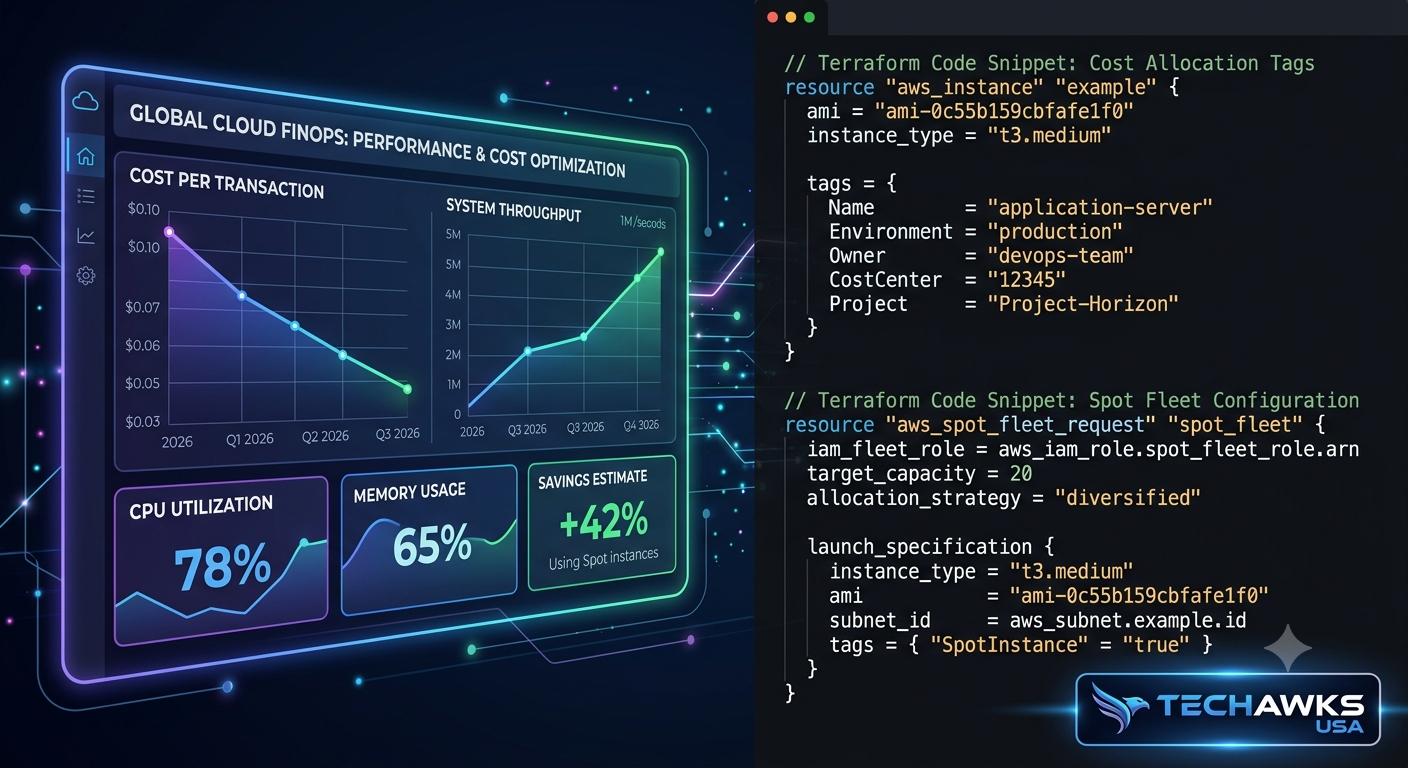
You can't optimize what you can't measure. Cost allocation tagging gives leadership visibility into unit economics per team, feature, or customer tier.
Standardize Tag Schemas: Mandate strict tags (Environment, Owner, CostCenter, Service) across all cloud infrastructure using Infrastructure as Code (IaC) guardrails (e.g., Terraform or AWS CloudFormation policies).
Track Unit Metrics: Shift your primary metric from total cloud spend to cost per active user or cost per transaction. This aligns engineering efficiency directly with business growth.
2. Leverage Architectural Cost-Optimization Patterns
Smart system design decisions reduce infrastructure overhead automatically.
Auto-Scaling with Spot/Preemptible Instances: Run fault-tolerant workloads, worker nodes, and stateless microservices on Spot instances to save up to 70–90% compared to On-Demand pricing.
Storage Tiering Automation: Configure automated Lifecycle Policies to transition infrequently accessed data from high-cost block storage to cold storage (e.g., S3 Glacier Flexible Retrieval).
3. Shift FinOps Left in the CI/CD Pipeline
Catching expensive architectural misconfigurations before deployment is significantly cheaper than fixing them post-launch.
Automated Pull Request Cost Estimation: Integrate tools like Infracost into GitHub Actions or GitLab CI to comment projected cost changes directly on pull requests before code is merged.
Continuous Anomaly Detection: Configure automated alert triggers using cloud-native tools (e.g., AWS Cost Anomaly Detection) to catch unexpected spend spikes within hours rather than at month-end.
4. Optimize Commitment-Based Savings
Commitment strategies yield massive discounts when managed properly.
Blend Savings Plans & Reserved Instances: Cover baseline 24/7 compute workloads with 1-year or 3-year Compute Savings Plans, reserving On-Demand instances strictly for unpredictable traffic spikes.
Key Takeaways
Tag everything: Enforce IaC tagging rules to track unit economics per team and feature.
Automate storage & compute: Use Spot instances and automated S3 lifecycle rules to cut baseline runtime costs.
Shift FinOps left: Run pre-merge cost estimates on code changes directly within CI/CD pipelines.
Commit to baseline load: Utilize Savings Plans for steady-state capacity to unlock steep discounts.
CTA (Join Techawks USA)
🇺🇸 Ready to level up your engineering strategy and scale smarter?
Join the Techawks USA community to connect with VP of Engineering peers, DevOps architects, and tech leaders shaping the future of software infrastructure in the US.
👉 [Join Techawks USA Today]
Effective Cloud Financial Management (FinOps) isn't about cutting costs at the expense of performance; it's about building cost-awareness into your engineering culture. Here is a practical framework for tech teams in the US market to optimize cloud architecture and maximize engineering ROI.
1. Implement Tagging & Cost Allocation Best Practices
You can't optimize what you can't measure. Cost allocation tagging gives leadership visibility into unit economics per team, feature, or customer tier.
Standardize Tag Schemas: Mandate strict tags (Environment, Owner, CostCenter, Service) across all cloud infrastructure using Infrastructure as Code (IaC) guardrails (e.g., Terraform or AWS CloudFormation policies).
Track Unit Metrics: Shift your primary metric from total cloud spend to cost per active user or cost per transaction. This aligns engineering efficiency directly with business growth.
2. Leverage Architectural Cost-Optimization Patterns
Smart system design decisions reduce infrastructure overhead automatically.
Auto-Scaling with Spot/Preemptible Instances: Run fault-tolerant workloads, worker nodes, and stateless microservices on Spot instances to save up to 70–90% compared to On-Demand pricing.
Storage Tiering Automation: Configure automated Lifecycle Policies to transition infrequently accessed data from high-cost block storage to cold storage (e.g., S3 Glacier Flexible Retrieval).
3. Shift FinOps Left in the CI/CD Pipeline
Catching expensive architectural misconfigurations before deployment is significantly cheaper than fixing them post-launch.
Automated Pull Request Cost Estimation: Integrate tools like Infracost into GitHub Actions or GitLab CI to comment projected cost changes directly on pull requests before code is merged.
Continuous Anomaly Detection: Configure automated alert triggers using cloud-native tools (e.g., AWS Cost Anomaly Detection) to catch unexpected spend spikes within hours rather than at month-end.
4. Optimize Commitment-Based Savings
Commitment strategies yield massive discounts when managed properly.
Blend Savings Plans & Reserved Instances: Cover baseline 24/7 compute workloads with 1-year or 3-year Compute Savings Plans, reserving On-Demand instances strictly for unpredictable traffic spikes.
Key Takeaways
Tag everything: Enforce IaC tagging rules to track unit economics per team and feature.
Automate storage & compute: Use Spot instances and automated S3 lifecycle rules to cut baseline runtime costs.
Shift FinOps left: Run pre-merge cost estimates on code changes directly within CI/CD pipelines.
Commit to baseline load: Utilize Savings Plans for steady-state capacity to unlock steep discounts.
CTA (Join Techawks USA)
🇺🇸 Ready to level up your engineering strategy and scale smarter?
Join the Techawks USA community to connect with VP of Engineering peers, DevOps architects, and tech leaders shaping the future of software infrastructure in the US.
👉 [Join Techawks USA Today]
The US Engineering Leader’s Playbook: Managing FinOps and Cloud Spend at Scale
Effective Cloud Financial Management (FinOps) isn't about cutting costs at the expense of performance; it's about building cost-awareness into your engineering culture. Here is a practical framework for tech teams in the US market to optimize cloud architecture and maximize engineering ROI.
1. Implement Tagging & Cost Allocation Best Practices
You can't optimize what you can't measure. Cost allocation tagging gives leadership visibility into unit economics per team, feature, or customer tier.
Standardize Tag Schemas: Mandate strict tags (Environment, Owner, CostCenter, Service) across all cloud infrastructure using Infrastructure as Code (IaC) guardrails (e.g., Terraform or AWS CloudFormation policies).
Track Unit Metrics: Shift your primary metric from total cloud spend to cost per active user or cost per transaction. This aligns engineering efficiency directly with business growth.
2. Leverage Architectural Cost-Optimization Patterns
Smart system design decisions reduce infrastructure overhead automatically.
Auto-Scaling with Spot/Preemptible Instances: Run fault-tolerant workloads, worker nodes, and stateless microservices on Spot instances to save up to 70–90% compared to On-Demand pricing.
Storage Tiering Automation: Configure automated Lifecycle Policies to transition infrequently accessed data from high-cost block storage to cold storage (e.g., S3 Glacier Flexible Retrieval).
3. Shift FinOps Left in the CI/CD Pipeline
Catching expensive architectural misconfigurations before deployment is significantly cheaper than fixing them post-launch.
Automated Pull Request Cost Estimation: Integrate tools like Infracost into GitHub Actions or GitLab CI to comment projected cost changes directly on pull requests before code is merged.
Continuous Anomaly Detection: Configure automated alert triggers using cloud-native tools (e.g., AWS Cost Anomaly Detection) to catch unexpected spend spikes within hours rather than at month-end.
4. Optimize Commitment-Based Savings
Commitment strategies yield massive discounts when managed properly.
Blend Savings Plans & Reserved Instances: Cover baseline 24/7 compute workloads with 1-year or 3-year Compute Savings Plans, reserving On-Demand instances strictly for unpredictable traffic spikes.
Key Takeaways
Tag everything: Enforce IaC tagging rules to track unit economics per team and feature.
Automate storage & compute: Use Spot instances and automated S3 lifecycle rules to cut baseline runtime costs.
Shift FinOps left: Run pre-merge cost estimates on code changes directly within CI/CD pipelines.
Commit to baseline load: Utilize Savings Plans for steady-state capacity to unlock steep discounts.
CTA (Join Techawks USA)
🇺🇸 Ready to level up your engineering strategy and scale smarter?
Join the Techawks USA community to connect with VP of Engineering peers, DevOps architects, and tech leaders shaping the future of software infrastructure in the US.
👉 [Join Techawks USA Today]

 English
 Arabic
 French
 Spanish
 Portuguese
 Deutsch
 Turkish
 Dutch
Dutch
 Italiano
 Russian
 Romaian
 Portuguese (Brazil)