


Building Zero-Trust Security into Modern Microservices: A Hands-On Guide for US Tech Teams
Adopting a Zero-Trust architecture isn't just a compliance exercise—it's a fundamental engineering practice that protects your applications at every layer. The core principle is simple: Never trust, always verify. Here is a step-by-step roadmap to implement Zero-Trust across your containerized services.
1. Enforce Mutual TLS (mTLS) for Inter-Service Traffic
Defaulting to unencrypted HTTP traffic inside your internal cluster opens the door to packet sniffing and man-in-the-middle attacks if a single container gets compromised.
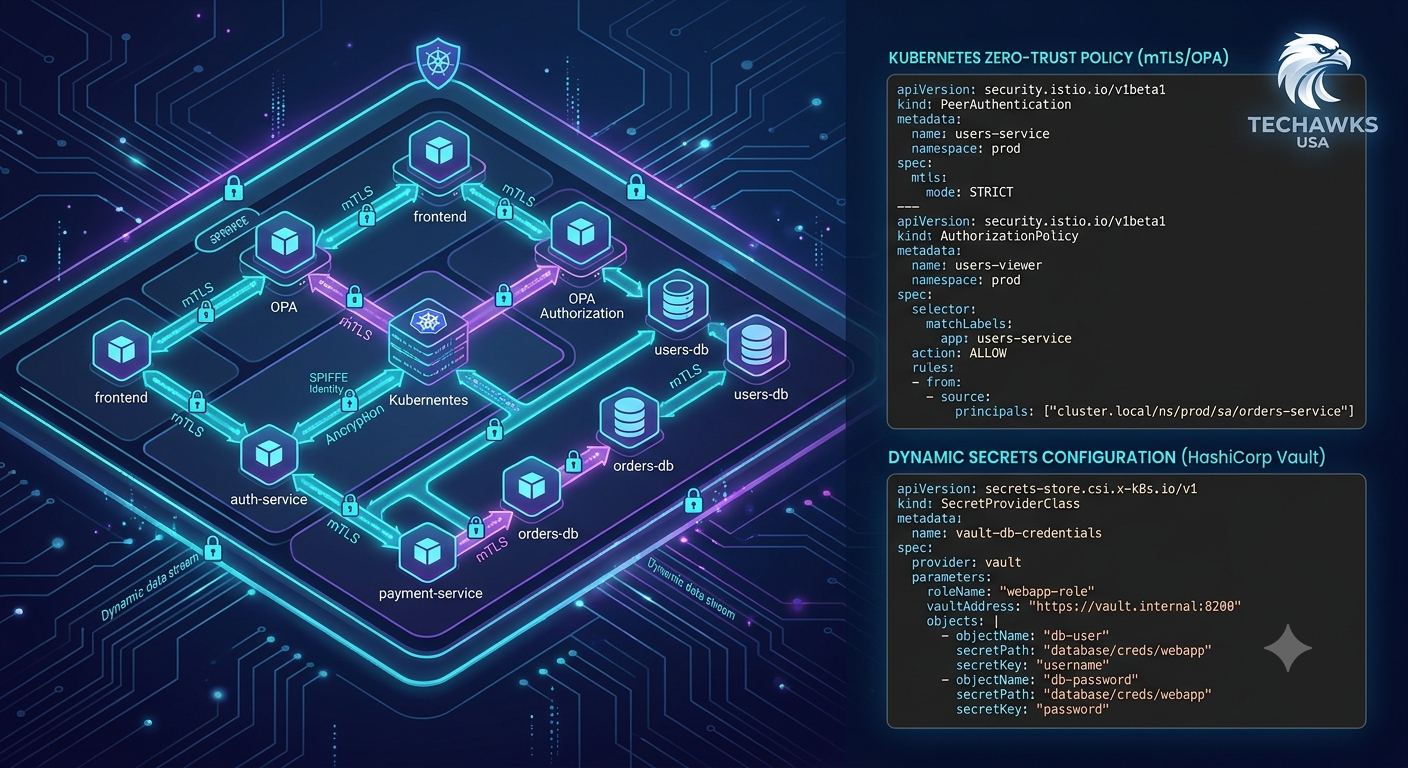
Service Mesh Automation: Use service meshes like Istio or Linkerd to automate mTLS certificate issuance, rotation, and encryption between services without altering application code.
Strict Mode: Transition your service mesh policies from permissive mode to STRICT mTLS to ensure any unencrypted internal traffic is blocked automatically.
2. Implement Granular Service-to-Service Authorization
Authentication (who are you?) is only half the battle; authorization (what are you allowed to do?) prevents unauthorized lateral movement.
Identity-Based Authorization: Assign cryptographically verifiable identities (such as SPIFFE IDs) to every workload.
Least-Privilege RBAC: Define explicit access policies using Open Policy Agent (OPA) or Kubernetes NetworkPolicies. For example, your payment-service should be the only workload permitted to communicate with your payment database endpoint.
3. Enforce Short-Lived, Dynamic Ephemeral Credentials
Hardcoded API keys and long-lived database passwords in secrets managers remain a top source of data breaches.
Dynamic Secrets Generation: Integrate tools like HashiCorp Vault to issue short-lived, dynamic credentials for database access that expire automatically after a few minutes or hours.
OIDC-Based CI/CD Authentication: Eliminate static cloud provider access keys in your GitHub Actions or GitLab CI/CD pipelines by leveraging OpenID Connect (OIDC) to request short-lived IAM roles dynamically during deployment runs.
4. Shift Security Left with Automated Container Scanning
Preventing vulnerabilities from reaching production is far easier than patching live infrastructure.
Pipeline Vulnerability Gate: Integrate vulnerability scanners (e.g., Trivy, Grype) into your CI/CD pipeline to automatically block container image builds that contain high or critical CVEs.
Signed Container Images: Use tools like Sigstore/Cosign to cryptographically sign container images upon build, ensuring your Kubernetes cluster only deploys verified, untampered artifacts.
Key Takeaways
Encrypt internal traffic: Use Service Mesh to enforce strict mTLS between every microservice.
Limit lateral movement: Define identity-based access control policies (OPA/SPIFFE) with least-privilege principles.
Ditch static keys: Transition to short-lived dynamic credentials and OIDC-based deployment permissions.
Validate at build time: Scan and cryptographically sign container images before they enter production environments.
CTA (Join Techawks USA)
🛡️ Ready to build resilient, security-first systems alongside leading US engineers?
Join the Techawks USA community to collaborate on Cloud-Native security, system architecture strategies, and DevSecOps best practices.
👉 [Join Techawks USA Today]
Adopting a Zero-Trust architecture isn't just a compliance exercise—it's a fundamental engineering practice that protects your applications at every layer. The core principle is simple: Never trust, always verify. Here is a step-by-step roadmap to implement Zero-Trust across your containerized services.
1. Enforce Mutual TLS (mTLS) for Inter-Service Traffic
Defaulting to unencrypted HTTP traffic inside your internal cluster opens the door to packet sniffing and man-in-the-middle attacks if a single container gets compromised.
Service Mesh Automation: Use service meshes like Istio or Linkerd to automate mTLS certificate issuance, rotation, and encryption between services without altering application code.
Strict Mode: Transition your service mesh policies from permissive mode to STRICT mTLS to ensure any unencrypted internal traffic is blocked automatically.
2. Implement Granular Service-to-Service Authorization
Authentication (who are you?) is only half the battle; authorization (what are you allowed to do?) prevents unauthorized lateral movement.
Identity-Based Authorization: Assign cryptographically verifiable identities (such as SPIFFE IDs) to every workload.
Least-Privilege RBAC: Define explicit access policies using Open Policy Agent (OPA) or Kubernetes NetworkPolicies. For example, your payment-service should be the only workload permitted to communicate with your payment database endpoint.
3. Enforce Short-Lived, Dynamic Ephemeral Credentials
Hardcoded API keys and long-lived database passwords in secrets managers remain a top source of data breaches.
Dynamic Secrets Generation: Integrate tools like HashiCorp Vault to issue short-lived, dynamic credentials for database access that expire automatically after a few minutes or hours.
OIDC-Based CI/CD Authentication: Eliminate static cloud provider access keys in your GitHub Actions or GitLab CI/CD pipelines by leveraging OpenID Connect (OIDC) to request short-lived IAM roles dynamically during deployment runs.
4. Shift Security Left with Automated Container Scanning
Preventing vulnerabilities from reaching production is far easier than patching live infrastructure.
Pipeline Vulnerability Gate: Integrate vulnerability scanners (e.g., Trivy, Grype) into your CI/CD pipeline to automatically block container image builds that contain high or critical CVEs.
Signed Container Images: Use tools like Sigstore/Cosign to cryptographically sign container images upon build, ensuring your Kubernetes cluster only deploys verified, untampered artifacts.
Key Takeaways
Encrypt internal traffic: Use Service Mesh to enforce strict mTLS between every microservice.
Limit lateral movement: Define identity-based access control policies (OPA/SPIFFE) with least-privilege principles.
Ditch static keys: Transition to short-lived dynamic credentials and OIDC-based deployment permissions.
Validate at build time: Scan and cryptographically sign container images before they enter production environments.
CTA (Join Techawks USA)
🛡️ Ready to build resilient, security-first systems alongside leading US engineers?
Join the Techawks USA community to collaborate on Cloud-Native security, system architecture strategies, and DevSecOps best practices.
👉 [Join Techawks USA Today]
Building Zero-Trust Security into Modern Microservices: A Hands-On Guide for US Tech Teams
Adopting a Zero-Trust architecture isn't just a compliance exercise—it's a fundamental engineering practice that protects your applications at every layer. The core principle is simple: Never trust, always verify. Here is a step-by-step roadmap to implement Zero-Trust across your containerized services.
1. Enforce Mutual TLS (mTLS) for Inter-Service Traffic
Defaulting to unencrypted HTTP traffic inside your internal cluster opens the door to packet sniffing and man-in-the-middle attacks if a single container gets compromised.
Service Mesh Automation: Use service meshes like Istio or Linkerd to automate mTLS certificate issuance, rotation, and encryption between services without altering application code.
Strict Mode: Transition your service mesh policies from permissive mode to STRICT mTLS to ensure any unencrypted internal traffic is blocked automatically.
2. Implement Granular Service-to-Service Authorization
Authentication (who are you?) is only half the battle; authorization (what are you allowed to do?) prevents unauthorized lateral movement.
Identity-Based Authorization: Assign cryptographically verifiable identities (such as SPIFFE IDs) to every workload.
Least-Privilege RBAC: Define explicit access policies using Open Policy Agent (OPA) or Kubernetes NetworkPolicies. For example, your payment-service should be the only workload permitted to communicate with your payment database endpoint.
3. Enforce Short-Lived, Dynamic Ephemeral Credentials
Hardcoded API keys and long-lived database passwords in secrets managers remain a top source of data breaches.
Dynamic Secrets Generation: Integrate tools like HashiCorp Vault to issue short-lived, dynamic credentials for database access that expire automatically after a few minutes or hours.
OIDC-Based CI/CD Authentication: Eliminate static cloud provider access keys in your GitHub Actions or GitLab CI/CD pipelines by leveraging OpenID Connect (OIDC) to request short-lived IAM roles dynamically during deployment runs.
4. Shift Security Left with Automated Container Scanning
Preventing vulnerabilities from reaching production is far easier than patching live infrastructure.
Pipeline Vulnerability Gate: Integrate vulnerability scanners (e.g., Trivy, Grype) into your CI/CD pipeline to automatically block container image builds that contain high or critical CVEs.
Signed Container Images: Use tools like Sigstore/Cosign to cryptographically sign container images upon build, ensuring your Kubernetes cluster only deploys verified, untampered artifacts.
Key Takeaways
Encrypt internal traffic: Use Service Mesh to enforce strict mTLS between every microservice.
Limit lateral movement: Define identity-based access control policies (OPA/SPIFFE) with least-privilege principles.
Ditch static keys: Transition to short-lived dynamic credentials and OIDC-based deployment permissions.
Validate at build time: Scan and cryptographically sign container images before they enter production environments.
CTA (Join Techawks USA)
🛡️ Ready to build resilient, security-first systems alongside leading US engineers?
Join the Techawks USA community to collaborate on Cloud-Native security, system architecture strategies, and DevSecOps best practices.
👉 [Join Techawks USA Today]

 Arabic
 French
 Spanish
 Portuguese
 Deutsch
 Turkish
 Dutch
Dutch
 Italiano
 Russian
 Romaian
 Portuguese (Brazil)
 Greek
Greek