


Centralized vs. Decentralized KMS in eu-west-2: Where Do You Draw the Line for UK Compliance?
Maintaining strict data residency and GDPR compliance within the eu-west-2 (London) region is a non-negotiable for UK engineering teams. However, as cloud environments scale, key management becomes one of the trickiest architectural decisions to balance between security compliance and developer velocity.
Here are the two dominant strategies UK tech teams deploy today:
Strategy A: The Centralized Security Account (Hub-and-Spoke)
The Blueprint: All Customer Managed Keys (CMKs) are generated, rotated, and audited inside a dedicated, isolated Security cloud account. Application accounts request access via cross-account key policies.
The Advantage: Perfect for audit readiness. Your compliance team has a single pane of glass for access control, key rotation logs, and regional boundary enforcement.
The Friction: Introduces cross-account IAM complexity, potential bottlenecks for platform teams, and tighter throttling limits.
Strategy B: Decentralized Workload-Bound KMS
The Blueprint: Each microservice or workload account owns its own KMS keys directly alongside its resources within eu-west-2.
The Advantage: High developer autonomy and isolation. A compromise in one workload account doesn't risk exposure to cross-account encryption infrastructure.
The Friction: Harder to enforce uniform policy compliance without automated guardrails (e.g., OPA or AWS Config) checking every single account.
How to Decide for Your Stack:
If you operate in highly regulated sectors (FinTech, HealthTech): Centralized KMS usually wins because auditors want a clean, single audit trail for key governance.
If you run high-velocity SaaS microservices: Decentralized KMS with strict Organization SCPs (preventing keys from outside eu-west-2) keeps teams moving without central blockers.
Key Takeaways
Centralized KMS simplifies compliance reporting and key governance, but increases cross-account access policy overhead.
Decentralized KMS boosts team autonomy and blast-radius containment, but requires automated policy enforcement to prevent configuration drift.
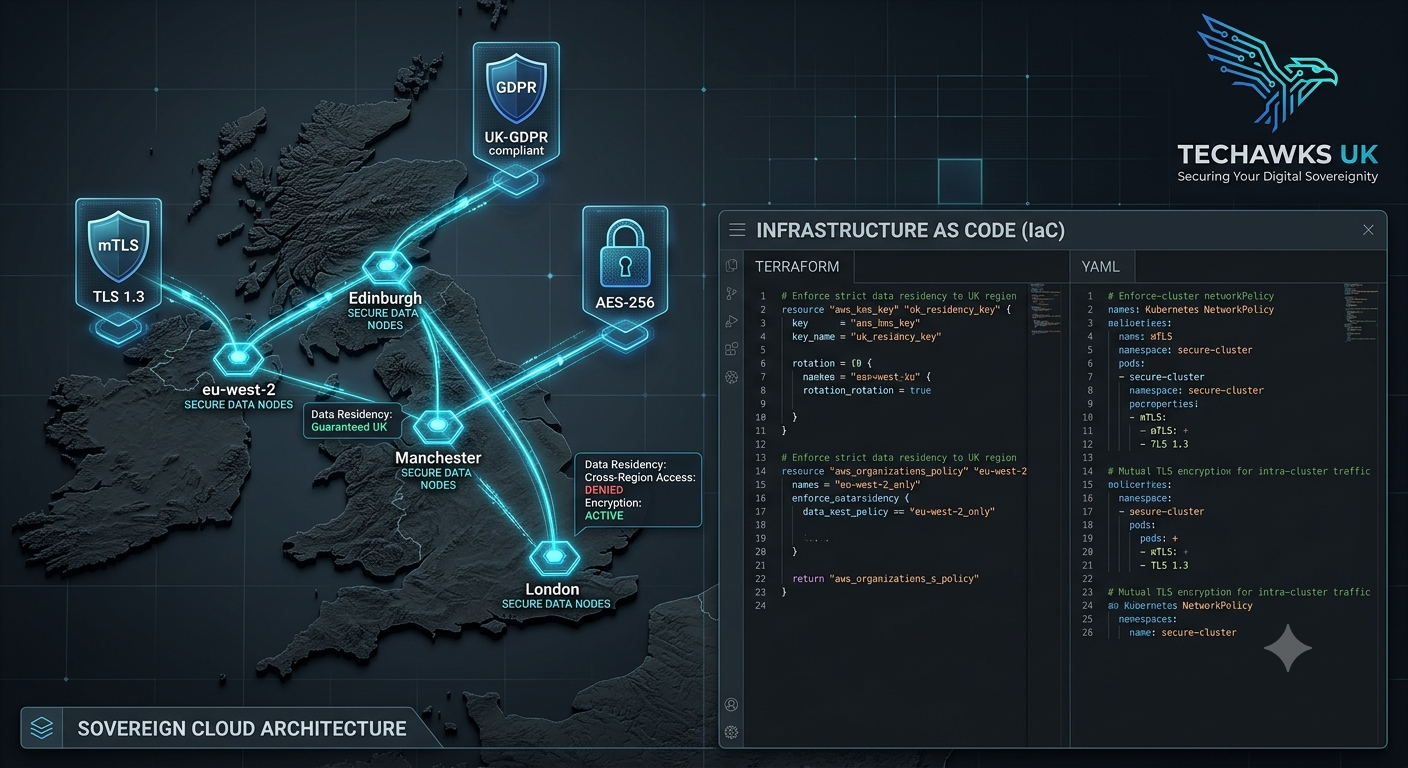
Region Locks are Mandatory: Whichever model you choose, key creation must be hard-locked to eu-west-2 using Infrastructure as Code (IaC) guardrails.
CTA
How is your team handling key management and regional compliance in your cloud setups? Drop your architectural hot takes or questions below, and join Techawks UK to engage with local cloud architects and engineering leaders!
👉 [Join Techawks UK Community]
Maintaining strict data residency and GDPR compliance within the eu-west-2 (London) region is a non-negotiable for UK engineering teams. However, as cloud environments scale, key management becomes one of the trickiest architectural decisions to balance between security compliance and developer velocity.
Here are the two dominant strategies UK tech teams deploy today:
Strategy A: The Centralized Security Account (Hub-and-Spoke)
The Blueprint: All Customer Managed Keys (CMKs) are generated, rotated, and audited inside a dedicated, isolated Security cloud account. Application accounts request access via cross-account key policies.
The Advantage: Perfect for audit readiness. Your compliance team has a single pane of glass for access control, key rotation logs, and regional boundary enforcement.
The Friction: Introduces cross-account IAM complexity, potential bottlenecks for platform teams, and tighter throttling limits.
Strategy B: Decentralized Workload-Bound KMS
The Blueprint: Each microservice or workload account owns its own KMS keys directly alongside its resources within eu-west-2.
The Advantage: High developer autonomy and isolation. A compromise in one workload account doesn't risk exposure to cross-account encryption infrastructure.
The Friction: Harder to enforce uniform policy compliance without automated guardrails (e.g., OPA or AWS Config) checking every single account.
How to Decide for Your Stack:
If you operate in highly regulated sectors (FinTech, HealthTech): Centralized KMS usually wins because auditors want a clean, single audit trail for key governance.
If you run high-velocity SaaS microservices: Decentralized KMS with strict Organization SCPs (preventing keys from outside eu-west-2) keeps teams moving without central blockers.
Key Takeaways
Centralized KMS simplifies compliance reporting and key governance, but increases cross-account access policy overhead.
Decentralized KMS boosts team autonomy and blast-radius containment, but requires automated policy enforcement to prevent configuration drift.
Region Locks are Mandatory: Whichever model you choose, key creation must be hard-locked to eu-west-2 using Infrastructure as Code (IaC) guardrails.
CTA
How is your team handling key management and regional compliance in your cloud setups? Drop your architectural hot takes or questions below, and join Techawks UK to engage with local cloud architects and engineering leaders!
👉 [Join Techawks UK Community]
Centralized vs. Decentralized KMS in eu-west-2: Where Do You Draw the Line for UK Compliance?
Maintaining strict data residency and GDPR compliance within the eu-west-2 (London) region is a non-negotiable for UK engineering teams. However, as cloud environments scale, key management becomes one of the trickiest architectural decisions to balance between security compliance and developer velocity.
Here are the two dominant strategies UK tech teams deploy today:
Strategy A: The Centralized Security Account (Hub-and-Spoke)
The Blueprint: All Customer Managed Keys (CMKs) are generated, rotated, and audited inside a dedicated, isolated Security cloud account. Application accounts request access via cross-account key policies.
The Advantage: Perfect for audit readiness. Your compliance team has a single pane of glass for access control, key rotation logs, and regional boundary enforcement.
The Friction: Introduces cross-account IAM complexity, potential bottlenecks for platform teams, and tighter throttling limits.
Strategy B: Decentralized Workload-Bound KMS
The Blueprint: Each microservice or workload account owns its own KMS keys directly alongside its resources within eu-west-2.
The Advantage: High developer autonomy and isolation. A compromise in one workload account doesn't risk exposure to cross-account encryption infrastructure.
The Friction: Harder to enforce uniform policy compliance without automated guardrails (e.g., OPA or AWS Config) checking every single account.
How to Decide for Your Stack:
If you operate in highly regulated sectors (FinTech, HealthTech): Centralized KMS usually wins because auditors want a clean, single audit trail for key governance.
If you run high-velocity SaaS microservices: Decentralized KMS with strict Organization SCPs (preventing keys from outside eu-west-2) keeps teams moving without central blockers.
Key Takeaways
Centralized KMS simplifies compliance reporting and key governance, but increases cross-account access policy overhead.
Decentralized KMS boosts team autonomy and blast-radius containment, but requires automated policy enforcement to prevent configuration drift.
Region Locks are Mandatory: Whichever model you choose, key creation must be hard-locked to eu-west-2 using Infrastructure as Code (IaC) guardrails.
CTA
How is your team handling key management and regional compliance in your cloud setups? Drop your architectural hot takes or questions below, and join Techawks UK to engage with local cloud architects and engineering leaders!
👉 [Join Techawks UK Community]

 English
 Arabic
 French
 Spanish
 Portuguese
 Deutsch
 Turkish
 Dutch
Dutch
 Italiano
 Russian
 Romaian
 Greek
Greek