


The UAE Cloud Sovereignty Framework: Ensuring Compliance in me-central-1
As engineering teams expand their cloud footprint across the Emirates, aligning cloud infrastructure with local regulatory requirements—such as UAE Federal Decree-Law No. 45 of 2021 (PDPL) and NESA compliance—is critical.
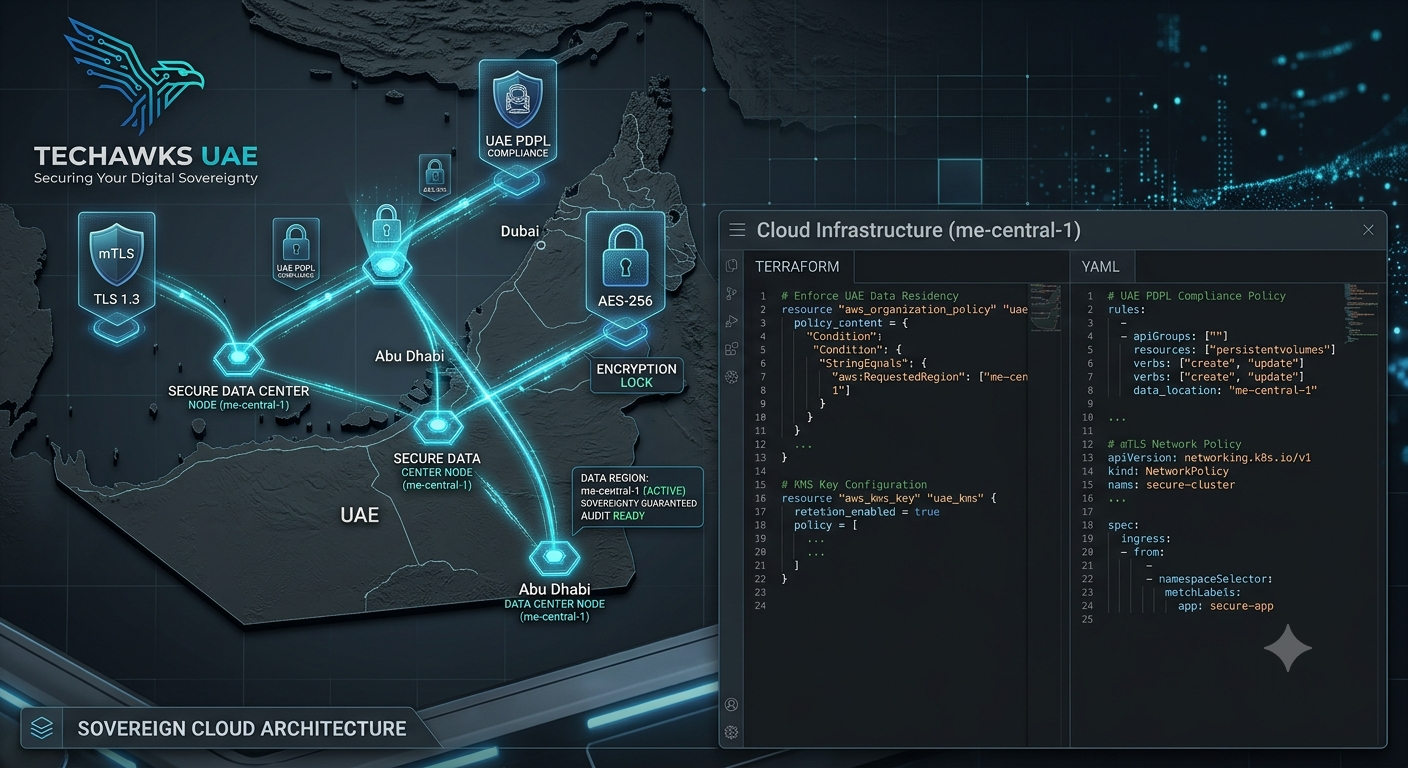
Deploying workloads inside local Middle East cloud regions (such as AWS me-central-1 in the UAE) is the first step, but continuous data sovereignty requires explicit technical guardrails.
Bookmark this 3-part architectural resource to keep your UAE cloud stacks audit-ready:
1. Hard-Coded Data Residency Controls
Ensure zero accidental cross-border data leakage by enforcing region-locking policy constraints directly inside your deployment pipeline.
Service Control Policies (SCPs): Enforce organization-level constraints that block API calls originating outside UAE cloud regions (me-central-1).
Infrastructure as Code (IaC) Guardrails: Integrate static code analysis (e.g., checkov or tfsec) into your CI/CD pipelines to validate that storage buckets (S3, Blob Storage) and database instances are provisioned exclusively with UAE regional endpoints.
2. UAE-Hosted Key Management & Encryption
Under local data protection guidelines, managing cryptographic keys in local geographic boundaries ensures strict data control.
Customer Managed Keys (CMKs): Generate and manage KMS keys dedicated strictly to me-central-1.
Enforce TLS 1.3 & mTLS: Mandate TLS 1.3 for external ingress traffic and mutual TLS (mTLS) for internal mesh communication across microservices.
3. Automated Local Backup & Disaster Recovery (DR)
Disaster recovery strategies must comply with data localization requirements. Replicating databases to international regions during failovers can unknowingly violate PDPL standards.
Intra-Region Multi-AZ DR: Utilize Multi-Availability Zone configurations inside me-central-1 for high availability rather than default cross-border cross-region replication.
Encrypted Cross-Account Backups: If replicating data for vaulting, ensure target accounts reside within approved UAE availability zones and keys remain locally isolated.
Key Takeaways
PDPL Alignment: Selecting local UAE regions is essential, but IAM boundary policies are what enforce strict legal compliance.
Local Key Governance: Keep KMS keys bound to me-central-1 to maintain cryptographically guaranteed data sovereignty.
DR Compliance: Ensure backup and failover targets stay within local geographical boundaries.
CTA
Building or migrating cloud infrastructure in the UAE? Join Techawks UAE to connect with local tech leaders, access UAE-tailored architecture blueprints, and join the conversation.
👉 [Join Techawks UAE Community]
As engineering teams expand their cloud footprint across the Emirates, aligning cloud infrastructure with local regulatory requirements—such as UAE Federal Decree-Law No. 45 of 2021 (PDPL) and NESA compliance—is critical.
Deploying workloads inside local Middle East cloud regions (such as AWS me-central-1 in the UAE) is the first step, but continuous data sovereignty requires explicit technical guardrails.
Bookmark this 3-part architectural resource to keep your UAE cloud stacks audit-ready:
1. Hard-Coded Data Residency Controls
Ensure zero accidental cross-border data leakage by enforcing region-locking policy constraints directly inside your deployment pipeline.
Service Control Policies (SCPs): Enforce organization-level constraints that block API calls originating outside UAE cloud regions (me-central-1).
Infrastructure as Code (IaC) Guardrails: Integrate static code analysis (e.g., checkov or tfsec) into your CI/CD pipelines to validate that storage buckets (S3, Blob Storage) and database instances are provisioned exclusively with UAE regional endpoints.
2. UAE-Hosted Key Management & Encryption
Under local data protection guidelines, managing cryptographic keys in local geographic boundaries ensures strict data control.
Customer Managed Keys (CMKs): Generate and manage KMS keys dedicated strictly to me-central-1.
Enforce TLS 1.3 & mTLS: Mandate TLS 1.3 for external ingress traffic and mutual TLS (mTLS) for internal mesh communication across microservices.
3. Automated Local Backup & Disaster Recovery (DR)
Disaster recovery strategies must comply with data localization requirements. Replicating databases to international regions during failovers can unknowingly violate PDPL standards.
Intra-Region Multi-AZ DR: Utilize Multi-Availability Zone configurations inside me-central-1 for high availability rather than default cross-border cross-region replication.
Encrypted Cross-Account Backups: If replicating data for vaulting, ensure target accounts reside within approved UAE availability zones and keys remain locally isolated.
Key Takeaways
PDPL Alignment: Selecting local UAE regions is essential, but IAM boundary policies are what enforce strict legal compliance.
Local Key Governance: Keep KMS keys bound to me-central-1 to maintain cryptographically guaranteed data sovereignty.
DR Compliance: Ensure backup and failover targets stay within local geographical boundaries.
CTA
Building or migrating cloud infrastructure in the UAE? Join Techawks UAE to connect with local tech leaders, access UAE-tailored architecture blueprints, and join the conversation.
👉 [Join Techawks UAE Community]
The UAE Cloud Sovereignty Framework: Ensuring Compliance in me-central-1
As engineering teams expand their cloud footprint across the Emirates, aligning cloud infrastructure with local regulatory requirements—such as UAE Federal Decree-Law No. 45 of 2021 (PDPL) and NESA compliance—is critical.
Deploying workloads inside local Middle East cloud regions (such as AWS me-central-1 in the UAE) is the first step, but continuous data sovereignty requires explicit technical guardrails.
Bookmark this 3-part architectural resource to keep your UAE cloud stacks audit-ready:
1. Hard-Coded Data Residency Controls
Ensure zero accidental cross-border data leakage by enforcing region-locking policy constraints directly inside your deployment pipeline.
Service Control Policies (SCPs): Enforce organization-level constraints that block API calls originating outside UAE cloud regions (me-central-1).
Infrastructure as Code (IaC) Guardrails: Integrate static code analysis (e.g., checkov or tfsec) into your CI/CD pipelines to validate that storage buckets (S3, Blob Storage) and database instances are provisioned exclusively with UAE regional endpoints.
2. UAE-Hosted Key Management & Encryption
Under local data protection guidelines, managing cryptographic keys in local geographic boundaries ensures strict data control.
Customer Managed Keys (CMKs): Generate and manage KMS keys dedicated strictly to me-central-1.
Enforce TLS 1.3 & mTLS: Mandate TLS 1.3 for external ingress traffic and mutual TLS (mTLS) for internal mesh communication across microservices.
3. Automated Local Backup & Disaster Recovery (DR)
Disaster recovery strategies must comply with data localization requirements. Replicating databases to international regions during failovers can unknowingly violate PDPL standards.
Intra-Region Multi-AZ DR: Utilize Multi-Availability Zone configurations inside me-central-1 for high availability rather than default cross-border cross-region replication.
Encrypted Cross-Account Backups: If replicating data for vaulting, ensure target accounts reside within approved UAE availability zones and keys remain locally isolated.
Key Takeaways
PDPL Alignment: Selecting local UAE regions is essential, but IAM boundary policies are what enforce strict legal compliance.
Local Key Governance: Keep KMS keys bound to me-central-1 to maintain cryptographically guaranteed data sovereignty.
DR Compliance: Ensure backup and failover targets stay within local geographical boundaries.
CTA
Building or migrating cloud infrastructure in the UAE? Join Techawks UAE to connect with local tech leaders, access UAE-tailored architecture blueprints, and join the conversation.
👉 [Join Techawks UAE Community]

 English
 Arabic
 French
 Spanish
 Portuguese
 Deutsch
 Turkish
 Dutch
Dutch
 Italiano
 Russian
 Romaian
 Greek
Greek