


Mastering Zero Trust Data Governance in me-central-1: A Practical Guide for UAE Cloud Engineers
In the UAE's rapidly evolving technology ecosystem, data protection regulations (such as Federal Decree-Law No. 45 of 2021) demand more than default infrastructure defaults. True cloud sovereignty requires implementing a Zero Trust Data Governance model where identity, key management, and transit layers explicitly enforce regional isolation.
Here is a 3-step actionable framework to harden your UAE cloud architecture against data leakage and compliance gaps:
1. Implement Policy-Based Ingress/Egress Isolation
Prevent data from unexpectedly leaving the UAE region by configuring hard guardrails in your Infrastructure as Code (IaC) setup.
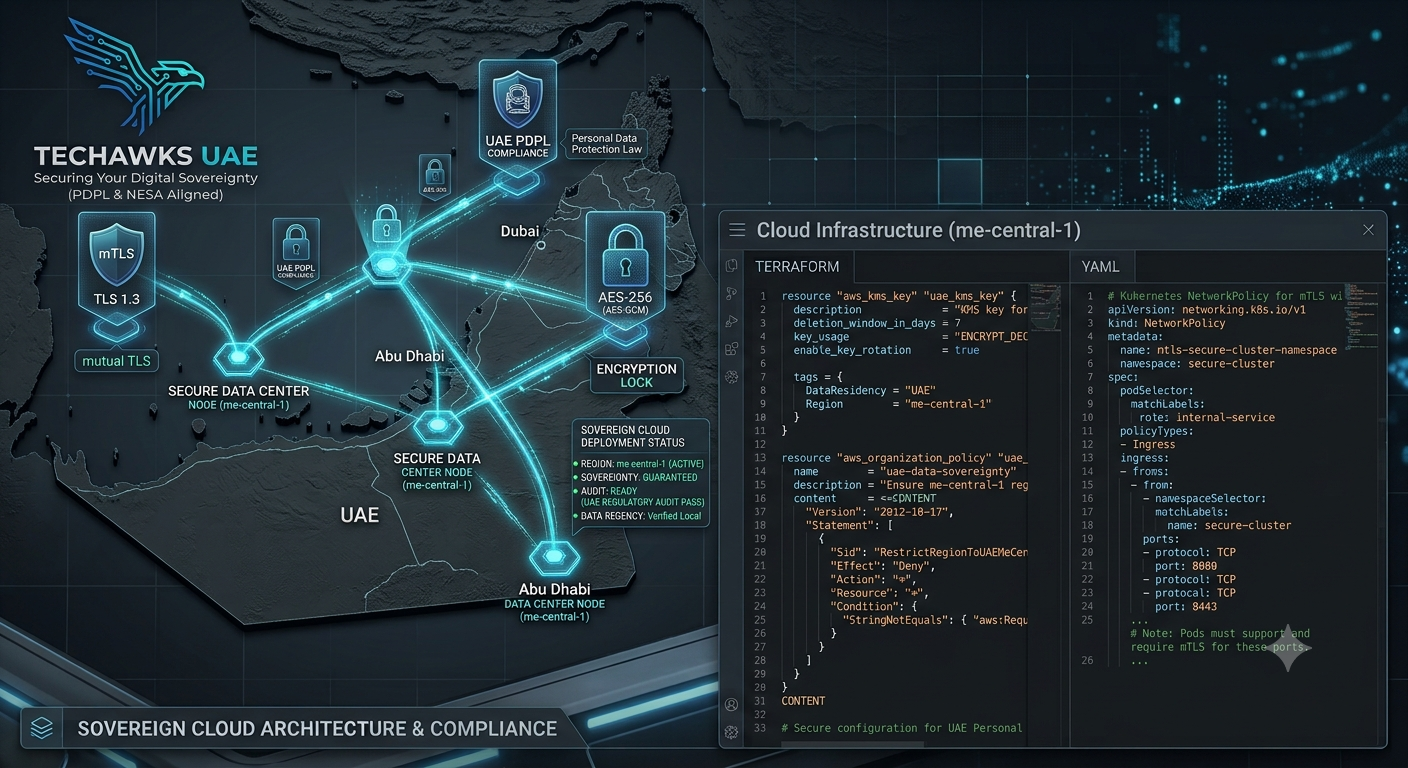
Service Control Policies (SCPs): Set up organizational SCPs that deny all non-me-central-1 API actions for production data services (S3, RDS, DynamoDB).
Kubernetes Egress Filtering: Use NetworkPolicies or CNI plugins (like Cilium) to restrict pod egress traffic solely to internal service endpoints and approved local APIs.
2. Isolate Cryptographic Key Boundaries
Data encryption at rest is only as secure as key accessibility. If key control resides outside local boundaries, cross-border jurisdictional risks remain.
Regional KMS Binding: Ensure AWS KMS Customer Managed Keys (CMKs) or Azure Key Vault secrets are strictly provisioned inside UAE availability zones with local key policies.
Automate Key Rotation: Configure automated 90-day rotation schedules via Terraform/YAML to minimize long-term key exposure without manual maintenance.
3. Enforce Strict Intra-Cluster Encryption (mTLS)
Protecting data in transit within local data centers is just as critical as protecting data at rest.
Service Mesh Security: Deploy Mutual TLS (mTLS) across microservices using Istio or Linkerd to ensure all inter-pod communications are encrypted with TLS 1.3.
Explicit Workload Identities: Authenticate pod-to-pod requests based on cryptographic workload identities rather than relying solely on network IP subnets.
Key Takeaways
IAM > Region Selection: Selecting me-central-1 fulfills physical storage needs, but explicit IAM condition policies prevent cross-border data exposure.
Cryptographic Boundary Control: Keep key management native to local regions to comply with UAE PDPL standards.
Zero Trust Transit: Mandate TLS 1.3 and mTLS across all service-to-service communication to secure data in motion.
CTA
Looking to build resilient, audit-ready cloud architecture tailored for the Emirates? Join Techawks UAE to exchange blueprints with local DevOps engineers, cloud architects, and security specialists.
👉 [Join Techawks UAE Community]
In the UAE's rapidly evolving technology ecosystem, data protection regulations (such as Federal Decree-Law No. 45 of 2021) demand more than default infrastructure defaults. True cloud sovereignty requires implementing a Zero Trust Data Governance model where identity, key management, and transit layers explicitly enforce regional isolation.
Here is a 3-step actionable framework to harden your UAE cloud architecture against data leakage and compliance gaps:
1. Implement Policy-Based Ingress/Egress Isolation
Prevent data from unexpectedly leaving the UAE region by configuring hard guardrails in your Infrastructure as Code (IaC) setup.
Service Control Policies (SCPs): Set up organizational SCPs that deny all non-me-central-1 API actions for production data services (S3, RDS, DynamoDB).
Kubernetes Egress Filtering: Use NetworkPolicies or CNI plugins (like Cilium) to restrict pod egress traffic solely to internal service endpoints and approved local APIs.
2. Isolate Cryptographic Key Boundaries
Data encryption at rest is only as secure as key accessibility. If key control resides outside local boundaries, cross-border jurisdictional risks remain.
Regional KMS Binding: Ensure AWS KMS Customer Managed Keys (CMKs) or Azure Key Vault secrets are strictly provisioned inside UAE availability zones with local key policies.
Automate Key Rotation: Configure automated 90-day rotation schedules via Terraform/YAML to minimize long-term key exposure without manual maintenance.
3. Enforce Strict Intra-Cluster Encryption (mTLS)
Protecting data in transit within local data centers is just as critical as protecting data at rest.
Service Mesh Security: Deploy Mutual TLS (mTLS) across microservices using Istio or Linkerd to ensure all inter-pod communications are encrypted with TLS 1.3.
Explicit Workload Identities: Authenticate pod-to-pod requests based on cryptographic workload identities rather than relying solely on network IP subnets.
Key Takeaways
IAM > Region Selection: Selecting me-central-1 fulfills physical storage needs, but explicit IAM condition policies prevent cross-border data exposure.
Cryptographic Boundary Control: Keep key management native to local regions to comply with UAE PDPL standards.
Zero Trust Transit: Mandate TLS 1.3 and mTLS across all service-to-service communication to secure data in motion.
CTA
Looking to build resilient, audit-ready cloud architecture tailored for the Emirates? Join Techawks UAE to exchange blueprints with local DevOps engineers, cloud architects, and security specialists.
👉 [Join Techawks UAE Community]
Mastering Zero Trust Data Governance in me-central-1: A Practical Guide for UAE Cloud Engineers
In the UAE's rapidly evolving technology ecosystem, data protection regulations (such as Federal Decree-Law No. 45 of 2021) demand more than default infrastructure defaults. True cloud sovereignty requires implementing a Zero Trust Data Governance model where identity, key management, and transit layers explicitly enforce regional isolation.
Here is a 3-step actionable framework to harden your UAE cloud architecture against data leakage and compliance gaps:
1. Implement Policy-Based Ingress/Egress Isolation
Prevent data from unexpectedly leaving the UAE region by configuring hard guardrails in your Infrastructure as Code (IaC) setup.
Service Control Policies (SCPs): Set up organizational SCPs that deny all non-me-central-1 API actions for production data services (S3, RDS, DynamoDB).
Kubernetes Egress Filtering: Use NetworkPolicies or CNI plugins (like Cilium) to restrict pod egress traffic solely to internal service endpoints and approved local APIs.
2. Isolate Cryptographic Key Boundaries
Data encryption at rest is only as secure as key accessibility. If key control resides outside local boundaries, cross-border jurisdictional risks remain.
Regional KMS Binding: Ensure AWS KMS Customer Managed Keys (CMKs) or Azure Key Vault secrets are strictly provisioned inside UAE availability zones with local key policies.
Automate Key Rotation: Configure automated 90-day rotation schedules via Terraform/YAML to minimize long-term key exposure without manual maintenance.
3. Enforce Strict Intra-Cluster Encryption (mTLS)
Protecting data in transit within local data centers is just as critical as protecting data at rest.
Service Mesh Security: Deploy Mutual TLS (mTLS) across microservices using Istio or Linkerd to ensure all inter-pod communications are encrypted with TLS 1.3.
Explicit Workload Identities: Authenticate pod-to-pod requests based on cryptographic workload identities rather than relying solely on network IP subnets.
Key Takeaways
IAM > Region Selection: Selecting me-central-1 fulfills physical storage needs, but explicit IAM condition policies prevent cross-border data exposure.
Cryptographic Boundary Control: Keep key management native to local regions to comply with UAE PDPL standards.
Zero Trust Transit: Mandate TLS 1.3 and mTLS across all service-to-service communication to secure data in motion.
CTA
Looking to build resilient, audit-ready cloud architecture tailored for the Emirates? Join Techawks UAE to exchange blueprints with local DevOps engineers, cloud architects, and security specialists.
👉 [Join Techawks UAE Community]

 English
 Arabic
 French
 Spanish
 Deutsch
 Turkish
 Dutch
Dutch
 Italiano
 Russian
 Romaian
 Portuguese (Brazil)
 Greek
Greek