


The UPI Paradox: Why 99.99% Uptime Isn't Enough for India's Next Billion Transactions
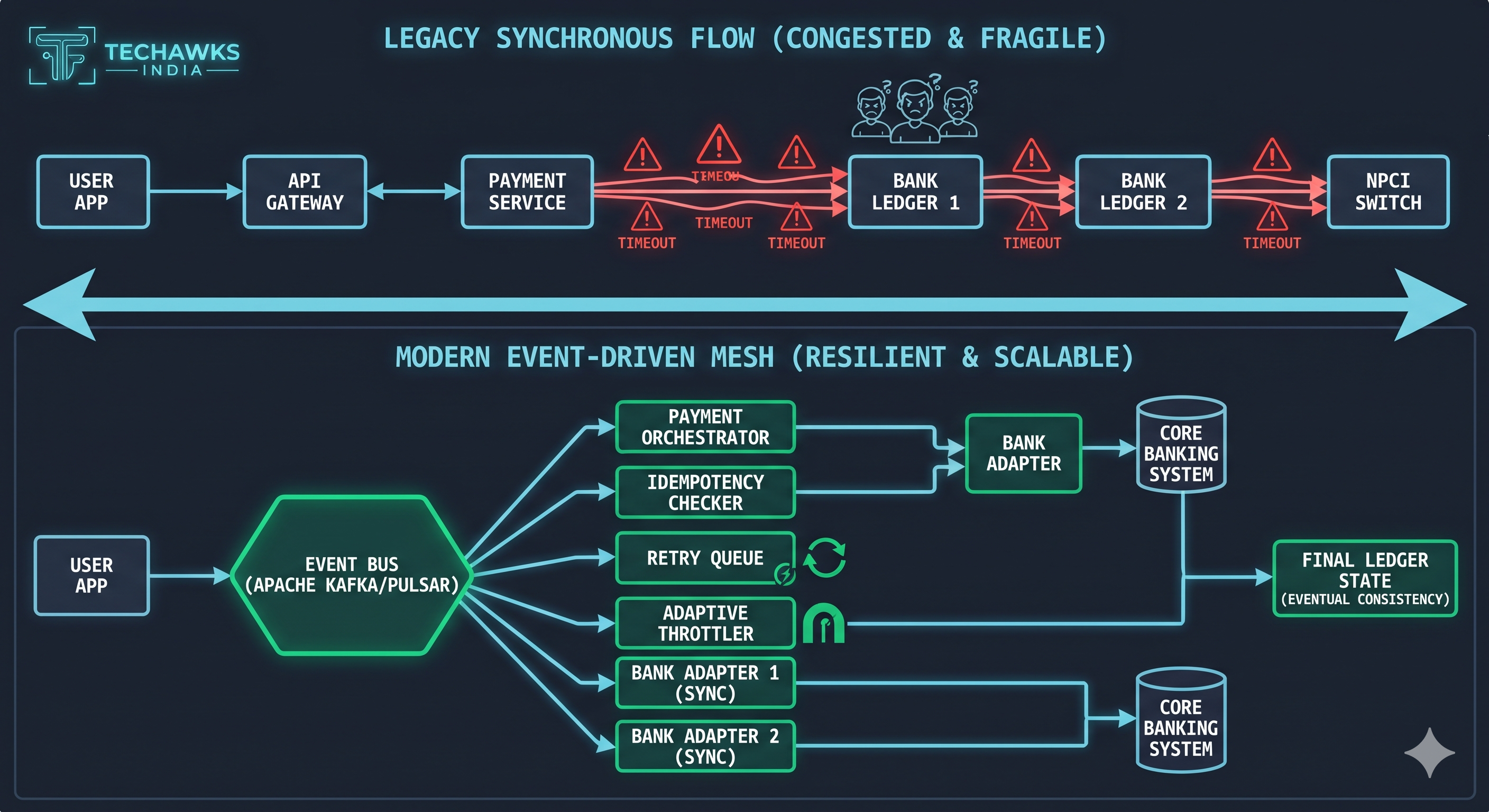
The challenge facing Indian fintech isn't just volume; it's the bursty nature of transactions during peak hours (think: salary day, cricket match over, or festival season). When millions of users attempt a transaction within the same second, a monolithic, synchronous architecture that waits for a bank's confirmation before updating the user interface will inevitably face timeouts and cascading database locks.
Success in this environment requires an architectural shift from Synchronous Coupling to Asynchronous Event Streaming and Idempotency.
Plaintext
[ User App ] ---1. Initiate Txn---> [ API Gateway ]
| |
+<--4. Acknowledge (Async) ---+ |
| |
+----------<--2. Publish Event--> [ Event Bus (Kafka/Pulsar) ]
|
|
+----------> [ Payment Processor ] ---> [ Core Banking System ]
| (Retry/Backoff)
[ Idempotent ] <--------+
[ Ledger ]
To build resilient, scalable payment rails for India, engineers must adopt these production-grade patterns:
Idempotency is Non-Negotiable: Every single service involved in the transaction must be designed to handle duplicate requests without changing the result beyond the initial application. A failed request followed by a retry must not double-debit the user.
Asynchronous Decoupling: Accept the transaction request instantly, place it on a durable event log (like Apache Kafka), and send an immediate acknowledgment to the user. The final settlement with the Core Banking System (CBS) happens in the background.
Eventual Consistency Models: The system must prioritize user experience and availability (CAP theorem's AP) during high load, accepting that the final ledger state might be reconciled milliseconds or seconds later, rather than in real-time.
Adaptive Throttling & Circuit Breaking: Implement intelligent rate limiting at the edge. If a specific bank's CBS starts timing out, the system must automatically open the circuit to that bank to prevent the entire UPI infrastructure from stalling.
Discussion Question
Which layer of the UPI stack do you believe is currently the most vulnerable to total failure during extreme peak load—the front-end gateway, the central NPCI switch, or the legacy Core Banking Systems of individual banks—and what is the single best architectural pattern to mitigate it?
CTA (Join Techawks India)
Deep dive into the architectural decisions shaping India’s digital future. Join the Techawks India community to discuss distributed systems, low-latency architecture, and how we scale for the next billion users. Link in bio.
The UPI Paradox: Why 99.99% Uptime Isn't Enough for India's Next Billion Transactions
The challenge facing Indian fintech isn't just volume; it's the bursty nature of transactions during peak hours (think: salary day, cricket match over, or festival season). When millions of users attempt a transaction within the same second, a monolithic, synchronous architecture that waits for a bank's confirmation before updating the user interface will inevitably face timeouts and cascading database locks.
Success in this environment requires an architectural shift from Synchronous Coupling to Asynchronous Event Streaming and Idempotency.
Plaintext
[ User App ] ---1. Initiate Txn---> [ API Gateway ]
| |
+<--4. Acknowledge (Async) ---+ |
| |
+----------<--2. Publish Event--> [ Event Bus (Kafka/Pulsar) ]
|
|
+----------> [ Payment Processor ] ---> [ Core Banking System ]
| (Retry/Backoff)
[ Idempotent ] <--------+
[ Ledger ]
To build resilient, scalable payment rails for India, engineers must adopt these production-grade patterns:
Idempotency is Non-Negotiable: Every single service involved in the transaction must be designed to handle duplicate requests without changing the result beyond the initial application. A failed request followed by a retry must not double-debit the user.
Asynchronous Decoupling: Accept the transaction request instantly, place it on a durable event log (like Apache Kafka), and send an immediate acknowledgment to the user. The final settlement with the Core Banking System (CBS) happens in the background.
Eventual Consistency Models: The system must prioritize user experience and availability (CAP theorem's AP) during high load, accepting that the final ledger state might be reconciled milliseconds or seconds later, rather than in real-time.
Adaptive Throttling & Circuit Breaking: Implement intelligent rate limiting at the edge. If a specific bank's CBS starts timing out, the system must automatically open the circuit to that bank to prevent the entire UPI infrastructure from stalling.
Discussion Question
Which layer of the UPI stack do you believe is currently the most vulnerable to total failure during extreme peak load—the front-end gateway, the central NPCI switch, or the legacy Core Banking Systems of individual banks—and what is the single best architectural pattern to mitigate it?
CTA (Join Techawks India)
Deep dive into the architectural decisions shaping India’s digital future. Join the Techawks India community to discuss distributed systems, low-latency architecture, and how we scale for the next billion users. Link in bio.

 Arabic
 French
 Spanish
 Portuguese
 Deutsch
 Turkish
 Dutch
 Italiano
 Russian
 Romaian
 Portuguese (Brazil)
 Greek