


The Sovereign Cloud Fallacy: Why Storing Data Locally Doesn't Mean Your Architecture is Secure
In high-growth digital ecosystems like the UAE, compliance regulations (such as the UAE PDPL) and national cloud security policies rightly emphasize data location, sovereignty, and strict privacy controls.
However, many engineering teams assume that hosting workloads in a local availability zone automatically guarantees compliance and resilience.
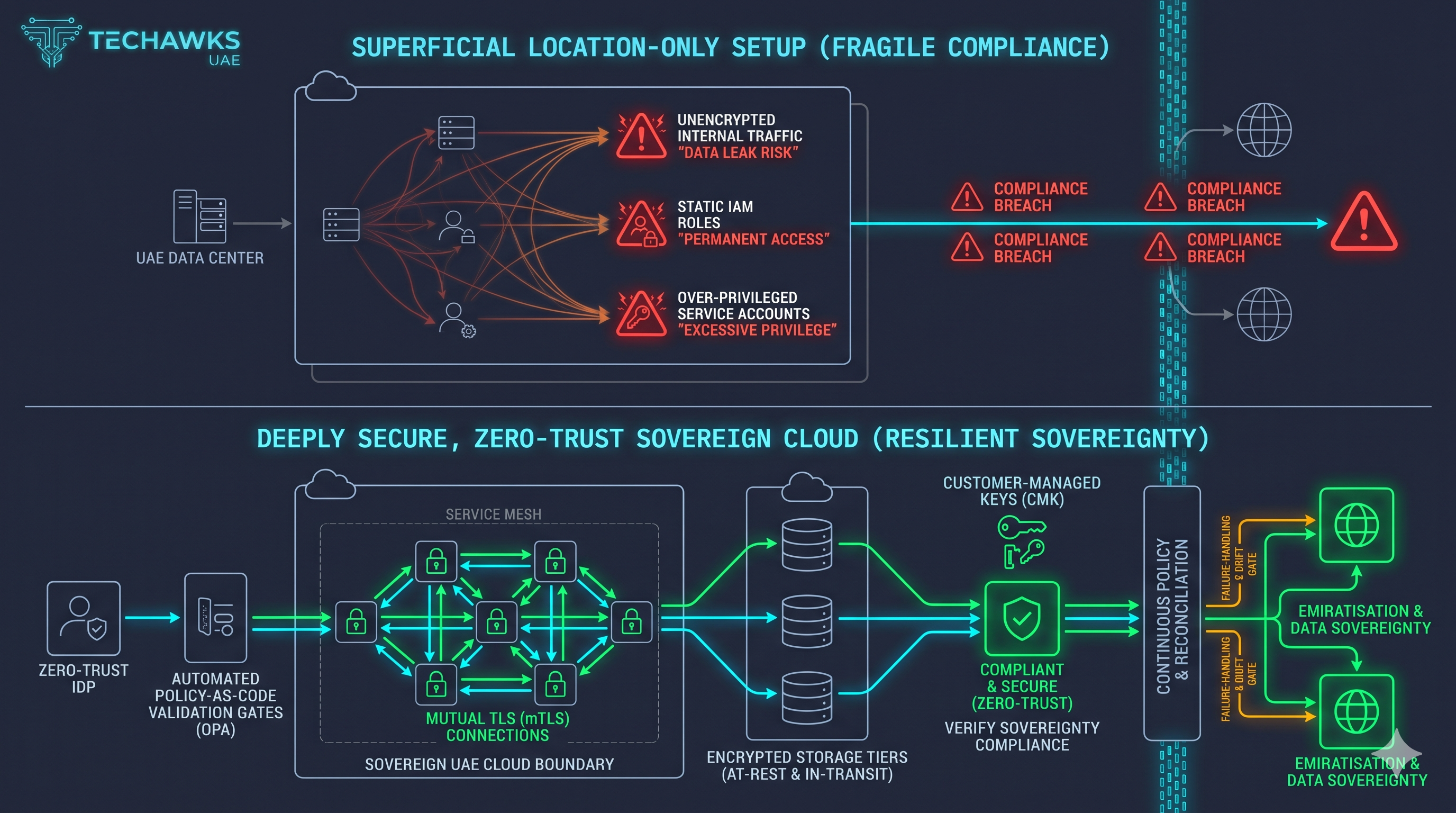
The reality is that data residency dictates where bits live, but architecture dictates whether those bits are secure. If your microservices rely on hardcoded credentials, unencrypted transit paths across internal VPCs, or over-privileged service accounts, a local perimeter won't stop lateral movement or data exfiltration.
Plaintext
[ Compliant Location ≠ Secure Architecture ]
+------------------------------------------+
| Local UAE Data Center (Region Locked) |
| [ Unencrypted Internal Traffic ] |
| [ Over-Privileged Service Accounts ] |
| [ Static IAM & Missing Token Scopes ] |
+------------------------------------------+
V
[ Vulnerable to Breach ]
To bridge the gap between regulatory compliance and true system resilience, engineering teams across the region must enforce these core practices:
Zero-Trust Internal Mesh: Never trust traffic simply because it originates inside a domestic data center or private cloud. Implement mutual TLS (mTLS) for all service-to-service communication.
Continuous Data Masking & Tokenization: Comply with privacy laws not just by locking down storage tiers, but by anonymizing and pseudonymizing sensitive personal data before it hits application logs or analytics pipelines.
Automated Policy-as-Code Guards: Use admission controllers to continuously enforce residency and security constraints (such as preventing accidental cross-border data replication or public S3 bucket configurations) at the pull-request stage.
Ephemeral Secrets Management: Eliminate static database passwords and hardcoded API tokens. Adopt dynamic secret injection with short-lived leases tied to cryptographic workload identities.
Discussion Question
Where has your team experienced friction between meeting strict data localization mandates and designing agile, multi-region or hybrid cloud architectures in the UAE?
CTA (Join Techawks UAE)
Engage with software architects, cloud engineers, and technical leaders shaping the future of secure, sovereign infrastructure across the UAE tech ecosystem. Join the Techawks UAE community to debate patterns and share production strategies. Link in bio.
In high-growth digital ecosystems like the UAE, compliance regulations (such as the UAE PDPL) and national cloud security policies rightly emphasize data location, sovereignty, and strict privacy controls.
However, many engineering teams assume that hosting workloads in a local availability zone automatically guarantees compliance and resilience.
The reality is that data residency dictates where bits live, but architecture dictates whether those bits are secure. If your microservices rely on hardcoded credentials, unencrypted transit paths across internal VPCs, or over-privileged service accounts, a local perimeter won't stop lateral movement or data exfiltration.
Plaintext
[ Compliant Location ≠ Secure Architecture ]
+------------------------------------------+
| Local UAE Data Center (Region Locked) |
| [ Unencrypted Internal Traffic ] |
| [ Over-Privileged Service Accounts ] |
| [ Static IAM & Missing Token Scopes ] |
+------------------------------------------+
V
[ Vulnerable to Breach ]
To bridge the gap between regulatory compliance and true system resilience, engineering teams across the region must enforce these core practices:
Zero-Trust Internal Mesh: Never trust traffic simply because it originates inside a domestic data center or private cloud. Implement mutual TLS (mTLS) for all service-to-service communication.
Continuous Data Masking & Tokenization: Comply with privacy laws not just by locking down storage tiers, but by anonymizing and pseudonymizing sensitive personal data before it hits application logs or analytics pipelines.
Automated Policy-as-Code Guards: Use admission controllers to continuously enforce residency and security constraints (such as preventing accidental cross-border data replication or public S3 bucket configurations) at the pull-request stage.
Ephemeral Secrets Management: Eliminate static database passwords and hardcoded API tokens. Adopt dynamic secret injection with short-lived leases tied to cryptographic workload identities.
Discussion Question
Where has your team experienced friction between meeting strict data localization mandates and designing agile, multi-region or hybrid cloud architectures in the UAE?
CTA (Join Techawks UAE)
Engage with software architects, cloud engineers, and technical leaders shaping the future of secure, sovereign infrastructure across the UAE tech ecosystem. Join the Techawks UAE community to debate patterns and share production strategies. Link in bio.
The Sovereign Cloud Fallacy: Why Storing Data Locally Doesn't Mean Your Architecture is Secure
In high-growth digital ecosystems like the UAE, compliance regulations (such as the UAE PDPL) and national cloud security policies rightly emphasize data location, sovereignty, and strict privacy controls.
However, many engineering teams assume that hosting workloads in a local availability zone automatically guarantees compliance and resilience.
The reality is that data residency dictates where bits live, but architecture dictates whether those bits are secure. If your microservices rely on hardcoded credentials, unencrypted transit paths across internal VPCs, or over-privileged service accounts, a local perimeter won't stop lateral movement or data exfiltration.
Plaintext
[ Compliant Location ≠ Secure Architecture ]
+------------------------------------------+
| Local UAE Data Center (Region Locked) |
| [ Unencrypted Internal Traffic ] |
| [ Over-Privileged Service Accounts ] |
| [ Static IAM & Missing Token Scopes ] |
+------------------------------------------+
V
[ Vulnerable to Breach ]
To bridge the gap between regulatory compliance and true system resilience, engineering teams across the region must enforce these core practices:
Zero-Trust Internal Mesh: Never trust traffic simply because it originates inside a domestic data center or private cloud. Implement mutual TLS (mTLS) for all service-to-service communication.
Continuous Data Masking & Tokenization: Comply with privacy laws not just by locking down storage tiers, but by anonymizing and pseudonymizing sensitive personal data before it hits application logs or analytics pipelines.
Automated Policy-as-Code Guards: Use admission controllers to continuously enforce residency and security constraints (such as preventing accidental cross-border data replication or public S3 bucket configurations) at the pull-request stage.
Ephemeral Secrets Management: Eliminate static database passwords and hardcoded API tokens. Adopt dynamic secret injection with short-lived leases tied to cryptographic workload identities.
Discussion Question
Where has your team experienced friction between meeting strict data localization mandates and designing agile, multi-region or hybrid cloud architectures in the UAE?
CTA (Join Techawks UAE)
Engage with software architects, cloud engineers, and technical leaders shaping the future of secure, sovereign infrastructure across the UAE tech ecosystem. Join the Techawks UAE community to debate patterns and share production strategies. Link in bio.

 Arabic
 French
 Spanish
 Portuguese
 Deutsch
 Turkish
 Dutch
 Italiano
 Russian
 Romaian
 Portuguese (Brazil)
 Greek