


The Canadian Cloud Sovereignty Blueprint: Navigating PIPEDA & ca-central-1 Compliance
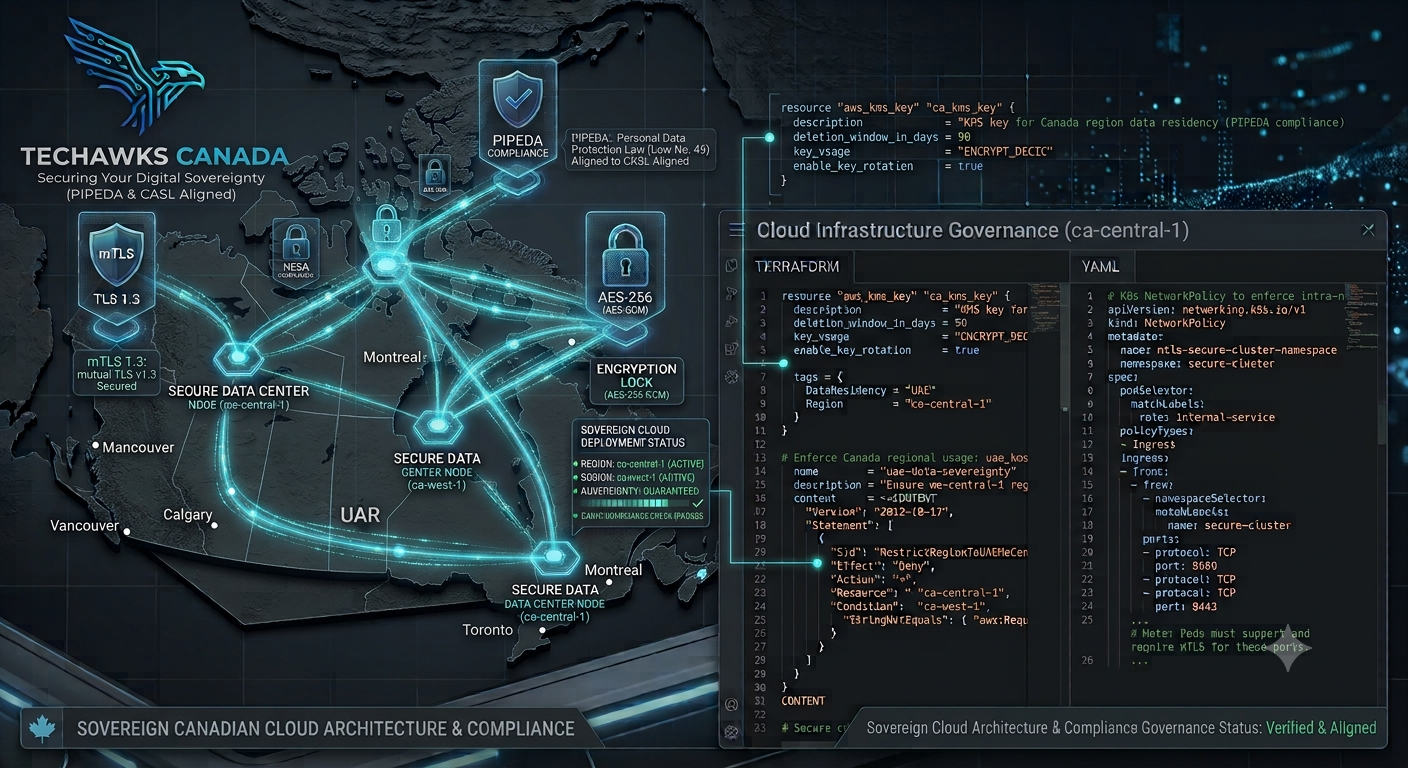
Under the Personal Information Protection and Electronic Documents Act (PIPEDA), Canadian organizations retain legal accountability for personal information regardless of where it travels or resides. While hosting workloads in local Canadian cloud regions ensures data residency, true data sovereignty demands strict access controls, localized key management, and automated guardrails.
Bookmark this 3-part architectural resource guide to keep your Canadian cloud infrastructure audit-ready:
1. Hard-Coded Ingress & Regional Boundary Controls
Eliminate unintended cross-border data leakage by embedding regional boundary constraints directly into your deployment pipeline.
Service Control Policies (SCPs): Configure organizational policies in your cloud environment to restrict resource creation exclusively to Canadian regions (ca-central-1 and ca-west-1).
IaC Static Analysis: Use static code scanners (such as tfsec or checkov) inside your CI/CD pipelines to ensure storage buckets (S3, Blob Storage) and database nodes cannot be provisioned outside approved Canadian endpoints.
2. Isolated KMS Key Management
Cryptographic controls must remain firmly under local governance to prevent foreign jurisdictional access from compromising sensitive data.
Customer Managed Keys (CMKs): Generate and manage KMS keys natively within local Canadian availability zones.
Automated Key Rotation: Hard-code automated key rotation parameters into your Infrastructure as Code (IaC) modules to satisfy data protection frameworks without operational burden.
3. Encrypted Transit and Cross-Region In-Country Resilience
PIPEDA demands strong safeguards for data in motion. Additionally, taking advantage of multi-region architecture within Canada provides resilience without crossing national borders.
In-Country Disaster Recovery: Replicate workloads between ca-central-1 and ca-west-1 for high availability and disaster recovery, ensuring failover mechanisms remain entirely within Canadian jurisdiction.
Intra-Cluster mTLS: Enforce Mutual TLS (mTLS) across microservices and pod-to-pod communications using a service mesh to guarantee end-to-end transport security.
Key Takeaways
Accountability over Geography: PIPEDA emphasizes organizational accountability and safeguard enforcement, making IAM and policy controls as crucial as server location.
In-Country Resilience: Leverage multi-region setups across ca-central-1 and ca-west-1 to maintain high availability while preserving data residency.
Automated Governance: Move compliance policies into your Terraform/YAML code to prevent configuration drift and guarantee audit readiness.
CTA
Are you migrating workloads or optimizing your cloud security posture in Canada? Join Techawks Canada to collaborate with local DevOps leaders, access sovereign cloud templates, and join the conversation.
👉 [Join Techawks Canada Community]
Under the Personal Information Protection and Electronic Documents Act (PIPEDA), Canadian organizations retain legal accountability for personal information regardless of where it travels or resides. While hosting workloads in local Canadian cloud regions ensures data residency, true data sovereignty demands strict access controls, localized key management, and automated guardrails.
Bookmark this 3-part architectural resource guide to keep your Canadian cloud infrastructure audit-ready:
1. Hard-Coded Ingress & Regional Boundary Controls
Eliminate unintended cross-border data leakage by embedding regional boundary constraints directly into your deployment pipeline.
Service Control Policies (SCPs): Configure organizational policies in your cloud environment to restrict resource creation exclusively to Canadian regions (ca-central-1 and ca-west-1).
IaC Static Analysis: Use static code scanners (such as tfsec or checkov) inside your CI/CD pipelines to ensure storage buckets (S3, Blob Storage) and database nodes cannot be provisioned outside approved Canadian endpoints.
2. Isolated KMS Key Management
Cryptographic controls must remain firmly under local governance to prevent foreign jurisdictional access from compromising sensitive data.
Customer Managed Keys (CMKs): Generate and manage KMS keys natively within local Canadian availability zones.
Automated Key Rotation: Hard-code automated key rotation parameters into your Infrastructure as Code (IaC) modules to satisfy data protection frameworks without operational burden.
3. Encrypted Transit and Cross-Region In-Country Resilience
PIPEDA demands strong safeguards for data in motion. Additionally, taking advantage of multi-region architecture within Canada provides resilience without crossing national borders.
In-Country Disaster Recovery: Replicate workloads between ca-central-1 and ca-west-1 for high availability and disaster recovery, ensuring failover mechanisms remain entirely within Canadian jurisdiction.
Intra-Cluster mTLS: Enforce Mutual TLS (mTLS) across microservices and pod-to-pod communications using a service mesh to guarantee end-to-end transport security.
Key Takeaways
Accountability over Geography: PIPEDA emphasizes organizational accountability and safeguard enforcement, making IAM and policy controls as crucial as server location.
In-Country Resilience: Leverage multi-region setups across ca-central-1 and ca-west-1 to maintain high availability while preserving data residency.
Automated Governance: Move compliance policies into your Terraform/YAML code to prevent configuration drift and guarantee audit readiness.
CTA
Are you migrating workloads or optimizing your cloud security posture in Canada? Join Techawks Canada to collaborate with local DevOps leaders, access sovereign cloud templates, and join the conversation.
👉 [Join Techawks Canada Community]
The Canadian Cloud Sovereignty Blueprint: Navigating PIPEDA & ca-central-1 Compliance
Under the Personal Information Protection and Electronic Documents Act (PIPEDA), Canadian organizations retain legal accountability for personal information regardless of where it travels or resides. While hosting workloads in local Canadian cloud regions ensures data residency, true data sovereignty demands strict access controls, localized key management, and automated guardrails.
Bookmark this 3-part architectural resource guide to keep your Canadian cloud infrastructure audit-ready:
1. Hard-Coded Ingress & Regional Boundary Controls
Eliminate unintended cross-border data leakage by embedding regional boundary constraints directly into your deployment pipeline.
Service Control Policies (SCPs): Configure organizational policies in your cloud environment to restrict resource creation exclusively to Canadian regions (ca-central-1 and ca-west-1).
IaC Static Analysis: Use static code scanners (such as tfsec or checkov) inside your CI/CD pipelines to ensure storage buckets (S3, Blob Storage) and database nodes cannot be provisioned outside approved Canadian endpoints.
2. Isolated KMS Key Management
Cryptographic controls must remain firmly under local governance to prevent foreign jurisdictional access from compromising sensitive data.
Customer Managed Keys (CMKs): Generate and manage KMS keys natively within local Canadian availability zones.
Automated Key Rotation: Hard-code automated key rotation parameters into your Infrastructure as Code (IaC) modules to satisfy data protection frameworks without operational burden.
3. Encrypted Transit and Cross-Region In-Country Resilience
PIPEDA demands strong safeguards for data in motion. Additionally, taking advantage of multi-region architecture within Canada provides resilience without crossing national borders.
In-Country Disaster Recovery: Replicate workloads between ca-central-1 and ca-west-1 for high availability and disaster recovery, ensuring failover mechanisms remain entirely within Canadian jurisdiction.
Intra-Cluster mTLS: Enforce Mutual TLS (mTLS) across microservices and pod-to-pod communications using a service mesh to guarantee end-to-end transport security.
Key Takeaways
Accountability over Geography: PIPEDA emphasizes organizational accountability and safeguard enforcement, making IAM and policy controls as crucial as server location.
In-Country Resilience: Leverage multi-region setups across ca-central-1 and ca-west-1 to maintain high availability while preserving data residency.
Automated Governance: Move compliance policies into your Terraform/YAML code to prevent configuration drift and guarantee audit readiness.
CTA
Are you migrating workloads or optimizing your cloud security posture in Canada? Join Techawks Canada to collaborate with local DevOps leaders, access sovereign cloud templates, and join the conversation.
👉 [Join Techawks Canada Community]

 English
 Arabic
 French
 Spanish
 Portuguese
 Deutsch
 Turkish
 Dutch
Dutch
 Italiano
 Romaian
 Portuguese (Brazil)
 Greek
Greek