


Mastering "India Stack": Why the ONDC Protocol is the Final Boss for Indian E-Commerce
The Problem: The Walled Garden
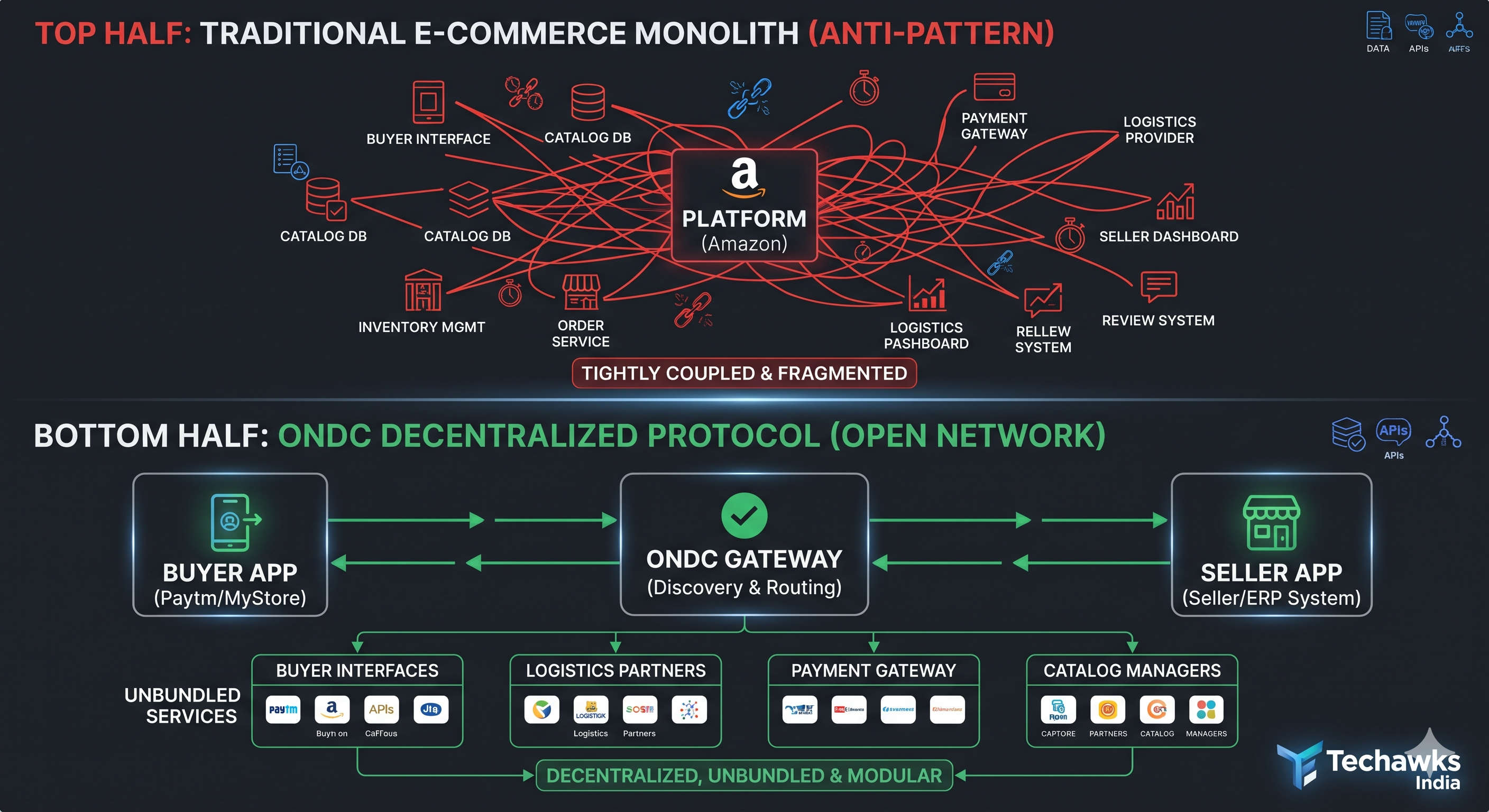
Traditional e-commerce (Amazon, Flipkart) operates as a "walled garden." As a seller, you are locked into their catalog system, their logistics, and their payment gateway. As a buyer, your data is trapped within their ecosystem. This creates high barriers to entry for small Kirana stores and limits innovation.
The Solution: The ONDC Unbundling
ONDC, built on the Beckn protocol, uses a decentralized, gateway-based architecture. It separates the buyer's interface (Buyer App) from the seller's inventory (Seller App).
The ONDC Workflow (Simplified):
Plaintext
[ BUYER (Paytm/MyStore) ]
│
▼
[ ONDC GATEWAY (Discovery & Routing) ]
│
▼
[ SELLER (Seller App/ERP System) ]
When a user searches for "shoes" on a buyer app:
The Gateway broadcasts the intent to all connected Seller Apps.
Seller Apps respond with catalog availability and pricing.
The Gateway presents the aggregated results to the user.
The transaction (Order, Fulfillment, Payment) happens directly between Buyer App and Seller App.
4 Actionable Principles for Developing on ONDC:
Adopt the Beckn Protocol: ONDC is not a monolith; it's a set of APIs based on Beckn. Study the specifications (Search, Select, Init, Confirm, Status, Update) to understand how state is managed across disparate systems.
Implement Stateless Gateways: Your Seller App must be designed to handle discovery requests from the Gateway without maintaining a persistent session. The protocol uses asynchronous messaging (webhooks) for fulfillment updates.
Master Catalog Synchronization: As a seller-side developer, your biggest challenge is real-time inventory sync. Your backend must be able to "publish" catalog updates (using the on_search API) to the ONDC network instantly.
Ensure Trust and Compliance: Every participant must have a valid digital signature (PKI) to interact on the network. Security and non-repudiation are enforced at the protocol level, not by a central authority.
Discussion Question
ONDC aims to level the playing field, but it introduces massive complexity in distributed transaction management (Sagas). If an order is confirmed on the Buyer App but the payment fails on the Seller App, who holds the state? Have you faced this "distributed system headache" while building an ONDC-compliant application?
CTA
Join Techawks India
Are you building the future of Indian e-commerce on ONDC? Share your architectural diagrams, your integration war stories, and your solutions to the "state problem" below, and join the most authoritative community for Indian tech professionals at Techawks India!
Mastering "India Stack": Why the ONDC Protocol is the Final Boss for Indian E-Commerce
The Problem: The Walled Garden
Traditional e-commerce (Amazon, Flipkart) operates as a "walled garden." As a seller, you are locked into their catalog system, their logistics, and their payment gateway. As a buyer, your data is trapped within their ecosystem. This creates high barriers to entry for small Kirana stores and limits innovation.
The Solution: The ONDC Unbundling
ONDC, built on the Beckn protocol, uses a decentralized, gateway-based architecture. It separates the buyer's interface (Buyer App) from the seller's inventory (Seller App).
The ONDC Workflow (Simplified):
Plaintext
[ BUYER (Paytm/MyStore) ]
│
▼
[ ONDC GATEWAY (Discovery & Routing) ]
│
▼
[ SELLER (Seller App/ERP System) ]
When a user searches for "shoes" on a buyer app:
The Gateway broadcasts the intent to all connected Seller Apps.
Seller Apps respond with catalog availability and pricing.
The Gateway presents the aggregated results to the user.
The transaction (Order, Fulfillment, Payment) happens directly between Buyer App and Seller App.
4 Actionable Principles for Developing on ONDC:
Adopt the Beckn Protocol: ONDC is not a monolith; it's a set of APIs based on Beckn. Study the specifications (Search, Select, Init, Confirm, Status, Update) to understand how state is managed across disparate systems.
Implement Stateless Gateways: Your Seller App must be designed to handle discovery requests from the Gateway without maintaining a persistent session. The protocol uses asynchronous messaging (webhooks) for fulfillment updates.
Master Catalog Synchronization: As a seller-side developer, your biggest challenge is real-time inventory sync. Your backend must be able to "publish" catalog updates (using the on_search API) to the ONDC network instantly.
Ensure Trust and Compliance: Every participant must have a valid digital signature (PKI) to interact on the network. Security and non-repudiation are enforced at the protocol level, not by a central authority.
Discussion Question
ONDC aims to level the playing field, but it introduces massive complexity in distributed transaction management (Sagas). If an order is confirmed on the Buyer App but the payment fails on the Seller App, who holds the state? Have you faced this "distributed system headache" while building an ONDC-compliant application?
CTA
Join Techawks India
Are you building the future of Indian e-commerce on ONDC? Share your architectural diagrams, your integration war stories, and your solutions to the "state problem" below, and join the most authoritative community for Indian tech professionals at Techawks India!

 English
 Arabic
 French
 Spanish
 Portuguese
 Deutsch
 Turkish
 Italiano
 Russian
 Romaian
 Portuguese (Brazil)
 Greek