


How to Structure Your Software Engineering Resume to Pass ATS Scanners and Land Interviews
Tech recruiters spend an average of six seconds scanning a resume before deciding whether to move forward or reject an applicant. To stand out in a competitive job market, your resume needs to balance machine readability (ATS optimization) with compelling human storytelling.
Follow this four-step blueprint to transform your resume into an interview-generating machine:
Step 1: Format for Uncompromising Machine Readability
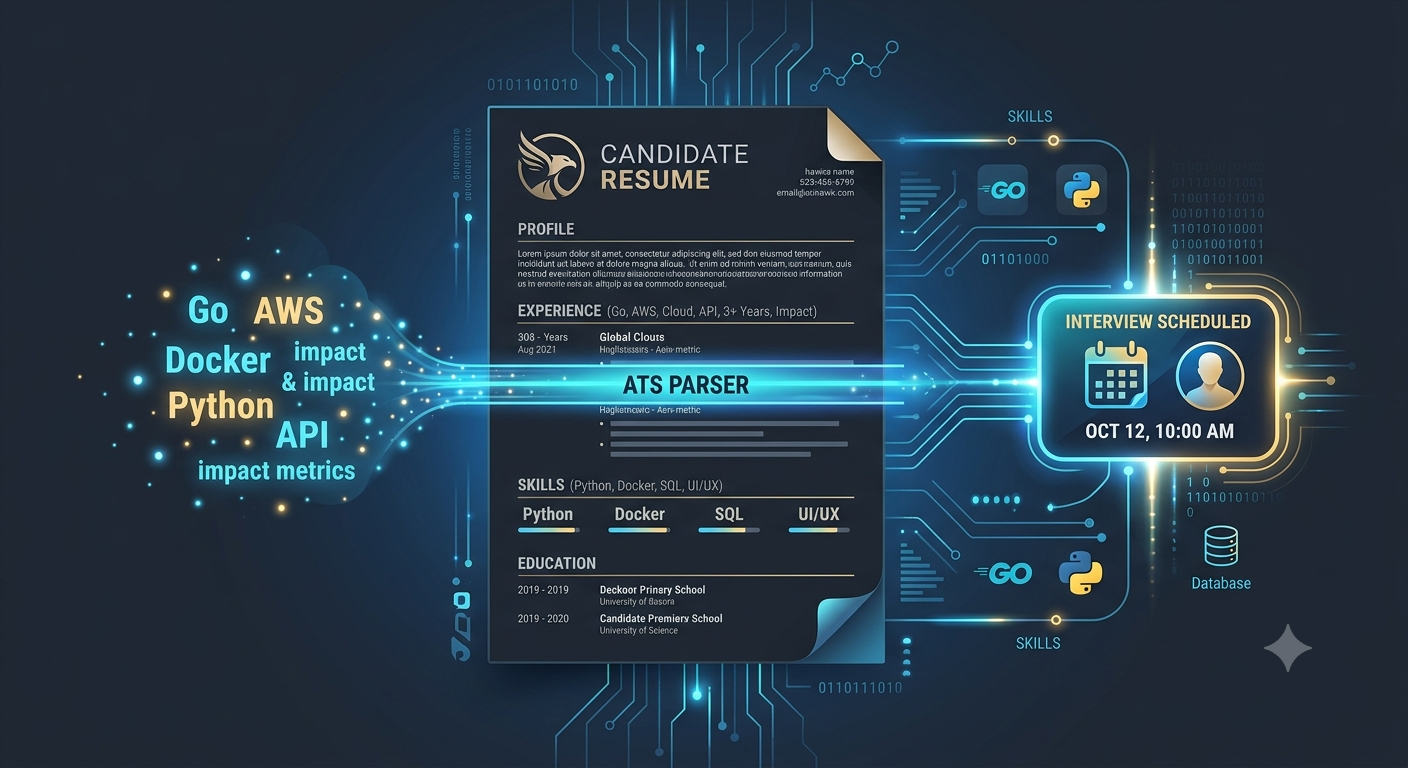
Applicant Tracking Systems parse text top-to-bottom, left-to-right. Complex multi-column layouts, graphics, icons, and text boxes often cause parsing errors that lead to automatic rejections.
Action: Stick to a clean, single-column layout using standard headings (Work Experience, Projects, Skills, Education). Export as a PDF or standard .docx unless specified otherwise, and ensure all text can be highlighted and copied.
Step 2: Structure Experience Bullets Using the XYZ Formula
Avoid listing job responsibilities like a task description (e.g., "Responsible for writing API endpoints"). Instead, use Google's proven XYZ Formula:
"Accomplished [X], as measured by [Y], by doing [Z]."
Action: Rewrite every experience bullet to lead with a strong action verb, quantify the business or technical outcome, and explain the tools used.
Before: Built microservices in Go.
After: Architected 4 backend microservices in Go, reducing API latency by 35% and supporting 100K+ daily active users.
Step 3: Strategically Integrate Relevant Technical Skills
Stuffing a block of 50 keywords at the bottom of your resume flags your application as spam. Instead, tailor your skill sections to align directly with the target job description.
Action: Group your technical stack into clear sub-categories (e.g., Languages, Frameworks, Cloud & DevOps, Database & Tools). Mention core technologies within your experience bullet points to demonstrate practical application, not just theoretical knowledge.
Step 4: Highlight Impact-Driven Side Projects (For Early/Mid-Career)
If you lack years of enterprise experience, production-ready side projects prove your capability better than any generic degree or certificate.
Action: Include a dedicated Projects section featuring 2–3 high-quality builds. Provide a direct GitHub link, live deployment link, a brief summary of the technical challenge solved, and the exact stack utilized.
Key Takeaways
Quantify Everything: Numbers prove impact—use metrics like latency reduction, performance boosts, cost savings, or user adoption rates.
Keep it Scannable: Use a clean single-column structure that passes both ATS parsers and six-second human scans.
Show, Don't Just Tell: Anchor your technical skills within real project outcomes rather than listing standalone buzzwords.
CTA
Ready to land your next high-impact tech role? Connect with talent acquisition specialists, engineering managers, and fellow tech professionals sharing insider referral codes, interview tips, and active openings. Join the Tech Jobs & Opportunities Community today!
Tech recruiters spend an average of six seconds scanning a resume before deciding whether to move forward or reject an applicant. To stand out in a competitive job market, your resume needs to balance machine readability (ATS optimization) with compelling human storytelling.
Follow this four-step blueprint to transform your resume into an interview-generating machine:
Step 1: Format for Uncompromising Machine Readability
Applicant Tracking Systems parse text top-to-bottom, left-to-right. Complex multi-column layouts, graphics, icons, and text boxes often cause parsing errors that lead to automatic rejections.
Action: Stick to a clean, single-column layout using standard headings (Work Experience, Projects, Skills, Education). Export as a PDF or standard .docx unless specified otherwise, and ensure all text can be highlighted and copied.
Step 2: Structure Experience Bullets Using the XYZ Formula
Avoid listing job responsibilities like a task description (e.g., "Responsible for writing API endpoints"). Instead, use Google's proven XYZ Formula:
"Accomplished [X], as measured by [Y], by doing [Z]."
Action: Rewrite every experience bullet to lead with a strong action verb, quantify the business or technical outcome, and explain the tools used.
Before: Built microservices in Go.
After: Architected 4 backend microservices in Go, reducing API latency by 35% and supporting 100K+ daily active users.
Step 3: Strategically Integrate Relevant Technical Skills
Stuffing a block of 50 keywords at the bottom of your resume flags your application as spam. Instead, tailor your skill sections to align directly with the target job description.
Action: Group your technical stack into clear sub-categories (e.g., Languages, Frameworks, Cloud & DevOps, Database & Tools). Mention core technologies within your experience bullet points to demonstrate practical application, not just theoretical knowledge.
Step 4: Highlight Impact-Driven Side Projects (For Early/Mid-Career)
If you lack years of enterprise experience, production-ready side projects prove your capability better than any generic degree or certificate.
Action: Include a dedicated Projects section featuring 2–3 high-quality builds. Provide a direct GitHub link, live deployment link, a brief summary of the technical challenge solved, and the exact stack utilized.
Key Takeaways
Quantify Everything: Numbers prove impact—use metrics like latency reduction, performance boosts, cost savings, or user adoption rates.
Keep it Scannable: Use a clean single-column structure that passes both ATS parsers and six-second human scans.
Show, Don't Just Tell: Anchor your technical skills within real project outcomes rather than listing standalone buzzwords.
CTA
Ready to land your next high-impact tech role? Connect with talent acquisition specialists, engineering managers, and fellow tech professionals sharing insider referral codes, interview tips, and active openings. Join the Tech Jobs & Opportunities Community today!
How to Structure Your Software Engineering Resume to Pass ATS Scanners and Land Interviews
Tech recruiters spend an average of six seconds scanning a resume before deciding whether to move forward or reject an applicant. To stand out in a competitive job market, your resume needs to balance machine readability (ATS optimization) with compelling human storytelling.
Follow this four-step blueprint to transform your resume into an interview-generating machine:
Step 1: Format for Uncompromising Machine Readability
Applicant Tracking Systems parse text top-to-bottom, left-to-right. Complex multi-column layouts, graphics, icons, and text boxes often cause parsing errors that lead to automatic rejections.
Action: Stick to a clean, single-column layout using standard headings (Work Experience, Projects, Skills, Education). Export as a PDF or standard .docx unless specified otherwise, and ensure all text can be highlighted and copied.
Step 2: Structure Experience Bullets Using the XYZ Formula
Avoid listing job responsibilities like a task description (e.g., "Responsible for writing API endpoints"). Instead, use Google's proven XYZ Formula:
"Accomplished [X], as measured by [Y], by doing [Z]."
Action: Rewrite every experience bullet to lead with a strong action verb, quantify the business or technical outcome, and explain the tools used.
Before: Built microservices in Go.
After: Architected 4 backend microservices in Go, reducing API latency by 35% and supporting 100K+ daily active users.
Step 3: Strategically Integrate Relevant Technical Skills
Stuffing a block of 50 keywords at the bottom of your resume flags your application as spam. Instead, tailor your skill sections to align directly with the target job description.
Action: Group your technical stack into clear sub-categories (e.g., Languages, Frameworks, Cloud & DevOps, Database & Tools). Mention core technologies within your experience bullet points to demonstrate practical application, not just theoretical knowledge.
Step 4: Highlight Impact-Driven Side Projects (For Early/Mid-Career)
If you lack years of enterprise experience, production-ready side projects prove your capability better than any generic degree or certificate.
Action: Include a dedicated Projects section featuring 2–3 high-quality builds. Provide a direct GitHub link, live deployment link, a brief summary of the technical challenge solved, and the exact stack utilized.
Key Takeaways
Quantify Everything: Numbers prove impact—use metrics like latency reduction, performance boosts, cost savings, or user adoption rates.
Keep it Scannable: Use a clean single-column structure that passes both ATS parsers and six-second human scans.
Show, Don't Just Tell: Anchor your technical skills within real project outcomes rather than listing standalone buzzwords.
CTA
Ready to land your next high-impact tech role? Connect with talent acquisition specialists, engineering managers, and fellow tech professionals sharing insider referral codes, interview tips, and active openings. Join the Tech Jobs & Opportunities Community today!

 English
 Arabic
 French
 Portuguese
 Deutsch
 Turkish
 Dutch
Dutch
 Italiano
 Russian
 Romaian
 Portuguese (Brazil)
 Greek
Greek