


The US Cloud Security & Compliance Audit Checklist
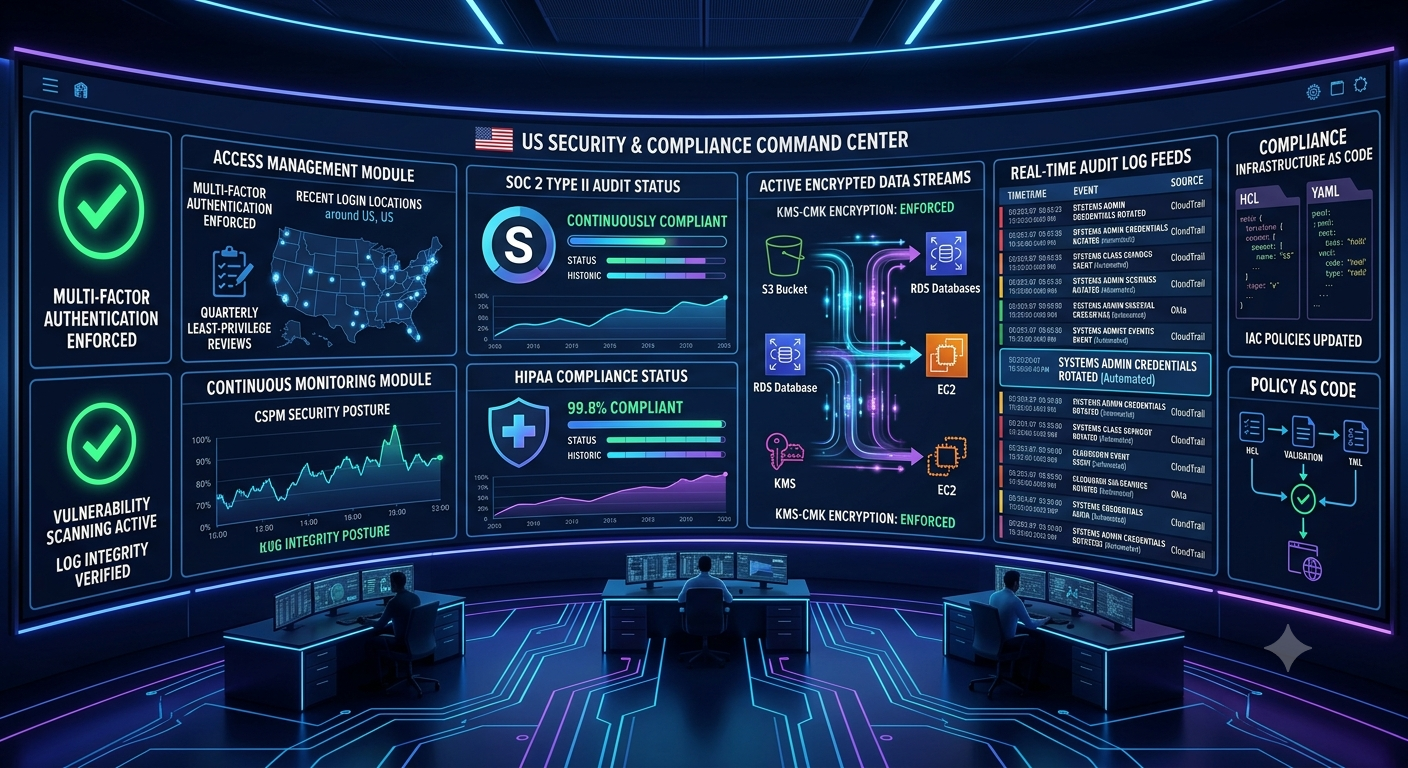
Preparing for an enterprise security audit can quickly derail engineering roadmaps if compliance isn't baked directly into your infrastructure as code (IaC).
Run through this checklist to ensure your AWS, Azure, or GCP environments meet foundational US security and regulatory baselines.
1. Access Control & Identity Management (SOC 2 CC6.1)
[ ] Enforce Centralized IdP & SSO: Mandate Single Sign-On (e.g., Okta, Azure AD) with hardware-backed Multi-Factor Authentication (MFA) for all IAM users.
[ ] Eliminate Static Long-Lived Credentials: Mandate short-lived, role-based temporary credentials (e.g., AWS STS, Workload Identity Federation) for both human operators and automated pipelines.
[ ] Conduct Quarterly Least-Privilege Reviews: Audit IAM policies regularly to purge inactive accounts, unused permissions, and overly permissive wildcard (*) access.
2. Data Protection & Encryption (SOC 2 CC6.6 / HIPAA)
[ ] Encrypt Data at Rest Everywhere: Enforce default KMS encryption using customer-managed keys (CMK) across all object storage buckets, managed databases, and EBS volumes.
[ ] Enforce TLS 1.3 for Data in Transit: Disable legacy protocols (TLS 1.0/1.1) across all public load balancers and internal service meshes.
[ ] Automate Sensitive Data Scanning: Deploy continuous data classification tools (e.g., AWS Macie) to detect unencrypted PII, PHI, or secrets in storage buckets and application logs.
3. Continuous Monitoring & Audit Logging (SOC 2 CC7.2)
[ ] Enable Immutable Audit Trail: Centralize AWS CloudTrail / GCP Audit Logs in a dedicated, tamper-proof, read-only security account with log file validation enabled.
[ ] Automate Security Posture Management (CSPM): Continuously scan cloud configurations against CIS Benchmarks to automatically flag misconfigurations (e.g., public S3 buckets).
[ ] Establish Incident Response SLA Alerts: Route high-severity security alerts (e.g., root account login, unauthorized IAM policy modification) directly to PagerDuty or your SOC team within 5 minutes.
Key Takeaways
Compliance as Infrastructure: Treat compliance controls as code (IaC) to prevent configuration drift between audit cycles.
Immutable Logging: Ensure audit trails are stored in an isolated, tamper-proof cloud account to maintain integrity during third-party reviews.
Zero Long-Lived Keys: Relying on automated identity federation significantly reduces your attack surface and satisfies stringent access control requirements.
CTA
Join Techawks USA to connect with US cloud architects, explore modern enterprise security standards, and stay ahead in cloud-native engineering.
Preparing for an enterprise security audit can quickly derail engineering roadmaps if compliance isn't baked directly into your infrastructure as code (IaC).
Run through this checklist to ensure your AWS, Azure, or GCP environments meet foundational US security and regulatory baselines.
1. Access Control & Identity Management (SOC 2 CC6.1)
[ ] Enforce Centralized IdP & SSO: Mandate Single Sign-On (e.g., Okta, Azure AD) with hardware-backed Multi-Factor Authentication (MFA) for all IAM users.
[ ] Eliminate Static Long-Lived Credentials: Mandate short-lived, role-based temporary credentials (e.g., AWS STS, Workload Identity Federation) for both human operators and automated pipelines.
[ ] Conduct Quarterly Least-Privilege Reviews: Audit IAM policies regularly to purge inactive accounts, unused permissions, and overly permissive wildcard (*) access.
2. Data Protection & Encryption (SOC 2 CC6.6 / HIPAA)
[ ] Encrypt Data at Rest Everywhere: Enforce default KMS encryption using customer-managed keys (CMK) across all object storage buckets, managed databases, and EBS volumes.
[ ] Enforce TLS 1.3 for Data in Transit: Disable legacy protocols (TLS 1.0/1.1) across all public load balancers and internal service meshes.
[ ] Automate Sensitive Data Scanning: Deploy continuous data classification tools (e.g., AWS Macie) to detect unencrypted PII, PHI, or secrets in storage buckets and application logs.
3. Continuous Monitoring & Audit Logging (SOC 2 CC7.2)
[ ] Enable Immutable Audit Trail: Centralize AWS CloudTrail / GCP Audit Logs in a dedicated, tamper-proof, read-only security account with log file validation enabled.
[ ] Automate Security Posture Management (CSPM): Continuously scan cloud configurations against CIS Benchmarks to automatically flag misconfigurations (e.g., public S3 buckets).
[ ] Establish Incident Response SLA Alerts: Route high-severity security alerts (e.g., root account login, unauthorized IAM policy modification) directly to PagerDuty or your SOC team within 5 minutes.
Key Takeaways
Compliance as Infrastructure: Treat compliance controls as code (IaC) to prevent configuration drift between audit cycles.
Immutable Logging: Ensure audit trails are stored in an isolated, tamper-proof cloud account to maintain integrity during third-party reviews.
Zero Long-Lived Keys: Relying on automated identity federation significantly reduces your attack surface and satisfies stringent access control requirements.
CTA
Join Techawks USA to connect with US cloud architects, explore modern enterprise security standards, and stay ahead in cloud-native engineering.
The US Cloud Security & Compliance Audit Checklist
Preparing for an enterprise security audit can quickly derail engineering roadmaps if compliance isn't baked directly into your infrastructure as code (IaC).
Run through this checklist to ensure your AWS, Azure, or GCP environments meet foundational US security and regulatory baselines.
1. Access Control & Identity Management (SOC 2 CC6.1)
[ ] Enforce Centralized IdP & SSO: Mandate Single Sign-On (e.g., Okta, Azure AD) with hardware-backed Multi-Factor Authentication (MFA) for all IAM users.
[ ] Eliminate Static Long-Lived Credentials: Mandate short-lived, role-based temporary credentials (e.g., AWS STS, Workload Identity Federation) for both human operators and automated pipelines.
[ ] Conduct Quarterly Least-Privilege Reviews: Audit IAM policies regularly to purge inactive accounts, unused permissions, and overly permissive wildcard (*) access.
2. Data Protection & Encryption (SOC 2 CC6.6 / HIPAA)
[ ] Encrypt Data at Rest Everywhere: Enforce default KMS encryption using customer-managed keys (CMK) across all object storage buckets, managed databases, and EBS volumes.
[ ] Enforce TLS 1.3 for Data in Transit: Disable legacy protocols (TLS 1.0/1.1) across all public load balancers and internal service meshes.
[ ] Automate Sensitive Data Scanning: Deploy continuous data classification tools (e.g., AWS Macie) to detect unencrypted PII, PHI, or secrets in storage buckets and application logs.
3. Continuous Monitoring & Audit Logging (SOC 2 CC7.2)
[ ] Enable Immutable Audit Trail: Centralize AWS CloudTrail / GCP Audit Logs in a dedicated, tamper-proof, read-only security account with log file validation enabled.
[ ] Automate Security Posture Management (CSPM): Continuously scan cloud configurations against CIS Benchmarks to automatically flag misconfigurations (e.g., public S3 buckets).
[ ] Establish Incident Response SLA Alerts: Route high-severity security alerts (e.g., root account login, unauthorized IAM policy modification) directly to PagerDuty or your SOC team within 5 minutes.
Key Takeaways
Compliance as Infrastructure: Treat compliance controls as code (IaC) to prevent configuration drift between audit cycles.
Immutable Logging: Ensure audit trails are stored in an isolated, tamper-proof cloud account to maintain integrity during third-party reviews.
Zero Long-Lived Keys: Relying on automated identity federation significantly reduces your attack surface and satisfies stringent access control requirements.
CTA
Join Techawks USA to connect with US cloud architects, explore modern enterprise security standards, and stay ahead in cloud-native engineering.

 English
 Arabic
 French
 Spanish
 Portuguese
 Deutsch
 Turkish
 Dutch
Dutch
 Russian
 Romaian
 Portuguese (Brazil)
 Greek
Greek