


The UK Enterprise Cloud Architecture & Sovereignty Checklist
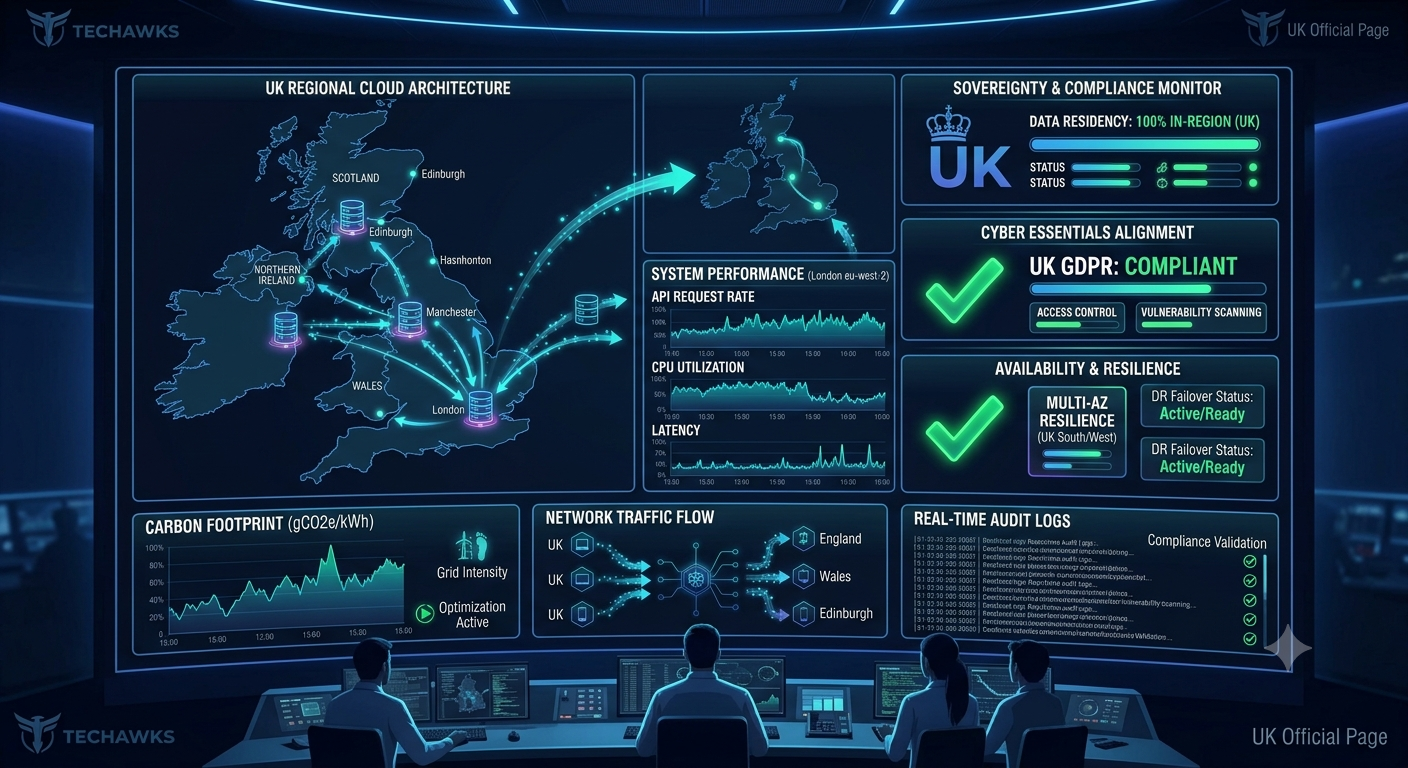
Designing production cloud systems for the UK market demands balancing data residency, strict regulatory compliance, and sustainable computing practices.
Before deploying new workloads or migrating legacy services, review your setup against this enterprise readiness checklist.
1. Data Residency & UK GDPR Alignment
[ ] In-Region Primary Storage: Ensure all customer PII, database backups, and object storage buckets reside strictly within UK cloud regions (e.g., AWS eu-west-2 London, Azure UK South/West).
[ ] Automated Data Subject Right Flows: Implement automated workflows to satisfy "Right to be Forgotten" (Article 17) and Data Subject Access Requests (DSARs) across primary and secondary storage layers.
[ ] Strict Cross-Border Safeguards: Enforce policy-as-code checks to prevent unauthorized egress of personal data to non-adequate third-country jurisdictions.
2. Security Controls & Cyber Essentials Alignment
[ ] Boundary Protection & Firewalls: Lock down public endpoints using Web Application Firewalls (WAF) and strictly limit administrative access (SSH/RDP) via secure bastions or direct identity proxies.
[ ] Zero-Trust Access Management: Enforce hardware MFA, Single Sign-On (SSO), and role-based access control (RBAC) across all cloud environments and developer tools.
[ ] Continuous Vulnerability Patching: Establish automated pipelines to scan container images and OS dependencies, applying critical security patches within defined SLA windows.
3. Sustainability & Operational Resilience
[ ] Carbon Footprint Tracking: Integrate cloud provider sustainability tools (e.g., AWS Customer Carbon Footprint Tool, Azure Sustainability Manager) to measure and optimize grid-carbon intensity.
[ ] Multi-Zone High Availability: Distribute critical workloads across multiple Availability Zones in the UK to ensure continuity during localized datacenter outages.
[ ] Automated Disaster Recovery (DR): Validate Recovery Time Objectives (RTO) and Recovery Point Objectives (RPO) with regular failover simulations into secondary resilient UK or EEA regions.
Key Takeaways
Locate Your Data: Enforce explicit regional constraints (eu-west-2) across all cloud services handling UK resident data.
Automate Compliance Workflows: Build DSAR and data deletion pipelines directly into your microservices architecture rather than treating them as manual processes.
Measure Environmental Impact: Optimizing resource usage directly reduces both cloud spend and overall carbon footprint.
CTA
Join Techawks UK to connect with UK technology leaders, master cloud architecture, and build compliant, world-class software systems.
Designing production cloud systems for the UK market demands balancing data residency, strict regulatory compliance, and sustainable computing practices.
Before deploying new workloads or migrating legacy services, review your setup against this enterprise readiness checklist.
1. Data Residency & UK GDPR Alignment
[ ] In-Region Primary Storage: Ensure all customer PII, database backups, and object storage buckets reside strictly within UK cloud regions (e.g., AWS eu-west-2 London, Azure UK South/West).
[ ] Automated Data Subject Right Flows: Implement automated workflows to satisfy "Right to be Forgotten" (Article 17) and Data Subject Access Requests (DSARs) across primary and secondary storage layers.
[ ] Strict Cross-Border Safeguards: Enforce policy-as-code checks to prevent unauthorized egress of personal data to non-adequate third-country jurisdictions.
2. Security Controls & Cyber Essentials Alignment
[ ] Boundary Protection & Firewalls: Lock down public endpoints using Web Application Firewalls (WAF) and strictly limit administrative access (SSH/RDP) via secure bastions or direct identity proxies.
[ ] Zero-Trust Access Management: Enforce hardware MFA, Single Sign-On (SSO), and role-based access control (RBAC) across all cloud environments and developer tools.
[ ] Continuous Vulnerability Patching: Establish automated pipelines to scan container images and OS dependencies, applying critical security patches within defined SLA windows.
3. Sustainability & Operational Resilience
[ ] Carbon Footprint Tracking: Integrate cloud provider sustainability tools (e.g., AWS Customer Carbon Footprint Tool, Azure Sustainability Manager) to measure and optimize grid-carbon intensity.
[ ] Multi-Zone High Availability: Distribute critical workloads across multiple Availability Zones in the UK to ensure continuity during localized datacenter outages.
[ ] Automated Disaster Recovery (DR): Validate Recovery Time Objectives (RTO) and Recovery Point Objectives (RPO) with regular failover simulations into secondary resilient UK or EEA regions.
Key Takeaways
Locate Your Data: Enforce explicit regional constraints (eu-west-2) across all cloud services handling UK resident data.
Automate Compliance Workflows: Build DSAR and data deletion pipelines directly into your microservices architecture rather than treating them as manual processes.
Measure Environmental Impact: Optimizing resource usage directly reduces both cloud spend and overall carbon footprint.
CTA
Join Techawks UK to connect with UK technology leaders, master cloud architecture, and build compliant, world-class software systems.
The UK Enterprise Cloud Architecture & Sovereignty Checklist
Designing production cloud systems for the UK market demands balancing data residency, strict regulatory compliance, and sustainable computing practices.
Before deploying new workloads or migrating legacy services, review your setup against this enterprise readiness checklist.
1. Data Residency & UK GDPR Alignment
[ ] In-Region Primary Storage: Ensure all customer PII, database backups, and object storage buckets reside strictly within UK cloud regions (e.g., AWS eu-west-2 London, Azure UK South/West).
[ ] Automated Data Subject Right Flows: Implement automated workflows to satisfy "Right to be Forgotten" (Article 17) and Data Subject Access Requests (DSARs) across primary and secondary storage layers.
[ ] Strict Cross-Border Safeguards: Enforce policy-as-code checks to prevent unauthorized egress of personal data to non-adequate third-country jurisdictions.
2. Security Controls & Cyber Essentials Alignment
[ ] Boundary Protection & Firewalls: Lock down public endpoints using Web Application Firewalls (WAF) and strictly limit administrative access (SSH/RDP) via secure bastions or direct identity proxies.
[ ] Zero-Trust Access Management: Enforce hardware MFA, Single Sign-On (SSO), and role-based access control (RBAC) across all cloud environments and developer tools.
[ ] Continuous Vulnerability Patching: Establish automated pipelines to scan container images and OS dependencies, applying critical security patches within defined SLA windows.
3. Sustainability & Operational Resilience
[ ] Carbon Footprint Tracking: Integrate cloud provider sustainability tools (e.g., AWS Customer Carbon Footprint Tool, Azure Sustainability Manager) to measure and optimize grid-carbon intensity.
[ ] Multi-Zone High Availability: Distribute critical workloads across multiple Availability Zones in the UK to ensure continuity during localized datacenter outages.
[ ] Automated Disaster Recovery (DR): Validate Recovery Time Objectives (RTO) and Recovery Point Objectives (RPO) with regular failover simulations into secondary resilient UK or EEA regions.
Key Takeaways
Locate Your Data: Enforce explicit regional constraints (eu-west-2) across all cloud services handling UK resident data.
Automate Compliance Workflows: Build DSAR and data deletion pipelines directly into your microservices architecture rather than treating them as manual processes.
Measure Environmental Impact: Optimizing resource usage directly reduces both cloud spend and overall carbon footprint.
CTA
Join Techawks UK to connect with UK technology leaders, master cloud architecture, and build compliant, world-class software systems.

 English
 Arabic
 French
 Portuguese
 Deutsch
 Turkish
 Dutch
Dutch
 Italiano
 Russian
 Romaian
 Portuguese (Brazil)
 Greek
Greek