


The UAE Enterprise Cloud Security & PDPL Compliance Checklist
Deploying software for the UAE market demands a clear balance between high-performance cloud engineering and localized regulatory adherence.
Run through this engineering checklist to ensure your cloud workloads align with UAE PDPL and local security frameworks.
1. In-Region Data Residency & Sovereignty
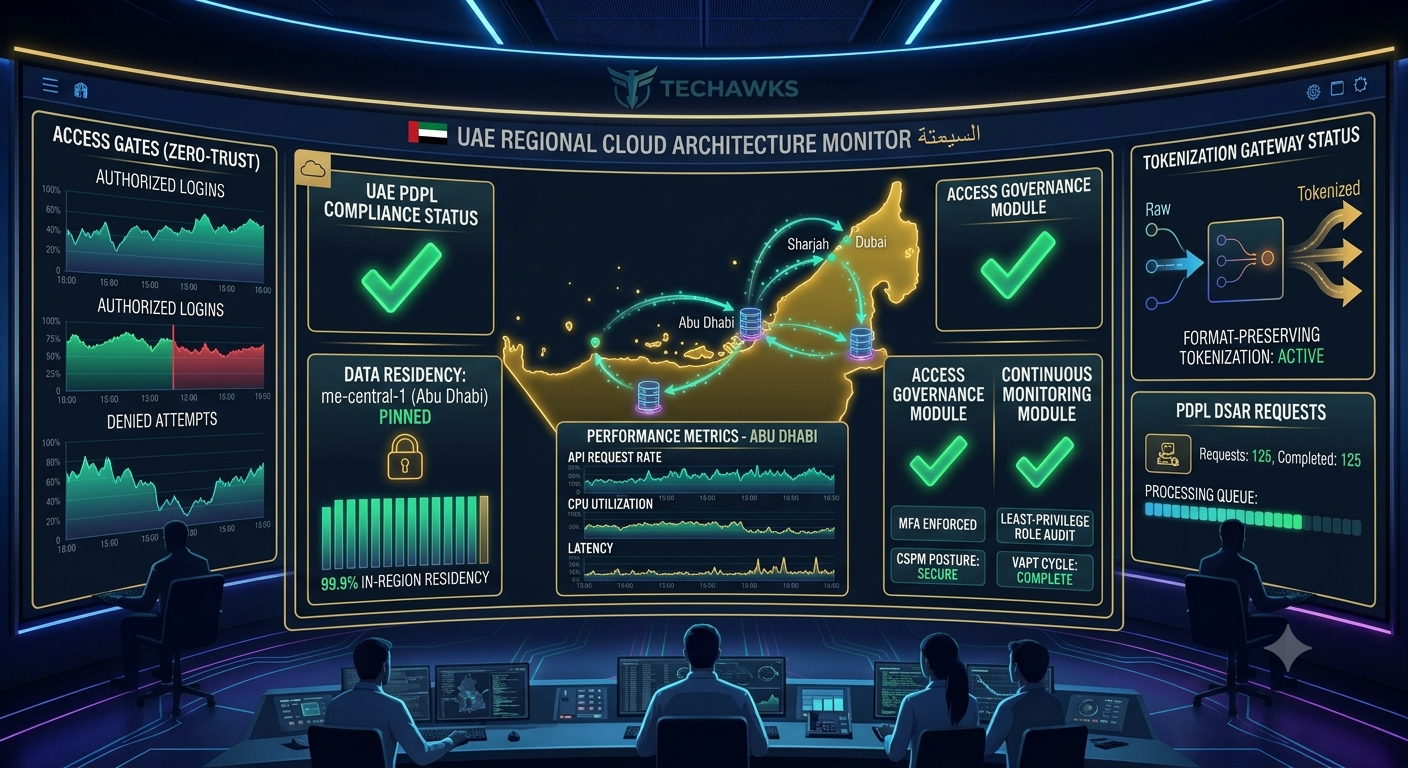
[ ] In-Region Primary Storage: Ensure all resident Personally Identifiable Information (PII) is primary-hosted strictly within local UAE datacenters (e.g., AWS me-central-1 Abu Dhabi or me-south-1 Dubai).
[ ] Dynamic Cross-Border Tokenization: Implement field-level tokenization or pseudonymization before transmitting non-PII payloads across international borders.
[ ] Sub-Processor Audit: Verify that all third-party vendors and API integrations handling local resident data adhere to explicit PDPL contractual safeguards.
2. Access Governance & Identity Controls
[ ] Explicit Consent Management: Deploy granular opt-in mechanisms to store and track explicit consent for every processed data category.
[ ] Zero-Trust Access & Hardware MFA: Mandate centralized Single Sign-On (SSO) with hardware-backed Multi-Factor Authentication for all production infrastructure.
[ ] Automated Data Subject Rights (DSAR): Build automated workflows to handle data access, correction, and "Right to Erasure" requests within statutory windows.
3. Continuous Monitoring & Threat Prevention
[ ] Immutable Audit Logging: Maintain centralized, tamper-proof audit trails for all data reads, writes, and detokenization events.
[ ] End-to-End Encryption: Enforce KMS-managed customer keys for data at rest and mandate TLS 1.3 for all internal and external network traffic.
[ ] Vulnerability Assessment & Penetration Testing (VAPT): Schedule regular automated vulnerability scans and annual penetration tests across all public-facing APIs and databases.
Key Takeaways
Locate Primary Data Locally: Enforce strict regional boundaries for primary datastores containing raw resident PII.
Tokenize Cross-Border Traffic: Strip sensitive identifiers at the edge before sending analytics or operational telemetry outside local cloud regions.
Automate Privacy Operations: Build DSAR and consent verification directly into your microservice architecture to avoid manual administrative burdens.
CTA
Join Techawks UAE to connect with Middle East technology leaders, master cloud architecture, and build compliant, world-class software systems.
Deploying software for the UAE market demands a clear balance between high-performance cloud engineering and localized regulatory adherence.
Run through this engineering checklist to ensure your cloud workloads align with UAE PDPL and local security frameworks.
1. In-Region Data Residency & Sovereignty
[ ] In-Region Primary Storage: Ensure all resident Personally Identifiable Information (PII) is primary-hosted strictly within local UAE datacenters (e.g., AWS me-central-1 Abu Dhabi or me-south-1 Dubai).
[ ] Dynamic Cross-Border Tokenization: Implement field-level tokenization or pseudonymization before transmitting non-PII payloads across international borders.
[ ] Sub-Processor Audit: Verify that all third-party vendors and API integrations handling local resident data adhere to explicit PDPL contractual safeguards.
2. Access Governance & Identity Controls
[ ] Explicit Consent Management: Deploy granular opt-in mechanisms to store and track explicit consent for every processed data category.
[ ] Zero-Trust Access & Hardware MFA: Mandate centralized Single Sign-On (SSO) with hardware-backed Multi-Factor Authentication for all production infrastructure.
[ ] Automated Data Subject Rights (DSAR): Build automated workflows to handle data access, correction, and "Right to Erasure" requests within statutory windows.
3. Continuous Monitoring & Threat Prevention
[ ] Immutable Audit Logging: Maintain centralized, tamper-proof audit trails for all data reads, writes, and detokenization events.
[ ] End-to-End Encryption: Enforce KMS-managed customer keys for data at rest and mandate TLS 1.3 for all internal and external network traffic.
[ ] Vulnerability Assessment & Penetration Testing (VAPT): Schedule regular automated vulnerability scans and annual penetration tests across all public-facing APIs and databases.
Key Takeaways
Locate Primary Data Locally: Enforce strict regional boundaries for primary datastores containing raw resident PII.
Tokenize Cross-Border Traffic: Strip sensitive identifiers at the edge before sending analytics or operational telemetry outside local cloud regions.
Automate Privacy Operations: Build DSAR and consent verification directly into your microservice architecture to avoid manual administrative burdens.
CTA
Join Techawks UAE to connect with Middle East technology leaders, master cloud architecture, and build compliant, world-class software systems.
The UAE Enterprise Cloud Security & PDPL Compliance Checklist
Deploying software for the UAE market demands a clear balance between high-performance cloud engineering and localized regulatory adherence.
Run through this engineering checklist to ensure your cloud workloads align with UAE PDPL and local security frameworks.
1. In-Region Data Residency & Sovereignty
[ ] In-Region Primary Storage: Ensure all resident Personally Identifiable Information (PII) is primary-hosted strictly within local UAE datacenters (e.g., AWS me-central-1 Abu Dhabi or me-south-1 Dubai).
[ ] Dynamic Cross-Border Tokenization: Implement field-level tokenization or pseudonymization before transmitting non-PII payloads across international borders.
[ ] Sub-Processor Audit: Verify that all third-party vendors and API integrations handling local resident data adhere to explicit PDPL contractual safeguards.
2. Access Governance & Identity Controls
[ ] Explicit Consent Management: Deploy granular opt-in mechanisms to store and track explicit consent for every processed data category.
[ ] Zero-Trust Access & Hardware MFA: Mandate centralized Single Sign-On (SSO) with hardware-backed Multi-Factor Authentication for all production infrastructure.
[ ] Automated Data Subject Rights (DSAR): Build automated workflows to handle data access, correction, and "Right to Erasure" requests within statutory windows.
3. Continuous Monitoring & Threat Prevention
[ ] Immutable Audit Logging: Maintain centralized, tamper-proof audit trails for all data reads, writes, and detokenization events.
[ ] End-to-End Encryption: Enforce KMS-managed customer keys for data at rest and mandate TLS 1.3 for all internal and external network traffic.
[ ] Vulnerability Assessment & Penetration Testing (VAPT): Schedule regular automated vulnerability scans and annual penetration tests across all public-facing APIs and databases.
Key Takeaways
Locate Primary Data Locally: Enforce strict regional boundaries for primary datastores containing raw resident PII.
Tokenize Cross-Border Traffic: Strip sensitive identifiers at the edge before sending analytics or operational telemetry outside local cloud regions.
Automate Privacy Operations: Build DSAR and consent verification directly into your microservice architecture to avoid manual administrative burdens.
CTA
Join Techawks UAE to connect with Middle East technology leaders, master cloud architecture, and build compliant, world-class software systems.

 English
 Arabic
 French
 Spanish
 Portuguese
 Deutsch
 Turkish
 Dutch
Dutch
 Italiano
 Russian
 Romaian
 Greek
Greek