


The Canadian Enterprise Cloud Security & Data Sovereignty Checklist
Architecting software for the Canadian enterprise market demands balancing strict data privacy regulations with scalable cloud performance.
Use this production checklist to verify that your AWS, Azure, or GCP workloads satisfy federal PIPEDA and provincial Law 25 compliance baselines.
1. In-Region Data Residency & Sovereignty
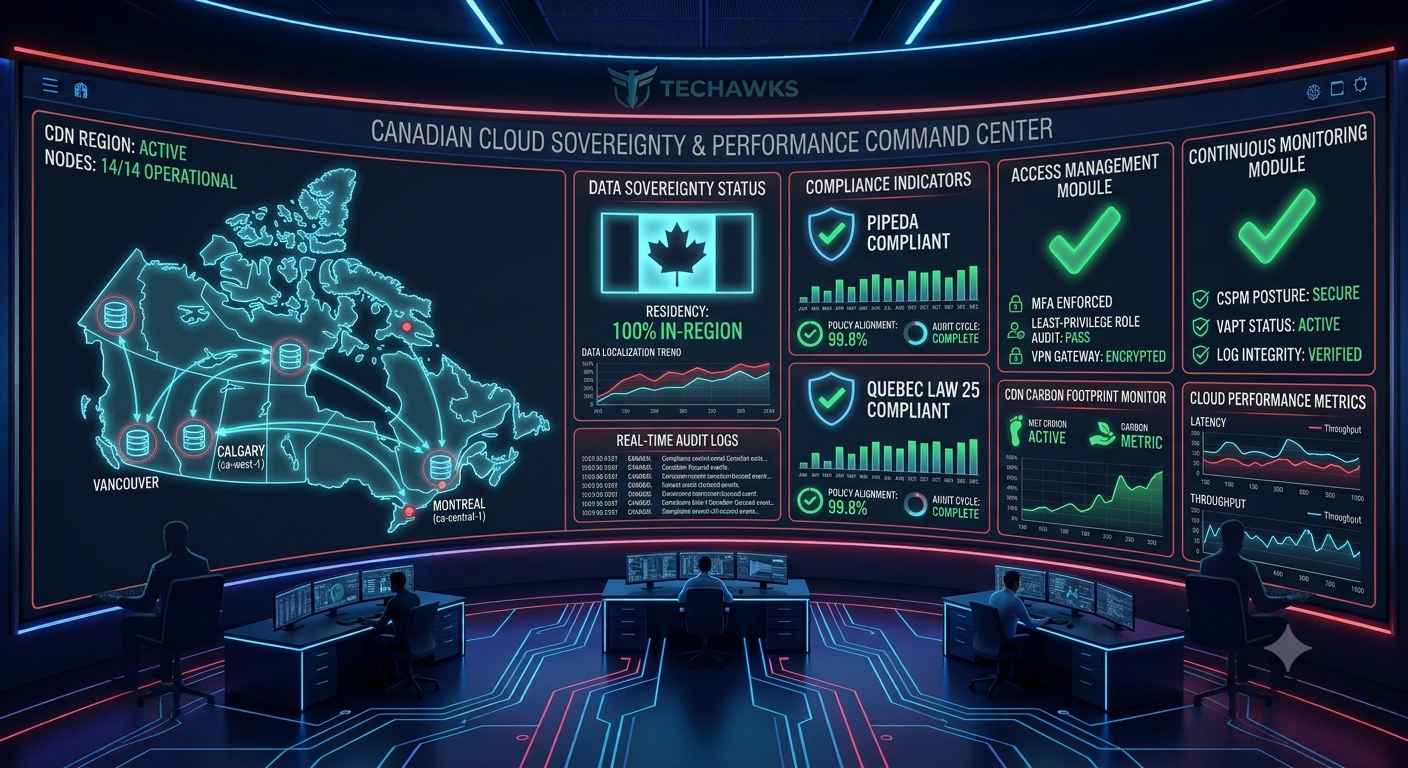
[ ] In-Country Primary Storage: Pin all primary database instances, object storage buckets, and automated backups strictly within Canadian cloud regions (e.g., AWS ca-central-1 Montreal or ca-west-1 Calgary).
[ ] Strict Cross-Border Control: Enforce policy-as-code guards to prevent unencrypted Personally Identifiable Information (PII) from egressing outside Canadian borders.
[ ] Sub-Processor Audit: Verify that all third-party telemetry, logging, and APM tools process Canadian resident data within compliant local boundaries.
2. Privacy Governance & Consent Controls (Law 25 / PIPEDA)
[ ] Explicit Consent Tracking: Build API-level validation gates to verify and log explicit consent parameters before processing user data.
[ ] Dynamic Field-Level Masking: Anonymize or hash sensitive fields (e.g., SIN, email, phone numbers) at the edge before sending events to downstream data streams or queues.
[ ] Automated Right-to-Erasure (DSAR): Deploy automated event-driven workflows to handle Data Subject Access Requests and complete data destruction across all datastores.
3. Access Governance & Continuous Security
[ ] Zero-Trust Identity Management: Enforce centralized Single Sign-On (SSO) backed by hardware Multi-Factor Authentication (MFA) for all engineering access.
[ ] KMS Customer-Managed Keys: Encrypt all data at rest using Customer Managed Keys (CMK) through AWS KMS or cloud equivalents with automated annual rotation.
[ ] Immutable Audit Trails: Maintain centralized, tamper-proof audit logs for all data access, encryption key usage, and system modification events.
Key Takeaways
Keep Data Local: Restrict primary workloads and secondary DR copies to domestic cloud regions (ca-central-1 / ca-west-1).
Automate Privacy Operations: Build Law 25 consent logging and deletion workflows directly into your microservices architecture.
Field-Level Protection: Hash or tokenize sensitive PII at the ingestion boundary before routing payload telemetry into secondary pipelines.
CTA
Join Techawks Canada to connect with Canadian technology leaders, master cloud architecture, and build compliant, world-class software systems.
Architecting software for the Canadian enterprise market demands balancing strict data privacy regulations with scalable cloud performance.
Use this production checklist to verify that your AWS, Azure, or GCP workloads satisfy federal PIPEDA and provincial Law 25 compliance baselines.
1. In-Region Data Residency & Sovereignty
[ ] In-Country Primary Storage: Pin all primary database instances, object storage buckets, and automated backups strictly within Canadian cloud regions (e.g., AWS ca-central-1 Montreal or ca-west-1 Calgary).
[ ] Strict Cross-Border Control: Enforce policy-as-code guards to prevent unencrypted Personally Identifiable Information (PII) from egressing outside Canadian borders.
[ ] Sub-Processor Audit: Verify that all third-party telemetry, logging, and APM tools process Canadian resident data within compliant local boundaries.
2. Privacy Governance & Consent Controls (Law 25 / PIPEDA)
[ ] Explicit Consent Tracking: Build API-level validation gates to verify and log explicit consent parameters before processing user data.
[ ] Dynamic Field-Level Masking: Anonymize or hash sensitive fields (e.g., SIN, email, phone numbers) at the edge before sending events to downstream data streams or queues.
[ ] Automated Right-to-Erasure (DSAR): Deploy automated event-driven workflows to handle Data Subject Access Requests and complete data destruction across all datastores.
3. Access Governance & Continuous Security
[ ] Zero-Trust Identity Management: Enforce centralized Single Sign-On (SSO) backed by hardware Multi-Factor Authentication (MFA) for all engineering access.
[ ] KMS Customer-Managed Keys: Encrypt all data at rest using Customer Managed Keys (CMK) through AWS KMS or cloud equivalents with automated annual rotation.
[ ] Immutable Audit Trails: Maintain centralized, tamper-proof audit logs for all data access, encryption key usage, and system modification events.
Key Takeaways
Keep Data Local: Restrict primary workloads and secondary DR copies to domestic cloud regions (ca-central-1 / ca-west-1).
Automate Privacy Operations: Build Law 25 consent logging and deletion workflows directly into your microservices architecture.
Field-Level Protection: Hash or tokenize sensitive PII at the ingestion boundary before routing payload telemetry into secondary pipelines.
CTA
Join Techawks Canada to connect with Canadian technology leaders, master cloud architecture, and build compliant, world-class software systems.
The Canadian Enterprise Cloud Security & Data Sovereignty Checklist
Architecting software for the Canadian enterprise market demands balancing strict data privacy regulations with scalable cloud performance.
Use this production checklist to verify that your AWS, Azure, or GCP workloads satisfy federal PIPEDA and provincial Law 25 compliance baselines.
1. In-Region Data Residency & Sovereignty
[ ] In-Country Primary Storage: Pin all primary database instances, object storage buckets, and automated backups strictly within Canadian cloud regions (e.g., AWS ca-central-1 Montreal or ca-west-1 Calgary).
[ ] Strict Cross-Border Control: Enforce policy-as-code guards to prevent unencrypted Personally Identifiable Information (PII) from egressing outside Canadian borders.
[ ] Sub-Processor Audit: Verify that all third-party telemetry, logging, and APM tools process Canadian resident data within compliant local boundaries.
2. Privacy Governance & Consent Controls (Law 25 / PIPEDA)
[ ] Explicit Consent Tracking: Build API-level validation gates to verify and log explicit consent parameters before processing user data.
[ ] Dynamic Field-Level Masking: Anonymize or hash sensitive fields (e.g., SIN, email, phone numbers) at the edge before sending events to downstream data streams or queues.
[ ] Automated Right-to-Erasure (DSAR): Deploy automated event-driven workflows to handle Data Subject Access Requests and complete data destruction across all datastores.
3. Access Governance & Continuous Security
[ ] Zero-Trust Identity Management: Enforce centralized Single Sign-On (SSO) backed by hardware Multi-Factor Authentication (MFA) for all engineering access.
[ ] KMS Customer-Managed Keys: Encrypt all data at rest using Customer Managed Keys (CMK) through AWS KMS or cloud equivalents with automated annual rotation.
[ ] Immutable Audit Trails: Maintain centralized, tamper-proof audit logs for all data access, encryption key usage, and system modification events.
Key Takeaways
Keep Data Local: Restrict primary workloads and secondary DR copies to domestic cloud regions (ca-central-1 / ca-west-1).
Automate Privacy Operations: Build Law 25 consent logging and deletion workflows directly into your microservices architecture.
Field-Level Protection: Hash or tokenize sensitive PII at the ingestion boundary before routing payload telemetry into secondary pipelines.
CTA
Join Techawks Canada to connect with Canadian technology leaders, master cloud architecture, and build compliant, world-class software systems.

 Arabic
 French
 Spanish
 Portuguese
 Deutsch
 Turkish
 Dutch
Dutch
 Italiano
 Russian
 Romaian
 Portuguese (Brazil)
 Greek
Greek