


Navigating the UAE’s Data Sovereignty Shift: Why 'Local-First' AI Architecture is the New Gold Standard for Senior Engineers
The Problem & Failure Modes
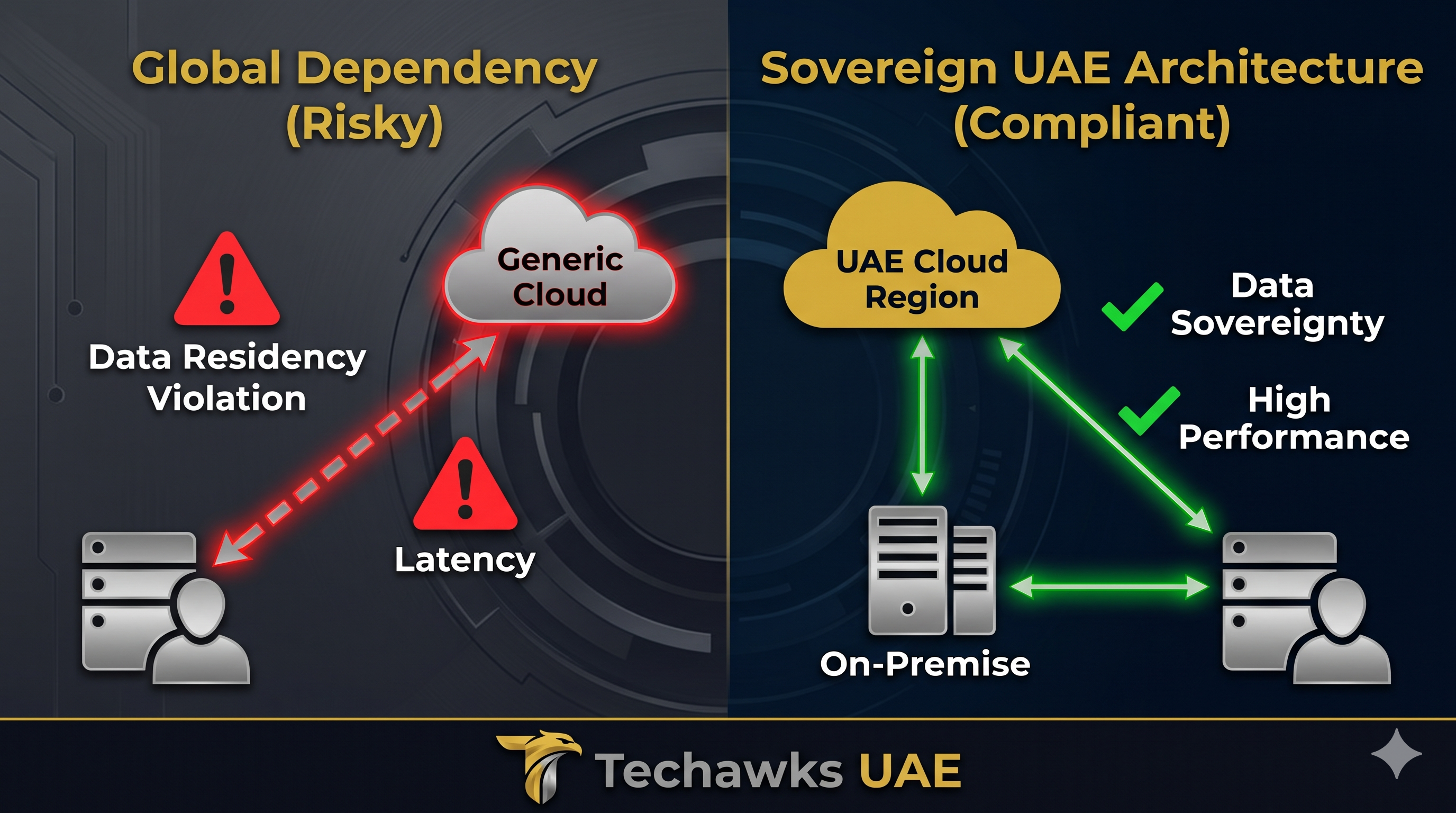
The UAE is aggressively localizing its critical data infrastructure (think healthcare, finance, government services). For senior engineers, deploying a generic, US-hosted model (e.g., standard OpenAI or Anthropic API) is no longer just a technical choice; it's a potential compliance failure.
The Latency Trap: Routing user requests to a distant region (e.g., US-East) adds unacceptable latency for real-time UAE applications, killing user experience in fintech or e-commerce.
The Compliance Chasm: UAE regulators (like the UAE Data Office and sector-specific authorities) mandate that sensitive citizen data must remain within national borders. A simple API call to a global provider puts your organization at risk of severe penalties.
The Innovation Stagnation: Relying on black-box global APIs prevents your team from fine-tuning models on proprietary Arabic datasets or specific industry knowledge crucial for the UAE market.
Architecture Workflow
To succeed, you must design a sovereign, hybrid architecture that keeps data and compute local while leveraging global knowledge safely.
[ UAE END USER ] <--> [ LOCAL EDGE / PROXY ] <--> [ ON-PREM or UAE CLOUD REGION (e.g., AWS/Azure/G42) ]
|
[ SECURE DATA PIPELINES ] <--> [ EMBEDDED VECTOR DB ] <-- [ SECURE LOCAL LLM (e.g., Llama 3, Jais Fine-tune) ]
3 Production-Grade Engineering Principles
Master Hybrid Deployment Patterns: Learn to architect solutions where the heavy lifting—RAG (Retrieval-Augmented Generation) and inference—occurs inside a UAE cloud region or on-premises infrastructure. The global API should only be used as a failover, not the primary engine.
Embrace 'Arabic-First' Fine-Tuning: The UAE market demands excellence in Arabic. Move beyond generic models and learn how to quantize and fine-tune open-source models (like Meta’s Llama 3 or core Arabic models like Jais) on local, secure datasets.
Implement 'Sovereign Guardrails': As a senior engineer, you own the compliance. Implement strict data loss prevention (DLP) and PII (Personally Identifiable Information) scrubbing before any data is sent to an external model, ensuring privacy-by-design.
Discussion Question
As a UAE-based tech professional, what is the biggest hurdle you face in implementing local-first AI architecture: cost of infrastructure, lack of available local GPU compute, or internal resistance from management still pushing for the 'easiest' global API solution?
CTA
Join Techawks UAE to master the practical, localized engineering skills—from sovereign AI architecture to regulatory compliance—that are defining high-impact, senior roles across the Emirates.
Navigating the UAE’s Data Sovereignty Shift: Why 'Local-First' AI Architecture is the New Gold Standard for Senior Engineers
The Problem & Failure Modes
The UAE is aggressively localizing its critical data infrastructure (think healthcare, finance, government services). For senior engineers, deploying a generic, US-hosted model (e.g., standard OpenAI or Anthropic API) is no longer just a technical choice; it's a potential compliance failure.
The Latency Trap: Routing user requests to a distant region (e.g., US-East) adds unacceptable latency for real-time UAE applications, killing user experience in fintech or e-commerce.
The Compliance Chasm: UAE regulators (like the UAE Data Office and sector-specific authorities) mandate that sensitive citizen data must remain within national borders. A simple API call to a global provider puts your organization at risk of severe penalties.
The Innovation Stagnation: Relying on black-box global APIs prevents your team from fine-tuning models on proprietary Arabic datasets or specific industry knowledge crucial for the UAE market.
Architecture Workflow
To succeed, you must design a sovereign, hybrid architecture that keeps data and compute local while leveraging global knowledge safely.
[ UAE END USER ] <--> [ LOCAL EDGE / PROXY ] <--> [ ON-PREM or UAE CLOUD REGION (e.g., AWS/Azure/G42) ]
|
[ SECURE DATA PIPELINES ] <--> [ EMBEDDED VECTOR DB ] <-- [ SECURE LOCAL LLM (e.g., Llama 3, Jais Fine-tune) ]
3 Production-Grade Engineering Principles
Master Hybrid Deployment Patterns: Learn to architect solutions where the heavy lifting—RAG (Retrieval-Augmented Generation) and inference—occurs inside a UAE cloud region or on-premises infrastructure. The global API should only be used as a failover, not the primary engine.
Embrace 'Arabic-First' Fine-Tuning: The UAE market demands excellence in Arabic. Move beyond generic models and learn how to quantize and fine-tune open-source models (like Meta’s Llama 3 or core Arabic models like Jais) on local, secure datasets.
Implement 'Sovereign Guardrails': As a senior engineer, you own the compliance. Implement strict data loss prevention (DLP) and PII (Personally Identifiable Information) scrubbing before any data is sent to an external model, ensuring privacy-by-design.
Discussion Question
As a UAE-based tech professional, what is the biggest hurdle you face in implementing local-first AI architecture: cost of infrastructure, lack of available local GPU compute, or internal resistance from management still pushing for the 'easiest' global API solution?
CTA
Join Techawks UAE to master the practical, localized engineering skills—from sovereign AI architecture to regulatory compliance—that are defining high-impact, senior roles across the Emirates.

 Arabic
 French
 Spanish
 Portuguese
 Deutsch
 Turkish
 Dutch
 Italiano
 Russian
 Romaian
 Portuguese (Brazil)
 Greek