


Beyond Dubai’s Smart City Dashboards: Why the UAE’s National AI Strategy Requires Localized Vector Databases
From Dubai's "D33" economic agenda to Abu Dhabi's industrial transformation, the UAE is aggressively integrating agentic AI into critical sectors like finance, logistics, and e-government. The core architectural challenge is no longer the model (GPT-4, Claude, or Falcon); it is context grounding.
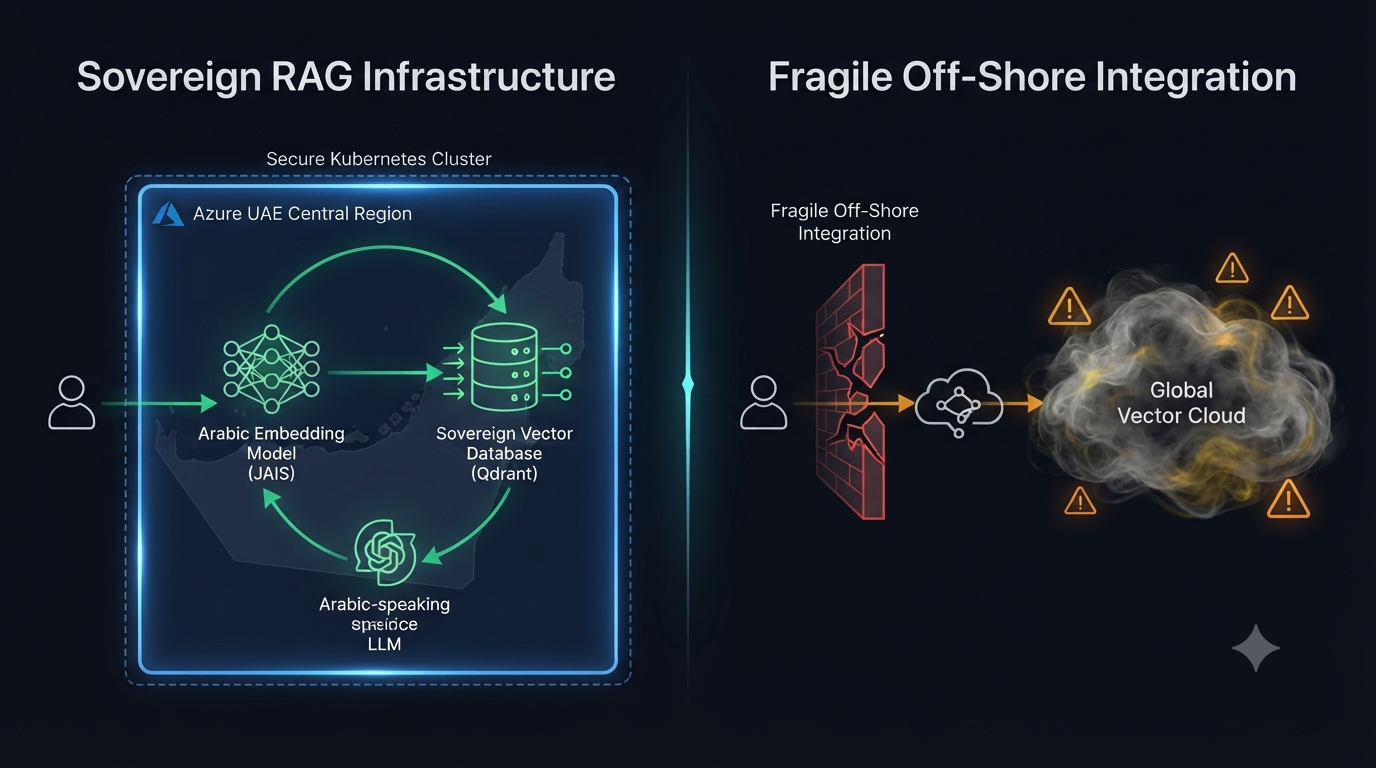
Retrieval-Augmented Generation (RAG) connects powerful models to your proprietary enterprise knowledge. However, naive implementations rely on embedding models and vector databases hosted offshore. This introduces three critical failure modes for UAE businesses operating under strict data residency regulations and Arabic language nuances:
Data Residency & Privacy: Sending sensitive corporate financials, customer PII, or trade data to a US-hosted vector database (like Pinecone or Weaviate Cloud) creates an immediate regulatory compliance risk under the UAE’s data protection laws.
Arabic Language Neglect: Global embedding models often perform poorly on specific Gulf Arabic dialects, legal terminology, or business jargon prevalent in UAE free zones. A generic index will hallucinate context, failing to retrieve the correct UAE-specific regulatory document.
Operational Latency: For real-time logistics (DP World) or high-frequency trading (ADGM), the network round trip to a foreign cloud for vector search adds unacceptable latency.
Why it matters:
Building world-class AI applications in the UAE requires sovereign RAG infrastructure. You must maintain strict control over where your embeddings live and how they interpret local context.
Teach Something Useful (Deploying a Sovereign RAG Stack):
Move your vector infrastructure onshore. Use open-source, embeddable vector databases (like Qdrant or ChromaDB) and deploy them on local Kubernetes clusters (e.g., AKS in Azure UAE Central or GKE in Dubai) or bare metal within sovereign infrastructure.
Conceptual Architecture for a Sovereign RAG Service:
Code snippet
graph TD
A[UAE User Request] --> B(API Gateway (Local Ingress));
B --> C{Orchestrator Service};
C -->|1. Local Arabic Embedding Model| D(Sovereign Embedding Service);
D -->|Numerical Representation| C;
C -->|2. Search Vector Index| E[Self-Hosted Vector DB (Qdrant/Milvus)];
E -->|Retrieved Local Context| C;
C -->|3. Prompt + Context| F[On-Premise LLM / Controlled API Endpoint];
F -->|Generated Arabic Response| C;
C --> B;
subgraph "UAE Sovereign Cloud Infrastructure (On-Prem or local region)"
D
E
F
end
Host Locally: Run your entire retrieval stack (Embedding Model + Vector DB) inside the UAE. Use open-source models fine-tuned for Arabic (like Jais) for the best results.
Enforce Network Perimeters: Use Kubernetes Network Policies to ensure the vector database is only accessible by your internal orchestrator service, never the public internet.
Implement Local Backups: Configure persistent volume snapshots for your vector database that remain physically within the UAE borders for disaster recovery and audit compliance.
Discussion Question:
For engineers and architects building AI solutions in the UAE: what is the biggest trade-off you have faced between using a fully managed, high-performance global vector service (like Pinecone) and the regulatory requirement to keep sensitive data on-premises in the UAE?
CTA (Join Techawks UAE):
Building the next generation of sovereign AI platforms, fintech systems, or smart city infrastructure across the UAE? Join the Techawks UAE community to connect with fellow engineers, share architectural blueprints for local compliance, and drive innovation forward responsibly.
Beyond Dubai’s Smart City Dashboards: Why the UAE’s National AI Strategy Requires Localized Vector Databases
From Dubai's "D33" economic agenda to Abu Dhabi's industrial transformation, the UAE is aggressively integrating agentic AI into critical sectors like finance, logistics, and e-government. The core architectural challenge is no longer the model (GPT-4, Claude, or Falcon); it is context grounding.
Retrieval-Augmented Generation (RAG) connects powerful models to your proprietary enterprise knowledge. However, naive implementations rely on embedding models and vector databases hosted offshore. This introduces three critical failure modes for UAE businesses operating under strict data residency regulations and Arabic language nuances:
Data Residency & Privacy: Sending sensitive corporate financials, customer PII, or trade data to a US-hosted vector database (like Pinecone or Weaviate Cloud) creates an immediate regulatory compliance risk under the UAE’s data protection laws.
Arabic Language Neglect: Global embedding models often perform poorly on specific Gulf Arabic dialects, legal terminology, or business jargon prevalent in UAE free zones. A generic index will hallucinate context, failing to retrieve the correct UAE-specific regulatory document.
Operational Latency: For real-time logistics (DP World) or high-frequency trading (ADGM), the network round trip to a foreign cloud for vector search adds unacceptable latency.
Why it matters:
Building world-class AI applications in the UAE requires sovereign RAG infrastructure. You must maintain strict control over where your embeddings live and how they interpret local context.
Teach Something Useful (Deploying a Sovereign RAG Stack):
Move your vector infrastructure onshore. Use open-source, embeddable vector databases (like Qdrant or ChromaDB) and deploy them on local Kubernetes clusters (e.g., AKS in Azure UAE Central or GKE in Dubai) or bare metal within sovereign infrastructure.
Conceptual Architecture for a Sovereign RAG Service:
Code snippet
graph TD
A[UAE User Request] --> B(API Gateway (Local Ingress));
B --> C{Orchestrator Service};
C -->|1. Local Arabic Embedding Model| D(Sovereign Embedding Service);
D -->|Numerical Representation| C;
C -->|2. Search Vector Index| E[Self-Hosted Vector DB (Qdrant/Milvus)];
E -->|Retrieved Local Context| C;
C -->|3. Prompt + Context| F[On-Premise LLM / Controlled API Endpoint];
F -->|Generated Arabic Response| C;
C --> B;
subgraph "UAE Sovereign Cloud Infrastructure (On-Prem or local region)"
D
E
F
end
Host Locally: Run your entire retrieval stack (Embedding Model + Vector DB) inside the UAE. Use open-source models fine-tuned for Arabic (like Jais) for the best results.
Enforce Network Perimeters: Use Kubernetes Network Policies to ensure the vector database is only accessible by your internal orchestrator service, never the public internet.
Implement Local Backups: Configure persistent volume snapshots for your vector database that remain physically within the UAE borders for disaster recovery and audit compliance.
Discussion Question:
For engineers and architects building AI solutions in the UAE: what is the biggest trade-off you have faced between using a fully managed, high-performance global vector service (like Pinecone) and the regulatory requirement to keep sensitive data on-premises in the UAE?
CTA (Join Techawks UAE):
Building the next generation of sovereign AI platforms, fintech systems, or smart city infrastructure across the UAE? Join the Techawks UAE community to connect with fellow engineers, share architectural blueprints for local compliance, and drive innovation forward responsibly.

 Arabic
 French
 Spanish
 Portuguese
 Deutsch
 Turkish
 Dutch
 Italiano
 Russian
 Romaian
 Portuguese (Brazil)
 Greek