


How to Stop LLM Hallucinations: A 4-Step Prompt Engineering Strategy
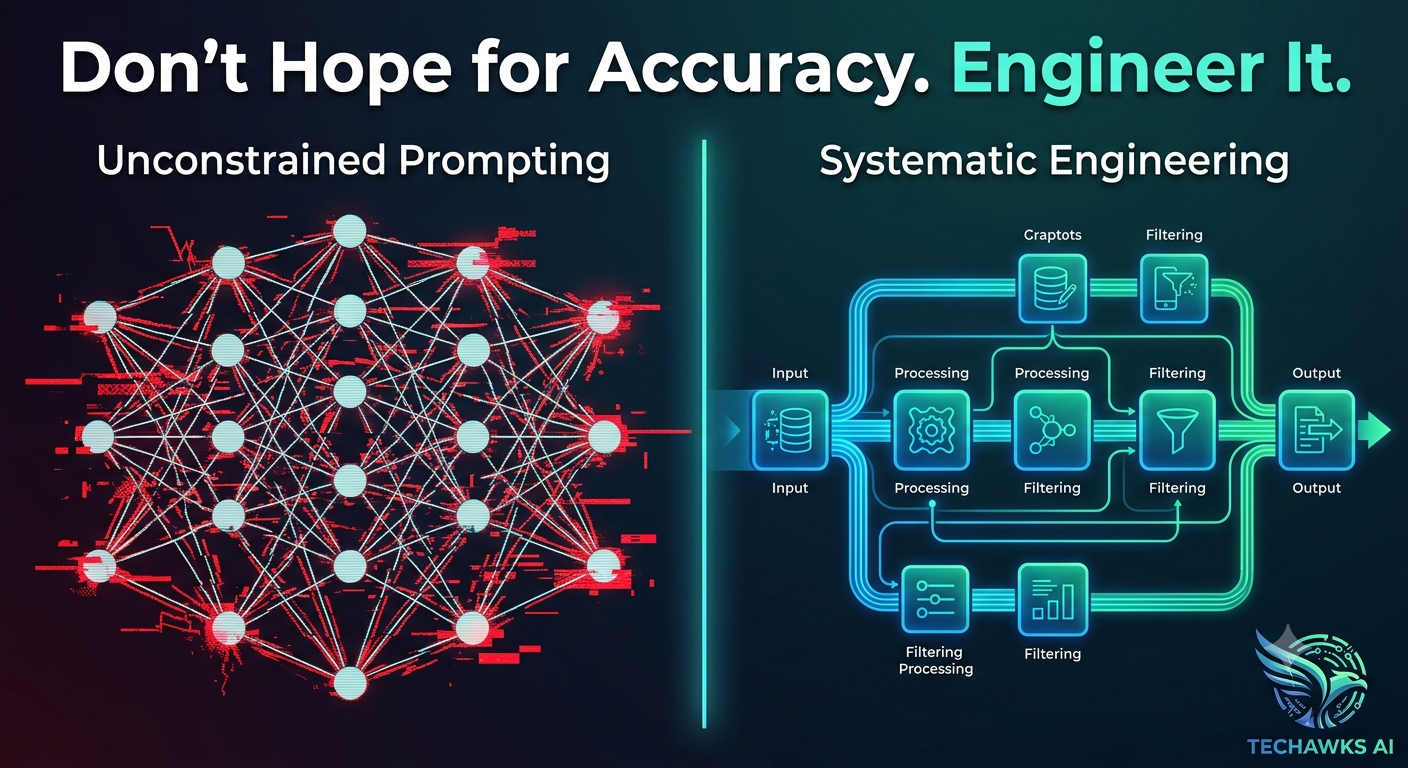
LLMs are incredible at reasoning and transformation, but notoriously unreliable as knowledge bases. When pushed for specific facts without constraints, models routinely invent believable falsehoods. The secret to reliable output isn't a larger model; it is framing the input to minimize ambiguity.
Instead of relying on luck, structure your prompts using this 4-step precision framework:
Supply explicit context (RAG pattern)
Weak: "Summarize our return policy."
Strong: "Based strictly on the text provided below, summarize the return policy. If the answer is not contained in the text, reply 'Information not available.'"
Assign a clear persona & role
Specify the expertise level, tone, and strict boundaries.
Example: "Act as a meticulous senior code auditor. Identify performance bottlenecks in the following function. Do not comment on syntax or styling."
Enforce Chain-of-Thought (CoT) reasoning
Instruct the model to break down its logic step-by-step before producing the final answer. Forcing step-by-step reasoning significantly reduces logical leaps and errors.
Example: "First, analyze the input parameters. Second, trace the loop execution. Third, output the final output value."
Define structured, deterministic output formats
Ask for outputs in formats like JSON, XML, or Markdown tables with precise keys. This prevents conversational padding and forces the model into structural compliance.
LLMs are incredible at reasoning and transformation, but notoriously unreliable as knowledge bases. When pushed for specific facts without constraints, models routinely invent believable falsehoods. The secret to reliable output isn't a larger model; it is framing the input to minimize ambiguity.
Instead of relying on luck, structure your prompts using this 4-step precision framework:
Supply explicit context (RAG pattern)
Weak: "Summarize our return policy."
Strong: "Based strictly on the text provided below, summarize the return policy. If the answer is not contained in the text, reply 'Information not available.'"
Assign a clear persona & role
Specify the expertise level, tone, and strict boundaries.
Example: "Act as a meticulous senior code auditor. Identify performance bottlenecks in the following function. Do not comment on syntax or styling."
Enforce Chain-of-Thought (CoT) reasoning
Instruct the model to break down its logic step-by-step before producing the final answer. Forcing step-by-step reasoning significantly reduces logical leaps and errors.
Example: "First, analyze the input parameters. Second, trace the loop execution. Third, output the final output value."
Define structured, deterministic output formats
Ask for outputs in formats like JSON, XML, or Markdown tables with precise keys. This prevents conversational padding and forces the model into structural compliance.
How to Stop LLM Hallucinations: A 4-Step Prompt Engineering Strategy
LLMs are incredible at reasoning and transformation, but notoriously unreliable as knowledge bases. When pushed for specific facts without constraints, models routinely invent believable falsehoods. The secret to reliable output isn't a larger model; it is framing the input to minimize ambiguity.
Instead of relying on luck, structure your prompts using this 4-step precision framework:
Supply explicit context (RAG pattern)
Weak: "Summarize our return policy."
Strong: "Based strictly on the text provided below, summarize the return policy. If the answer is not contained in the text, reply 'Information not available.'"
Assign a clear persona & role
Specify the expertise level, tone, and strict boundaries.
Example: "Act as a meticulous senior code auditor. Identify performance bottlenecks in the following function. Do not comment on syntax or styling."
Enforce Chain-of-Thought (CoT) reasoning
Instruct the model to break down its logic step-by-step before producing the final answer. Forcing step-by-step reasoning significantly reduces logical leaps and errors.
Example: "First, analyze the input parameters. Second, trace the loop execution. Third, output the final output value."
Define structured, deterministic output formats
Ask for outputs in formats like JSON, XML, or Markdown tables with precise keys. This prevents conversational padding and forces the model into structural compliance.

 English
 Arabic
 French
 Spanish
 Portuguese
 Deutsch
 Turkish
 Italiano
 Russian
 Romaian
 Portuguese (Brazil)
 Greek
Greek