


Mastering Async Control Flow: Stop Swallowing Errors in Asynchronous JavaScript
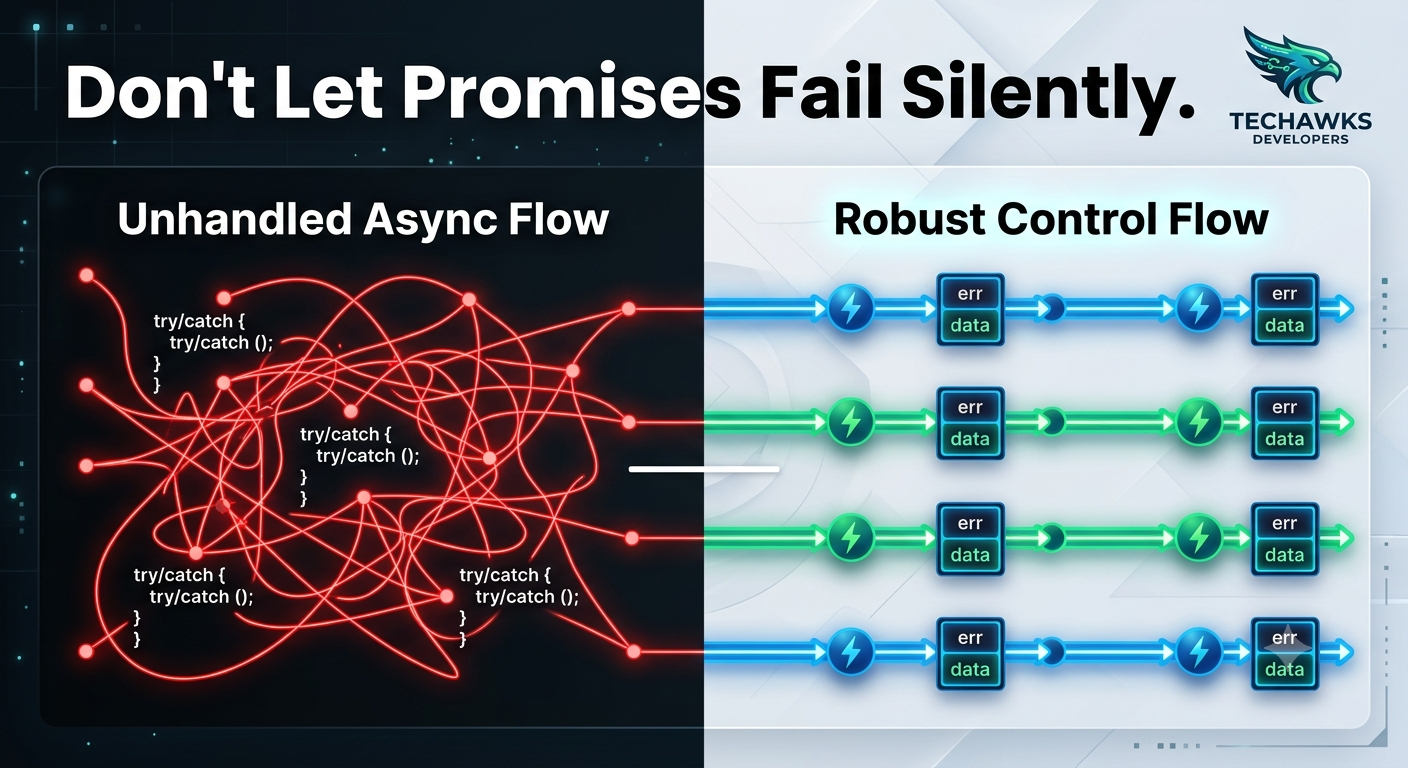
Asynchronous execution is core to modern modern web application development, yet error handling in async code remains one of the most frequent sources of runtime bugs. Relying strictly on basic try/catch blocks around async/await often leads to swallowed exceptions or redundant code.
Here is a clean, robust pattern for handling asynchronous operations cleanly without falling into common traps:
Avoid Universal Empty catch Blocks
Anti-Pattern: Catching an error and doing nothing or merely logging console.log(err). This lets application state fail silently.
Best Practice: Always rethrow unhandled exceptions or explicitly return a structured error result.
Adopt the Safe-Await Wrapper Pattern
Instead of nesting multiple try/catch blocks inside a single function, isolate promise calls using a simple utility function that returns a tuple [error, data]:
Example:
JavaScript
const safeAwait = (promise) => promise
.then(data => [null, data])
.catch(err => [err, null]);
// Usage
const [err, user] = await safeAwait(fetchUser(id));
if (err) return handleUserError(err);
Handle Concurrent Promises Safely
Avoid Promise.all if you need partial successes when executing multiple parallel requests. One failure will reject the entire batch.
Use Promise.all Settled instead to evaluate each status individually without halting execution.
Always Set Timeouts on External Requests
Never leave a fetch or network promise uncapped. Use AbortController to guarantee that hanging requests timeout gracefully.
Asynchronous execution is core to modern modern web application development, yet error handling in async code remains one of the most frequent sources of runtime bugs. Relying strictly on basic try/catch blocks around async/await often leads to swallowed exceptions or redundant code.
Here is a clean, robust pattern for handling asynchronous operations cleanly without falling into common traps:
Avoid Universal Empty catch Blocks
Anti-Pattern: Catching an error and doing nothing or merely logging console.log(err). This lets application state fail silently.
Best Practice: Always rethrow unhandled exceptions or explicitly return a structured error result.
Adopt the Safe-Await Wrapper Pattern
Instead of nesting multiple try/catch blocks inside a single function, isolate promise calls using a simple utility function that returns a tuple [error, data]:
Example:
JavaScript
const safeAwait = (promise) => promise
.then(data => [null, data])
.catch(err => [err, null]);
// Usage
const [err, user] = await safeAwait(fetchUser(id));
if (err) return handleUserError(err);
Handle Concurrent Promises Safely
Avoid Promise.all if you need partial successes when executing multiple parallel requests. One failure will reject the entire batch.
Use Promise.all Settled instead to evaluate each status individually without halting execution.
Always Set Timeouts on External Requests
Never leave a fetch or network promise uncapped. Use AbortController to guarantee that hanging requests timeout gracefully.
Mastering Async Control Flow: Stop Swallowing Errors in Asynchronous JavaScript
Asynchronous execution is core to modern modern web application development, yet error handling in async code remains one of the most frequent sources of runtime bugs. Relying strictly on basic try/catch blocks around async/await often leads to swallowed exceptions or redundant code.
Here is a clean, robust pattern for handling asynchronous operations cleanly without falling into common traps:
Avoid Universal Empty catch Blocks
Anti-Pattern: Catching an error and doing nothing or merely logging console.log(err). This lets application state fail silently.
Best Practice: Always rethrow unhandled exceptions or explicitly return a structured error result.
Adopt the Safe-Await Wrapper Pattern
Instead of nesting multiple try/catch blocks inside a single function, isolate promise calls using a simple utility function that returns a tuple [error, data]:
Example:
JavaScript
const safeAwait = (promise) => promise
.then(data => [null, data])
.catch(err => [err, null]);
// Usage
const [err, user] = await safeAwait(fetchUser(id));
if (err) return handleUserError(err);
Handle Concurrent Promises Safely
Avoid Promise.all if you need partial successes when executing multiple parallel requests. One failure will reject the entire batch.
Use Promise.all Settled instead to evaluate each status individually without halting execution.
Always Set Timeouts on External Requests
Never leave a fetch or network promise uncapped. Use AbortController to guarantee that hanging requests timeout gracefully.

 English
 Arabic
 French
 Spanish
 Portuguese
 Deutsch
 Dutch
Dutch
 Italiano
 Russian
 Romaian
 Portuguese (Brazil)
 Greek
Greek