


Headline
Tool Review: Why Grafana k6 Is the Gold Standard for Stress-Testing Indian Scale
Testing system resilience shouldn't require setting up complex, resource-heavy testing suites. k6 is an open-source, developer-centric load testing tool written in Go, designed to script performance tests natively in JavaScript or TypeScript.
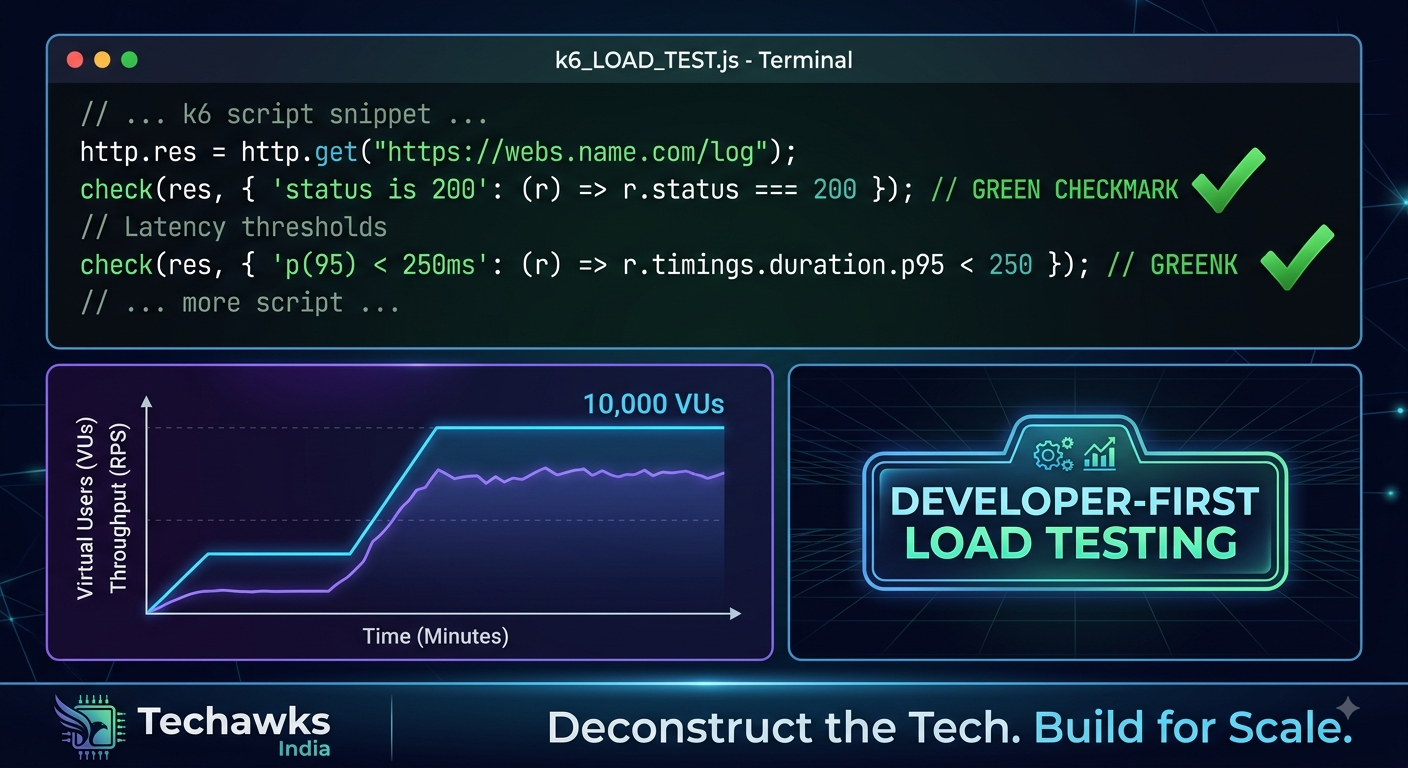
Unlike legacy tools that consume massive memory trying to simulate browser engines, k6 uses Go's concurrency primitives to generate thousands of virtual users (VUs) with minimal CPU and RAM usage on your local machine or CI server.
Key Features for Engineering Teams
Developer-Friendly Syntax: Scripts are written in clean ES6 JavaScript, making performance tests easy to write, review, and maintain inside your main repository alongside application code.
Low Resource Footprint: Capable of running high-concurrency tests (10k+ virtual users) directly from a standard dev laptop or lightweight CI runner.
Built for Automation: Integrates seamlessly into GitHub Actions, GitLab CI, or Jenkins, allowing teams to set performance thresholds (e.g., http_req_duration < 200ms for 95% of requests) that fail builds before degraded code hits production.
Native Observability Integration: Exports real-time metrics directly to Grafana, Prometheus, Datadog, or CSV files for instant debugging.
How to Action It: A 3-Step Testing Plan
Install and Script in 2 Minutes:
Install k6 via Homebrew, Chocolatey, or apt. Create a simple JS file to define ramping stages (e.g., ramp from 10 to 500 virtual users over 3 minutes).
Define Strict Performance Thresholds:
Set non-negotiable SLAs in your k6 script:
JavaScript
export const options = {
thresholds: {
http_req_duration: ['p(95)<250'], // 95% of requests must complete within 250ms
http_req_failed: ['rate<0.01'], // Error rate must stay below 1%
},
};
Automate in CI/CD:
Run k6 smoke tests on pull requests and full load tests on staging before every major deployment.
Key Takeaways
Shift-Left Performance Testing: k6 makes performance testing part of everyday development rather than a last-minute QA bottleneck.
Resource Efficient: Simulates massive user traffic with minimal hardware overhead compared to GUI-heavy alternatives.
Actionable Metrics: Measures Time To First Byte (TTFB), connection times, and payload transfer rates to give you clear data on backend bottlenecks.
CTA (Join Techawks India)
Building systems designed to handle millions of concurrent users?
Join Techawks India today—the official hub for engineers, system architects, and tech leaders deconstructing modern infrastructure, DevOps, and high-scale software design.
Tool Review: Why Grafana k6 Is the Gold Standard for Stress-Testing Indian Scale
Testing system resilience shouldn't require setting up complex, resource-heavy testing suites. k6 is an open-source, developer-centric load testing tool written in Go, designed to script performance tests natively in JavaScript or TypeScript.
Unlike legacy tools that consume massive memory trying to simulate browser engines, k6 uses Go's concurrency primitives to generate thousands of virtual users (VUs) with minimal CPU and RAM usage on your local machine or CI server.
Key Features for Engineering Teams
Developer-Friendly Syntax: Scripts are written in clean ES6 JavaScript, making performance tests easy to write, review, and maintain inside your main repository alongside application code.
Low Resource Footprint: Capable of running high-concurrency tests (10k+ virtual users) directly from a standard dev laptop or lightweight CI runner.
Built for Automation: Integrates seamlessly into GitHub Actions, GitLab CI, or Jenkins, allowing teams to set performance thresholds (e.g., http_req_duration < 200ms for 95% of requests) that fail builds before degraded code hits production.
Native Observability Integration: Exports real-time metrics directly to Grafana, Prometheus, Datadog, or CSV files for instant debugging.
How to Action It: A 3-Step Testing Plan
Install and Script in 2 Minutes:
Install k6 via Homebrew, Chocolatey, or apt. Create a simple JS file to define ramping stages (e.g., ramp from 10 to 500 virtual users over 3 minutes).
Define Strict Performance Thresholds:
Set non-negotiable SLAs in your k6 script:
JavaScript
export const options = {
thresholds: {
http_req_duration: ['p(95)<250'], // 95% of requests must complete within 250ms
http_req_failed: ['rate<0.01'], // Error rate must stay below 1%
},
};
Automate in CI/CD:
Run k6 smoke tests on pull requests and full load tests on staging before every major deployment.
Key Takeaways
Shift-Left Performance Testing: k6 makes performance testing part of everyday development rather than a last-minute QA bottleneck.
Resource Efficient: Simulates massive user traffic with minimal hardware overhead compared to GUI-heavy alternatives.
Actionable Metrics: Measures Time To First Byte (TTFB), connection times, and payload transfer rates to give you clear data on backend bottlenecks.
CTA (Join Techawks India)
Building systems designed to handle millions of concurrent users?
Join Techawks India today—the official hub for engineers, system architects, and tech leaders deconstructing modern infrastructure, DevOps, and high-scale software design.
Headline
Tool Review: Why Grafana k6 Is the Gold Standard for Stress-Testing Indian Scale
Testing system resilience shouldn't require setting up complex, resource-heavy testing suites. k6 is an open-source, developer-centric load testing tool written in Go, designed to script performance tests natively in JavaScript or TypeScript.
Unlike legacy tools that consume massive memory trying to simulate browser engines, k6 uses Go's concurrency primitives to generate thousands of virtual users (VUs) with minimal CPU and RAM usage on your local machine or CI server.
Key Features for Engineering Teams
Developer-Friendly Syntax: Scripts are written in clean ES6 JavaScript, making performance tests easy to write, review, and maintain inside your main repository alongside application code.
Low Resource Footprint: Capable of running high-concurrency tests (10k+ virtual users) directly from a standard dev laptop or lightweight CI runner.
Built for Automation: Integrates seamlessly into GitHub Actions, GitLab CI, or Jenkins, allowing teams to set performance thresholds (e.g., http_req_duration < 200ms for 95% of requests) that fail builds before degraded code hits production.
Native Observability Integration: Exports real-time metrics directly to Grafana, Prometheus, Datadog, or CSV files for instant debugging.
How to Action It: A 3-Step Testing Plan
Install and Script in 2 Minutes:
Install k6 via Homebrew, Chocolatey, or apt. Create a simple JS file to define ramping stages (e.g., ramp from 10 to 500 virtual users over 3 minutes).
Define Strict Performance Thresholds:
Set non-negotiable SLAs in your k6 script:
JavaScript
export const options = {
thresholds: {
http_req_duration: ['p(95)<250'], // 95% of requests must complete within 250ms
http_req_failed: ['rate<0.01'], // Error rate must stay below 1%
},
};
Automate in CI/CD:
Run k6 smoke tests on pull requests and full load tests on staging before every major deployment.
Key Takeaways
Shift-Left Performance Testing: k6 makes performance testing part of everyday development rather than a last-minute QA bottleneck.
Resource Efficient: Simulates massive user traffic with minimal hardware overhead compared to GUI-heavy alternatives.
Actionable Metrics: Measures Time To First Byte (TTFB), connection times, and payload transfer rates to give you clear data on backend bottlenecks.
CTA (Join Techawks India)
Building systems designed to handle millions of concurrent users?
Join Techawks India today—the official hub for engineers, system architects, and tech leaders deconstructing modern infrastructure, DevOps, and high-scale software design.

 Arabic
 French
 Spanish
 Portuguese
 Deutsch
 Turkish
 Dutch
Dutch
 Italiano
 Russian
 Romaian
 Portuguese (Brazil)
 Greek
Greek