


The GDPR & Data Residency Challenge: Is Your Cloud Architecture Compliance-Safe Under Audit?
Here is your engineering challenge for this week: Run an automated data-leak audit on your application’s logging and telemetry pipeline.
With strict UK GDPR and ICO regulatory standards, data residency isn't just a legal checkbox—it's a fundamental system design requirement. A single unmasked email address or IP logged in an unencrypted telemetry stream can breach data protection frameworks.
Take on the Techawks Data Residency Challenge with this 3-step compliance refactor:
1. Implement In-Flight PII Scrubbing
Never rely on developer discipline alone to keep PII out of logs.
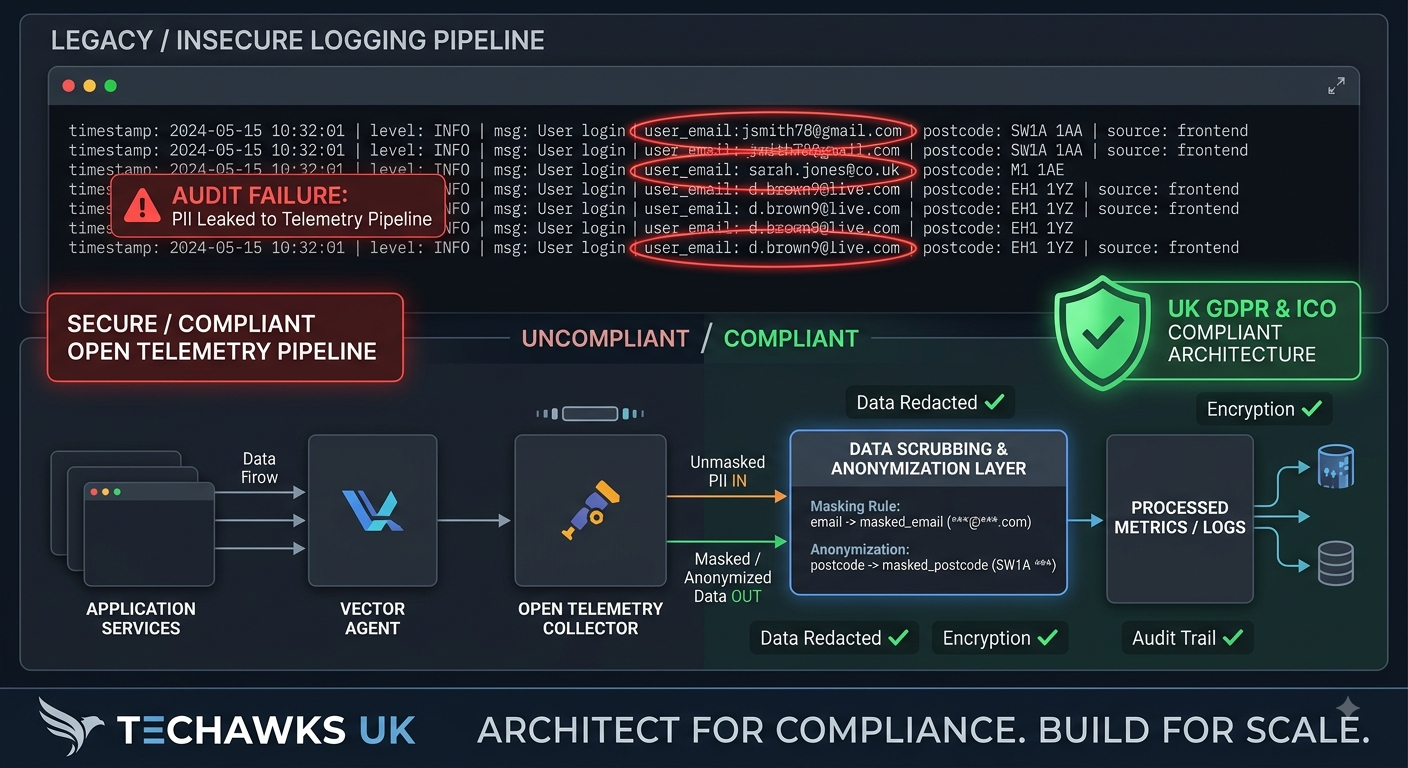
Action: Configure your log aggregators (e.g., FluentBit, Vector, or OpenTelemetry Collector) with strict regex-based redactors. Automatically mask email addresses, UK postcodes, phone numbers, and authorization headers before they leave your cluster memory.
2. Map Downstream Third-Party Data Flows
Your core application might reside in a London cloud region (like eu-west-2), but what about your vendors?
Action: Audit all third-party SDKs, error trackers (e.g., Sentry), and analytics tools. Ensure data processing agreements (DPAs) are in place and that data ingestion endpoints are pinned specifically to UK/EU regional nodes.
3. Automate Data Subject Access Requests (DSARs) & Right to Erasure
Manually writing SQL scripts to delete user records when a erasure request comes in is error-prone and unscalable.
Action: Architect a deterministic soft-delete and hard-anonymization workflow. Ensure cascading deletions reach your event queues, read-models, and search indexes (e.g., Elasticsearch) within required regulatory timeframes.
Key Takeaways
Logs are data stores: Telemetry and error logs fall under the same regulatory umbrella as your primary relational database.
Scrub at the edge: Mask PII at the collector/agent level before it crosses network boundaries.
Automate erasure paths: Design event-driven hard-deletion pipelines into your system architecture from day one.
CTA (Join Techawks UK)
Building high-scale, compliance-first software systems?
Join Techawks UK today. Connect with lead architects, security engineers, and tech pioneers across the UK discussing battle-tested strategies for data governance, cloud architecture, and modern platform engineering.
Here is your engineering challenge for this week: Run an automated data-leak audit on your application’s logging and telemetry pipeline.
With strict UK GDPR and ICO regulatory standards, data residency isn't just a legal checkbox—it's a fundamental system design requirement. A single unmasked email address or IP logged in an unencrypted telemetry stream can breach data protection frameworks.
Take on the Techawks Data Residency Challenge with this 3-step compliance refactor:
1. Implement In-Flight PII Scrubbing
Never rely on developer discipline alone to keep PII out of logs.
Action: Configure your log aggregators (e.g., FluentBit, Vector, or OpenTelemetry Collector) with strict regex-based redactors. Automatically mask email addresses, UK postcodes, phone numbers, and authorization headers before they leave your cluster memory.
2. Map Downstream Third-Party Data Flows
Your core application might reside in a London cloud region (like eu-west-2), but what about your vendors?
Action: Audit all third-party SDKs, error trackers (e.g., Sentry), and analytics tools. Ensure data processing agreements (DPAs) are in place and that data ingestion endpoints are pinned specifically to UK/EU regional nodes.
3. Automate Data Subject Access Requests (DSARs) & Right to Erasure
Manually writing SQL scripts to delete user records when a erasure request comes in is error-prone and unscalable.
Action: Architect a deterministic soft-delete and hard-anonymization workflow. Ensure cascading deletions reach your event queues, read-models, and search indexes (e.g., Elasticsearch) within required regulatory timeframes.
Key Takeaways
Logs are data stores: Telemetry and error logs fall under the same regulatory umbrella as your primary relational database.
Scrub at the edge: Mask PII at the collector/agent level before it crosses network boundaries.
Automate erasure paths: Design event-driven hard-deletion pipelines into your system architecture from day one.
CTA (Join Techawks UK)
Building high-scale, compliance-first software systems?
Join Techawks UK today. Connect with lead architects, security engineers, and tech pioneers across the UK discussing battle-tested strategies for data governance, cloud architecture, and modern platform engineering.
The GDPR & Data Residency Challenge: Is Your Cloud Architecture Compliance-Safe Under Audit?
Here is your engineering challenge for this week: Run an automated data-leak audit on your application’s logging and telemetry pipeline.
With strict UK GDPR and ICO regulatory standards, data residency isn't just a legal checkbox—it's a fundamental system design requirement. A single unmasked email address or IP logged in an unencrypted telemetry stream can breach data protection frameworks.
Take on the Techawks Data Residency Challenge with this 3-step compliance refactor:
1. Implement In-Flight PII Scrubbing
Never rely on developer discipline alone to keep PII out of logs.
Action: Configure your log aggregators (e.g., FluentBit, Vector, or OpenTelemetry Collector) with strict regex-based redactors. Automatically mask email addresses, UK postcodes, phone numbers, and authorization headers before they leave your cluster memory.
2. Map Downstream Third-Party Data Flows
Your core application might reside in a London cloud region (like eu-west-2), but what about your vendors?
Action: Audit all third-party SDKs, error trackers (e.g., Sentry), and analytics tools. Ensure data processing agreements (DPAs) are in place and that data ingestion endpoints are pinned specifically to UK/EU regional nodes.
3. Automate Data Subject Access Requests (DSARs) & Right to Erasure
Manually writing SQL scripts to delete user records when a erasure request comes in is error-prone and unscalable.
Action: Architect a deterministic soft-delete and hard-anonymization workflow. Ensure cascading deletions reach your event queues, read-models, and search indexes (e.g., Elasticsearch) within required regulatory timeframes.
Key Takeaways
Logs are data stores: Telemetry and error logs fall under the same regulatory umbrella as your primary relational database.
Scrub at the edge: Mask PII at the collector/agent level before it crosses network boundaries.
Automate erasure paths: Design event-driven hard-deletion pipelines into your system architecture from day one.
CTA (Join Techawks UK)
Building high-scale, compliance-first software systems?
Join Techawks UK today. Connect with lead architects, security engineers, and tech pioneers across the UK discussing battle-tested strategies for data governance, cloud architecture, and modern platform engineering.

 English
 Arabic
 French
 Spanish
 Portuguese
 Deutsch
 Turkish
 Dutch
Dutch
 Italiano
 Romaian
 Portuguese (Brazil)
 Greek
Greek