


The 7-Day Architecture Challenge: Is Your Cloud Data Ready for the UAE Personal Data Protection Law?
🚨 The Challenge
Over the next 7 days, we challenge your engineering and DevOps leads to inspect your production observability and data pipelines for PDPL non-compliance.
Under UAE PDPL, processing personal data without explicit consent or adequate sanitization carries heavy regulatory penalties. The biggest blind spot? Telemetry and logging layers.
Here are 3 core tests your team must run this week:
🧪 Test 1: The Raw Log Audit
The Task: Query your centralized log management tool (Elastic, Datadog, CloudWatch) for key UAE identifiers like Emirates IDs, phone numbers (+971), or physical addresses.
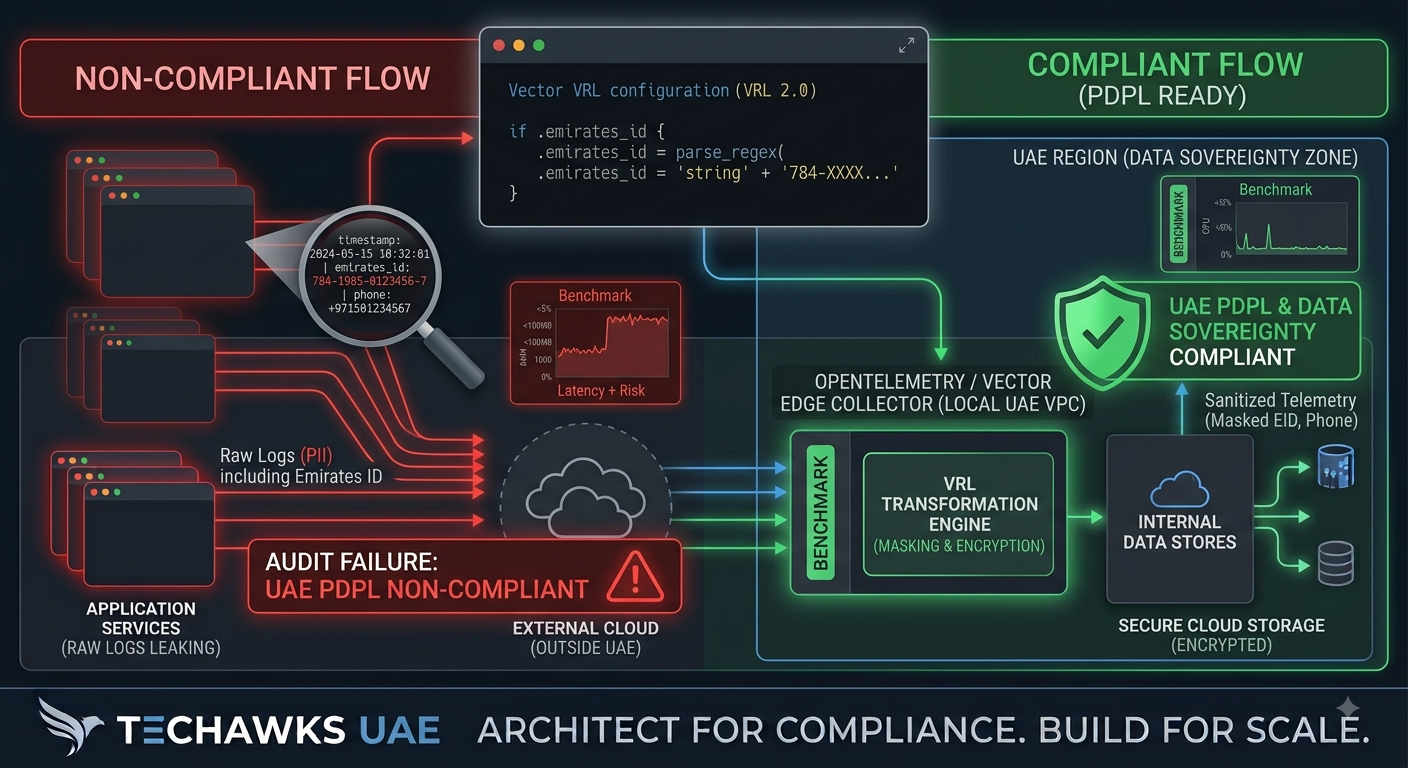
The Goal: Verify zero raw PII is written to long-term index storage. If unmasked identifiers appear in standard operational logs, your application services are leaking data.
🧪 Test 2: The Cross-Border Telemetry Flow
The Task: Trace the egress path of your trace data and metrics.
The Goal: Confirm that telemetry generated within UAE cloud infrastructure isn't automatically exported to third-party SaaS platforms hosted outside the GCC without edge-level redaction and encryption.
🧪 Test 3: The Edge-Sanitizer Verification
The Task: Inspect your collector layer (OpenTelemetry Collector, Vector, or FluentBit).
The Goal: Ensure transformation rules actively mask Emirates IDs (784-XXXX-XXXXXXX-X) and hash user credentials before the payload crosses out of your VPC.
🛠️ Practical Fix: Enforce Ingestion-Layer Redaction
Don't rely on developers to manually redact logs in application code. Implement an edge collector pattern within your UAE cloud VPC:
Deploy Local Ingestion Proxies: Pass all application logs through an in-region OpenTelemetry Collector or Vector node.
Automate Regex Transformations: Enforce strict VRL or Regex parsing rules at the proxy layer to strip or hash Emirates IDs, phone numbers, and location coordinates.
Audit Data Sovereign Paths: Ensure raw audit streams remain in encrypted, local object storage, while sanitized metrics route to your global observability dashboards.
Key Takeaways
Data Residency ≠ Full Compliance: Hosting servers in the UAE doesn't protect you if telemetry streams expose unmasked PII.
Redact at the Edge: Mask sensitive data like Emirates IDs inside your local VPC boundary before forwarding to third-party monitoring vendors.
Automate Compliance Rules: Use ingestion proxies (OpenTelemetry/Vector) to enforce privacy standards centrally rather than trusting individual microservices.
CTA (Join Techawks UAE)
Ready to elevate your cloud architecture and stay ahead of GCC data governance standards?
👉 [Join Techawks UAE today] to connect with premier Middle East system architects, access localized DevOps blueprints, and build enterprise platforms engineered for compliance and scale.
🚨 The Challenge
Over the next 7 days, we challenge your engineering and DevOps leads to inspect your production observability and data pipelines for PDPL non-compliance.
Under UAE PDPL, processing personal data without explicit consent or adequate sanitization carries heavy regulatory penalties. The biggest blind spot? Telemetry and logging layers.
Here are 3 core tests your team must run this week:
🧪 Test 1: The Raw Log Audit
The Task: Query your centralized log management tool (Elastic, Datadog, CloudWatch) for key UAE identifiers like Emirates IDs, phone numbers (+971), or physical addresses.
The Goal: Verify zero raw PII is written to long-term index storage. If unmasked identifiers appear in standard operational logs, your application services are leaking data.
🧪 Test 2: The Cross-Border Telemetry Flow
The Task: Trace the egress path of your trace data and metrics.
The Goal: Confirm that telemetry generated within UAE cloud infrastructure isn't automatically exported to third-party SaaS platforms hosted outside the GCC without edge-level redaction and encryption.
🧪 Test 3: The Edge-Sanitizer Verification
The Task: Inspect your collector layer (OpenTelemetry Collector, Vector, or FluentBit).
The Goal: Ensure transformation rules actively mask Emirates IDs (784-XXXX-XXXXXXX-X) and hash user credentials before the payload crosses out of your VPC.
🛠️ Practical Fix: Enforce Ingestion-Layer Redaction
Don't rely on developers to manually redact logs in application code. Implement an edge collector pattern within your UAE cloud VPC:
Deploy Local Ingestion Proxies: Pass all application logs through an in-region OpenTelemetry Collector or Vector node.
Automate Regex Transformations: Enforce strict VRL or Regex parsing rules at the proxy layer to strip or hash Emirates IDs, phone numbers, and location coordinates.
Audit Data Sovereign Paths: Ensure raw audit streams remain in encrypted, local object storage, while sanitized metrics route to your global observability dashboards.
Key Takeaways
Data Residency ≠ Full Compliance: Hosting servers in the UAE doesn't protect you if telemetry streams expose unmasked PII.
Redact at the Edge: Mask sensitive data like Emirates IDs inside your local VPC boundary before forwarding to third-party monitoring vendors.
Automate Compliance Rules: Use ingestion proxies (OpenTelemetry/Vector) to enforce privacy standards centrally rather than trusting individual microservices.
CTA (Join Techawks UAE)
Ready to elevate your cloud architecture and stay ahead of GCC data governance standards?
👉 [Join Techawks UAE today] to connect with premier Middle East system architects, access localized DevOps blueprints, and build enterprise platforms engineered for compliance and scale.
The 7-Day Architecture Challenge: Is Your Cloud Data Ready for the UAE Personal Data Protection Law?
🚨 The Challenge
Over the next 7 days, we challenge your engineering and DevOps leads to inspect your production observability and data pipelines for PDPL non-compliance.
Under UAE PDPL, processing personal data without explicit consent or adequate sanitization carries heavy regulatory penalties. The biggest blind spot? Telemetry and logging layers.
Here are 3 core tests your team must run this week:
🧪 Test 1: The Raw Log Audit
The Task: Query your centralized log management tool (Elastic, Datadog, CloudWatch) for key UAE identifiers like Emirates IDs, phone numbers (+971), or physical addresses.
The Goal: Verify zero raw PII is written to long-term index storage. If unmasked identifiers appear in standard operational logs, your application services are leaking data.
🧪 Test 2: The Cross-Border Telemetry Flow
The Task: Trace the egress path of your trace data and metrics.
The Goal: Confirm that telemetry generated within UAE cloud infrastructure isn't automatically exported to third-party SaaS platforms hosted outside the GCC without edge-level redaction and encryption.
🧪 Test 3: The Edge-Sanitizer Verification
The Task: Inspect your collector layer (OpenTelemetry Collector, Vector, or FluentBit).
The Goal: Ensure transformation rules actively mask Emirates IDs (784-XXXX-XXXXXXX-X) and hash user credentials before the payload crosses out of your VPC.
🛠️ Practical Fix: Enforce Ingestion-Layer Redaction
Don't rely on developers to manually redact logs in application code. Implement an edge collector pattern within your UAE cloud VPC:
Deploy Local Ingestion Proxies: Pass all application logs through an in-region OpenTelemetry Collector or Vector node.
Automate Regex Transformations: Enforce strict VRL or Regex parsing rules at the proxy layer to strip or hash Emirates IDs, phone numbers, and location coordinates.
Audit Data Sovereign Paths: Ensure raw audit streams remain in encrypted, local object storage, while sanitized metrics route to your global observability dashboards.
Key Takeaways
Data Residency ≠ Full Compliance: Hosting servers in the UAE doesn't protect you if telemetry streams expose unmasked PII.
Redact at the Edge: Mask sensitive data like Emirates IDs inside your local VPC boundary before forwarding to third-party monitoring vendors.
Automate Compliance Rules: Use ingestion proxies (OpenTelemetry/Vector) to enforce privacy standards centrally rather than trusting individual microservices.
CTA (Join Techawks UAE)
Ready to elevate your cloud architecture and stay ahead of GCC data governance standards?
👉 [Join Techawks UAE today] to connect with premier Middle East system architects, access localized DevOps blueprints, and build enterprise platforms engineered for compliance and scale.

 Arabic
 French
 Spanish
 Portuguese
 Deutsch
 Turkish
 Dutch
Dutch
 Italiano
 Russian
 Romaian
 Portuguese (Brazil)
 Greek
Greek