


Tool Review: Is OpenTelemetry Collector the Right Choice for UAE PDPL Architecture?
What is the OpenTelemetry Collector?
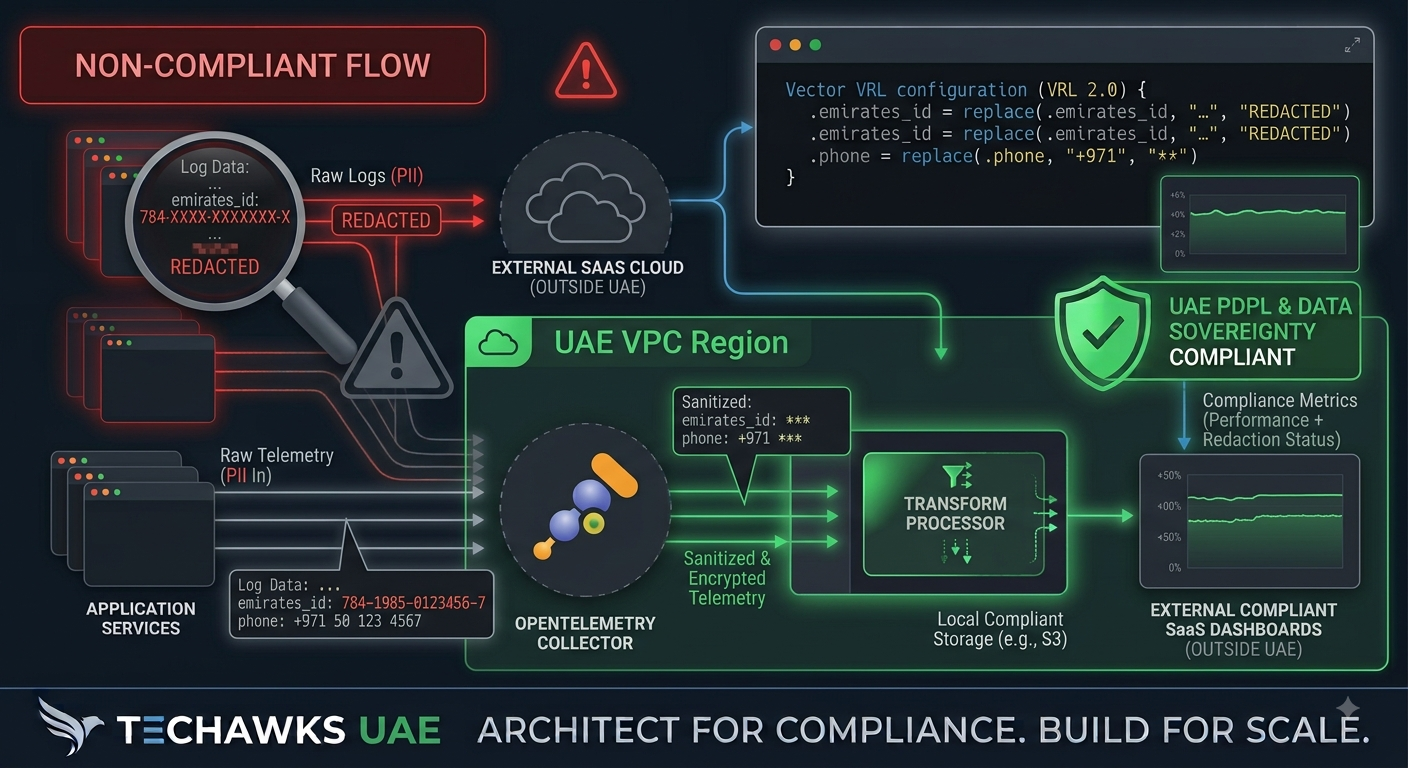
The OpenTelemetry Collector is a vendor-agnostic proxy component that accepts, processes, and exports telemetry data (metrics, logs, and traces). It sits between your application workloads and your backend monitoring destinations, giving you complete control over every byte of telemetry generated across your stack.
🟢 Where OTel Collector Excels
Strict In-VPC Data Boundary: Runs directly inside your local UAE cloud infrastructure (e.g., AWS me-central-1 or Azure UAE North). This ensures all data transformation happens before egress.
Powerful Attribute Masking (Transform Processor): Native processors allow you to redact or replace sensitive UAE identifiers—such as Emirates IDs (784-XXXX...) or mobile numbers (+971...)—at ingestion time.
Vendor Decoupling: Easily route sanitized operational metrics to third-party SaaS platforms while keeping raw, encrypted audit logs locked inside compliant local cloud storage.
🟡 Where It Falls Short
Configuration Overhead: YAML-based pipeline configurations can become verbose and complex as masking rules and routing paths grow across microservices.
Resource Tuning Required: Under high throughput, memory limits must be calibrated carefully using the memory_limiter processor to prevent container OOM (Out Of Memory) crashes during traffic spikes.
🛠️ Practical Verdict: How to Build a Compliant Telemetry Pipeline in the UAE
To ensure alignment with Federal Decree-Law No. 45 (UAE PDPL), leverage the OTel Collector using this deployment strategy:
Deploy as an In-Region Gateway: Run the OTel Collector as a dedicated cluster inside your local UAE VPC boundary.
Configure Edge Masking: Use the transform processor with regex logic to hash personal email addresses and mask Emirates ID numbers prior to export.
Establish Sovereign Dual-Routing: Send scrubbed, compliant metrics to external observability platforms while storing raw, encrypted logs in a local, access-controlled S3/Blob bucket within the UAE region.
Key Takeaways
Ingestion-Layer Control: OTel Collector gives engineering teams complete control over PII redaction inside their own network perimeter.
UAE PDPL Readiness: Strip Emirates IDs, phone numbers, and location coordinates before telemetry leaves the local VPC.
No Vendor Lock-in: Move freely between observability vendors without rewriting application-level instrumentation code.
CTA (Join Techawks UAE)
Building high-scale, compliant cloud infrastructure in the UAE and Middle East?
👉 [Join Techawks UAE today] to access production-ready OTel collector configurations, connect with local enterprise architects, and master cloud compliance at scale.
What is the OpenTelemetry Collector?
The OpenTelemetry Collector is a vendor-agnostic proxy component that accepts, processes, and exports telemetry data (metrics, logs, and traces). It sits between your application workloads and your backend monitoring destinations, giving you complete control over every byte of telemetry generated across your stack.
🟢 Where OTel Collector Excels
Strict In-VPC Data Boundary: Runs directly inside your local UAE cloud infrastructure (e.g., AWS me-central-1 or Azure UAE North). This ensures all data transformation happens before egress.
Powerful Attribute Masking (Transform Processor): Native processors allow you to redact or replace sensitive UAE identifiers—such as Emirates IDs (784-XXXX...) or mobile numbers (+971...)—at ingestion time.
Vendor Decoupling: Easily route sanitized operational metrics to third-party SaaS platforms while keeping raw, encrypted audit logs locked inside compliant local cloud storage.
🟡 Where It Falls Short
Configuration Overhead: YAML-based pipeline configurations can become verbose and complex as masking rules and routing paths grow across microservices.
Resource Tuning Required: Under high throughput, memory limits must be calibrated carefully using the memory_limiter processor to prevent container OOM (Out Of Memory) crashes during traffic spikes.
🛠️ Practical Verdict: How to Build a Compliant Telemetry Pipeline in the UAE
To ensure alignment with Federal Decree-Law No. 45 (UAE PDPL), leverage the OTel Collector using this deployment strategy:
Deploy as an In-Region Gateway: Run the OTel Collector as a dedicated cluster inside your local UAE VPC boundary.
Configure Edge Masking: Use the transform processor with regex logic to hash personal email addresses and mask Emirates ID numbers prior to export.
Establish Sovereign Dual-Routing: Send scrubbed, compliant metrics to external observability platforms while storing raw, encrypted logs in a local, access-controlled S3/Blob bucket within the UAE region.
Key Takeaways
Ingestion-Layer Control: OTel Collector gives engineering teams complete control over PII redaction inside their own network perimeter.
UAE PDPL Readiness: Strip Emirates IDs, phone numbers, and location coordinates before telemetry leaves the local VPC.
No Vendor Lock-in: Move freely between observability vendors without rewriting application-level instrumentation code.
CTA (Join Techawks UAE)
Building high-scale, compliant cloud infrastructure in the UAE and Middle East?
👉 [Join Techawks UAE today] to access production-ready OTel collector configurations, connect with local enterprise architects, and master cloud compliance at scale.
Tool Review: Is OpenTelemetry Collector the Right Choice for UAE PDPL Architecture?
What is the OpenTelemetry Collector?
The OpenTelemetry Collector is a vendor-agnostic proxy component that accepts, processes, and exports telemetry data (metrics, logs, and traces). It sits between your application workloads and your backend monitoring destinations, giving you complete control over every byte of telemetry generated across your stack.
🟢 Where OTel Collector Excels
Strict In-VPC Data Boundary: Runs directly inside your local UAE cloud infrastructure (e.g., AWS me-central-1 or Azure UAE North). This ensures all data transformation happens before egress.
Powerful Attribute Masking (Transform Processor): Native processors allow you to redact or replace sensitive UAE identifiers—such as Emirates IDs (784-XXXX...) or mobile numbers (+971...)—at ingestion time.
Vendor Decoupling: Easily route sanitized operational metrics to third-party SaaS platforms while keeping raw, encrypted audit logs locked inside compliant local cloud storage.
🟡 Where It Falls Short
Configuration Overhead: YAML-based pipeline configurations can become verbose and complex as masking rules and routing paths grow across microservices.
Resource Tuning Required: Under high throughput, memory limits must be calibrated carefully using the memory_limiter processor to prevent container OOM (Out Of Memory) crashes during traffic spikes.
🛠️ Practical Verdict: How to Build a Compliant Telemetry Pipeline in the UAE
To ensure alignment with Federal Decree-Law No. 45 (UAE PDPL), leverage the OTel Collector using this deployment strategy:
Deploy as an In-Region Gateway: Run the OTel Collector as a dedicated cluster inside your local UAE VPC boundary.
Configure Edge Masking: Use the transform processor with regex logic to hash personal email addresses and mask Emirates ID numbers prior to export.
Establish Sovereign Dual-Routing: Send scrubbed, compliant metrics to external observability platforms while storing raw, encrypted logs in a local, access-controlled S3/Blob bucket within the UAE region.
Key Takeaways
Ingestion-Layer Control: OTel Collector gives engineering teams complete control over PII redaction inside their own network perimeter.
UAE PDPL Readiness: Strip Emirates IDs, phone numbers, and location coordinates before telemetry leaves the local VPC.
No Vendor Lock-in: Move freely between observability vendors without rewriting application-level instrumentation code.
CTA (Join Techawks UAE)
Building high-scale, compliant cloud infrastructure in the UAE and Middle East?
👉 [Join Techawks UAE today] to access production-ready OTel collector configurations, connect with local enterprise architects, and master cloud compliance at scale.

 English
 Arabic
 Spanish
 Portuguese
 Deutsch
 Turkish
 Dutch
Dutch
 Italiano
 Russian
 Romaian
 Portuguese (Brazil)
 Greek
Greek