


The 7-Day Architecture Challenge: Is Your Telemetry Leaking Canadian PII Across Provincial Lines?
🚨 The Challenge
Over the next 7 days, we challenge your engineering and DevOps leads to inspect your production application logging and telemetry layers for provincial and federal non-compliance.
Under Canadian privacy frameworks (including PIPEDA and Quebec's stringent Law 25), transmitting identifiable user information—such as full Canadian postal codes (K1A 0B1), email addresses, or static IP addresses—into unencrypted secondary log stores or cross-border SaaS tools without explicit consent or anonymization creates severe regulatory exposure.
Run these 3 core tests on your stack this week:
🧪 Test 1: The Raw Log Audit
The Task: Query your centralized log aggregator (Elastic, Datadog, Grafana Loki) for key Canadian PII patterns.
The Goal: Search for unmasked Canadian postal codes, phone numbers, and personal email handles in application stdout/stderr streams. Verify zero raw PII is indexed in operational log stores.
🧪 Test 2: The Egress & Cross-Border Boundary Check
The Task: Trace the exact egress network route of your traces, metrics, and log streams.
The Goal: Confirm that telemetry generated by Canadian users is not crossing national or provincial boundaries into third-party monitoring platforms before undergoing in-VPC scrubbing.
🧪 Test 3: The Ingestion Proxy Verification
The Task: Audit your edge collector layer (OpenTelemetry Collector, Vector, or FluentBit).
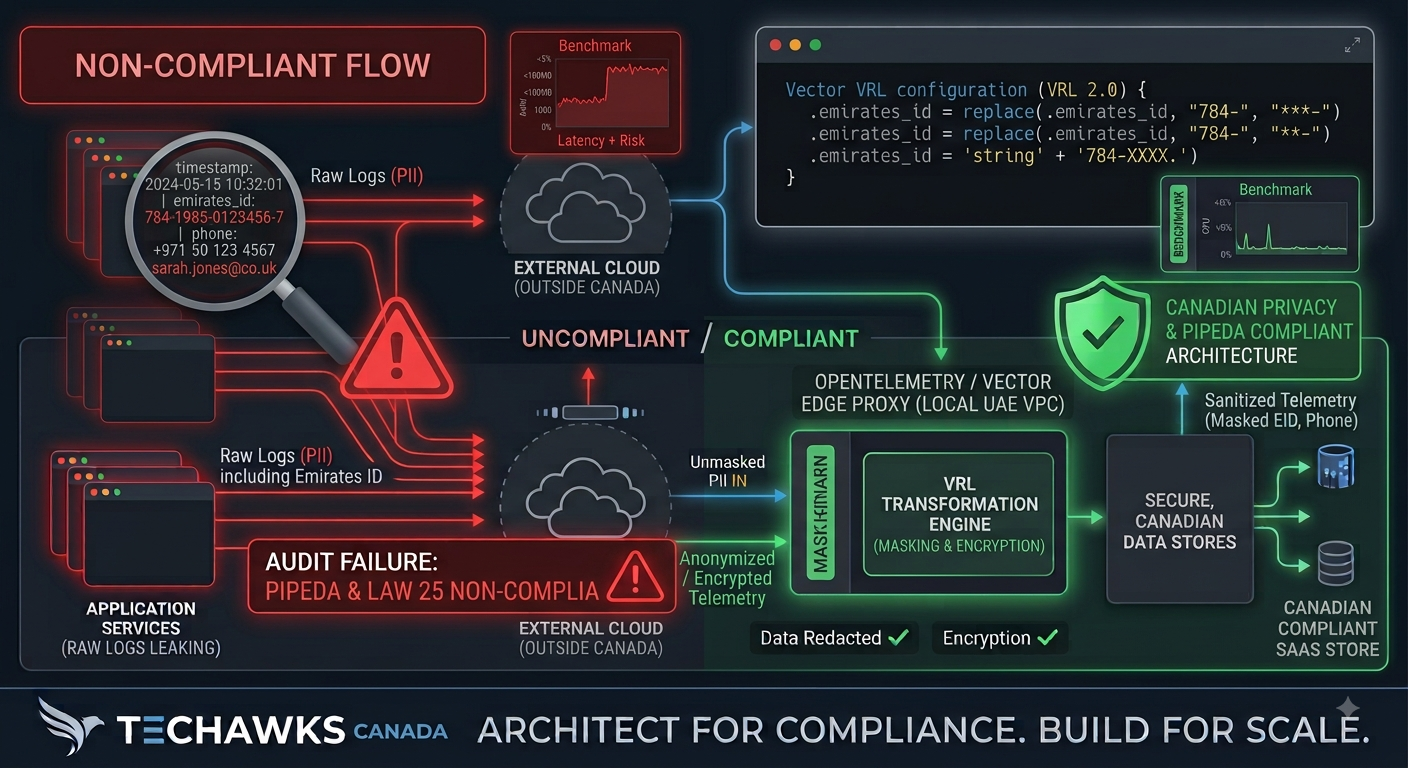
The Goal: Verify that transformation rules actively redact or hash identifiers at the source node—truncating postcodes to the forward sort area (e.g., K1A ***) before data packets hit the network wire.
🛠️ Practical Fix: Enforce Edge-Layer Redaction
Don't rely on individual developers to remember to sanitize every log statement in application code. Enforce privacy at the infrastructure edge:
Deploy In-VPC Collectors: Run dedicated OpenTelemetry Collector or Vector proxies inside your Canadian cloud boundary.
Apply Ingestion Regex Rules: Use collector-level transformation processors to scrub emails, truncate postal codes, and mask IP addresses at the ingestion point.
Isolate Audit Streams: Route fully anonymized metrics to global monitoring dashboards while storing encrypted, access-controlled raw audit logs within local Canadian storage.
Key Takeaways
Logs Are In Scope: IP addresses, full postal codes, and user handles in telemetry fall strictly under Canadian privacy standards.
Hosting Is Not Enough: In-region cloud hosting doesn't protect your organization if outbound telemetry streams export raw user data across borders.
Scrub at the Ingestion Layer: Implement OpenTelemetry or Vector collectors within your Canadian VPC boundary to automate sanitization prior to egress.
CTA (Join Techawks Canada)
Looking to modernise your cloud architecture and build privacy-first telemetry pipelines?
👉 [Join Techawks Canada today] to connect with top-tier Canadian system architects, access localized compliance blueprints, and build infrastructure engineered for scale.
🚨 The Challenge
Over the next 7 days, we challenge your engineering and DevOps leads to inspect your production application logging and telemetry layers for provincial and federal non-compliance.
Under Canadian privacy frameworks (including PIPEDA and Quebec's stringent Law 25), transmitting identifiable user information—such as full Canadian postal codes (K1A 0B1), email addresses, or static IP addresses—into unencrypted secondary log stores or cross-border SaaS tools without explicit consent or anonymization creates severe regulatory exposure.
Run these 3 core tests on your stack this week:
🧪 Test 1: The Raw Log Audit
The Task: Query your centralized log aggregator (Elastic, Datadog, Grafana Loki) for key Canadian PII patterns.
The Goal: Search for unmasked Canadian postal codes, phone numbers, and personal email handles in application stdout/stderr streams. Verify zero raw PII is indexed in operational log stores.
🧪 Test 2: The Egress & Cross-Border Boundary Check
The Task: Trace the exact egress network route of your traces, metrics, and log streams.
The Goal: Confirm that telemetry generated by Canadian users is not crossing national or provincial boundaries into third-party monitoring platforms before undergoing in-VPC scrubbing.
🧪 Test 3: The Ingestion Proxy Verification
The Task: Audit your edge collector layer (OpenTelemetry Collector, Vector, or FluentBit).
The Goal: Verify that transformation rules actively redact or hash identifiers at the source node—truncating postcodes to the forward sort area (e.g., K1A ***) before data packets hit the network wire.
🛠️ Practical Fix: Enforce Edge-Layer Redaction
Don't rely on individual developers to remember to sanitize every log statement in application code. Enforce privacy at the infrastructure edge:
Deploy In-VPC Collectors: Run dedicated OpenTelemetry Collector or Vector proxies inside your Canadian cloud boundary.
Apply Ingestion Regex Rules: Use collector-level transformation processors to scrub emails, truncate postal codes, and mask IP addresses at the ingestion point.
Isolate Audit Streams: Route fully anonymized metrics to global monitoring dashboards while storing encrypted, access-controlled raw audit logs within local Canadian storage.
Key Takeaways
Logs Are In Scope: IP addresses, full postal codes, and user handles in telemetry fall strictly under Canadian privacy standards.
Hosting Is Not Enough: In-region cloud hosting doesn't protect your organization if outbound telemetry streams export raw user data across borders.
Scrub at the Ingestion Layer: Implement OpenTelemetry or Vector collectors within your Canadian VPC boundary to automate sanitization prior to egress.
CTA (Join Techawks Canada)
Looking to modernise your cloud architecture and build privacy-first telemetry pipelines?
👉 [Join Techawks Canada today] to connect with top-tier Canadian system architects, access localized compliance blueprints, and build infrastructure engineered for scale.
The 7-Day Architecture Challenge: Is Your Telemetry Leaking Canadian PII Across Provincial Lines?
🚨 The Challenge
Over the next 7 days, we challenge your engineering and DevOps leads to inspect your production application logging and telemetry layers for provincial and federal non-compliance.
Under Canadian privacy frameworks (including PIPEDA and Quebec's stringent Law 25), transmitting identifiable user information—such as full Canadian postal codes (K1A 0B1), email addresses, or static IP addresses—into unencrypted secondary log stores or cross-border SaaS tools without explicit consent or anonymization creates severe regulatory exposure.
Run these 3 core tests on your stack this week:
🧪 Test 1: The Raw Log Audit
The Task: Query your centralized log aggregator (Elastic, Datadog, Grafana Loki) for key Canadian PII patterns.
The Goal: Search for unmasked Canadian postal codes, phone numbers, and personal email handles in application stdout/stderr streams. Verify zero raw PII is indexed in operational log stores.
🧪 Test 2: The Egress & Cross-Border Boundary Check
The Task: Trace the exact egress network route of your traces, metrics, and log streams.
The Goal: Confirm that telemetry generated by Canadian users is not crossing national or provincial boundaries into third-party monitoring platforms before undergoing in-VPC scrubbing.
🧪 Test 3: The Ingestion Proxy Verification
The Task: Audit your edge collector layer (OpenTelemetry Collector, Vector, or FluentBit).
The Goal: Verify that transformation rules actively redact or hash identifiers at the source node—truncating postcodes to the forward sort area (e.g., K1A ***) before data packets hit the network wire.
🛠️ Practical Fix: Enforce Edge-Layer Redaction
Don't rely on individual developers to remember to sanitize every log statement in application code. Enforce privacy at the infrastructure edge:
Deploy In-VPC Collectors: Run dedicated OpenTelemetry Collector or Vector proxies inside your Canadian cloud boundary.
Apply Ingestion Regex Rules: Use collector-level transformation processors to scrub emails, truncate postal codes, and mask IP addresses at the ingestion point.
Isolate Audit Streams: Route fully anonymized metrics to global monitoring dashboards while storing encrypted, access-controlled raw audit logs within local Canadian storage.
Key Takeaways
Logs Are In Scope: IP addresses, full postal codes, and user handles in telemetry fall strictly under Canadian privacy standards.
Hosting Is Not Enough: In-region cloud hosting doesn't protect your organization if outbound telemetry streams export raw user data across borders.
Scrub at the Ingestion Layer: Implement OpenTelemetry or Vector collectors within your Canadian VPC boundary to automate sanitization prior to egress.
CTA (Join Techawks Canada)
Looking to modernise your cloud architecture and build privacy-first telemetry pipelines?
👉 [Join Techawks Canada today] to connect with top-tier Canadian system architects, access localized compliance blueprints, and build infrastructure engineered for scale.

 English
 Arabic
 French
 Spanish
 Portuguese
 Turkish
 Dutch
Dutch
 Italiano
 Russian
 Romaian
 Portuguese (Brazil)
 Greek
Greek