


Tool Review: Is Vector the Ultimate Pipeline Engine for Canadian PIPEDA & Law 25 Compliance?
What is Vector?
Vector (maintained by Datadog) is a lightweight, high-performance observability data pipeline built in Rust. It operates as an edge agent or aggregator sitting between your application services and downstream monitoring tools (such as Datadog, Grafana Loki, or CloudWatch). Its primary job is collecting, transforming, and routing telemetry events with minimal CPU and memory overhead.
🟢 Where Vector Excels
Extreme Performance & Memory Safety: Written in Rust, Vector handles high log volumes with sub-millisecond processing latency and low CPU overhead—making it ideal as a Kubernetes sidecar or DaemonSet in production Canadian deployments.
VRL (Vector Remap Language) Precision: Vector’s native expression language, VRL, allows developers to safely parse and sanitize unstructured logs. Unlike complex regex replacements, VRL provides compile-time checks to prevent runtime errors.
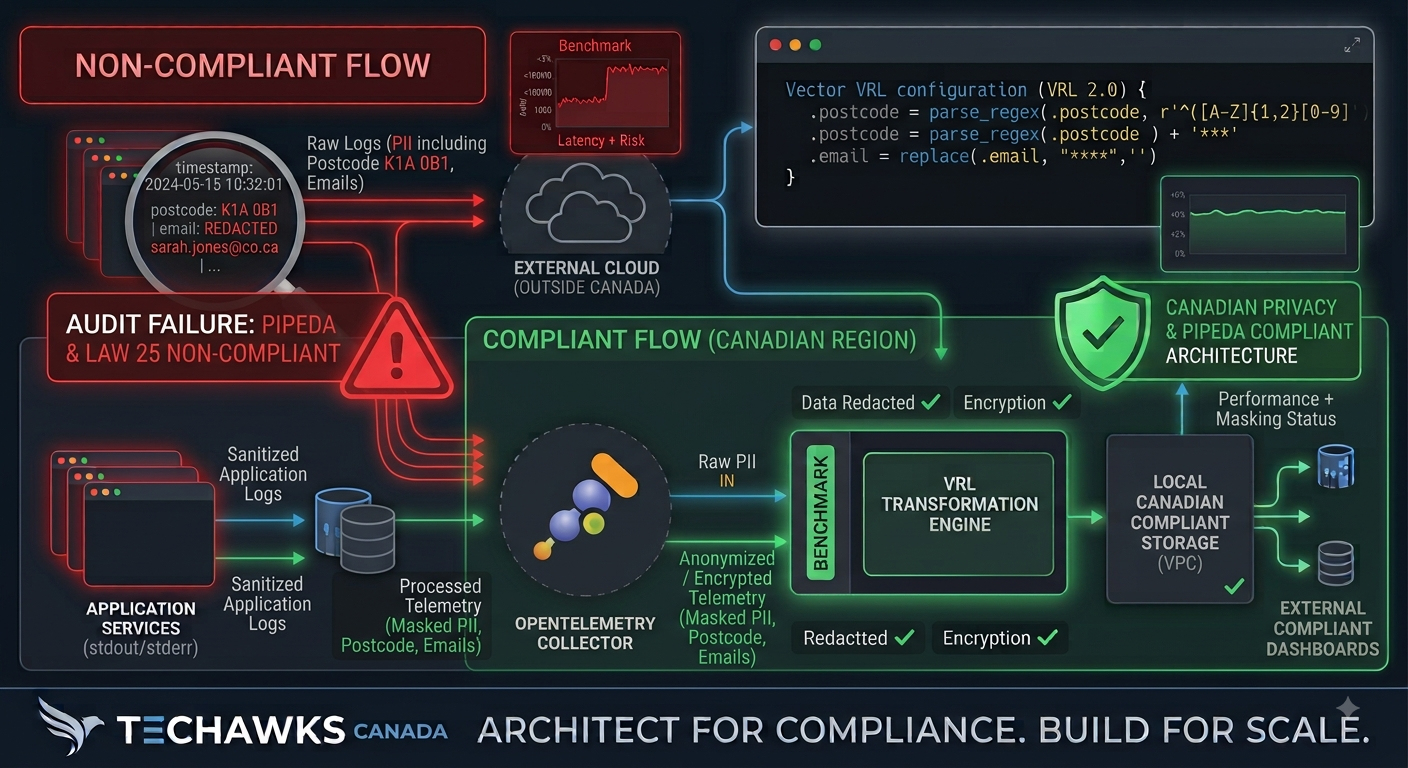
In-VPC Ingestion-Layer Redaction: Easily truncate Canadian postal codes to Forward Sortation Areas (e.g., K1A 0B1 to K1A ***), redact phone numbers, and hash user email addresses inside your AWS ca-central-1 or Azure Canada Central VPC before payload transmission across borders.
🟡 Where It Falls Short
VRL Learning Curve: Engineering teams need to learn VRL syntax rather than relying strictly on standard JSON-path parsing, which adds initial onboarding friction.
OTel Ecosystem Integration: While Vector supports OpenTelemetry log formats, its trace-handling capabilities are secondary compared to the native OpenTelemetry Collector.
🛠️ Practical Verdict: How to Deploy Vector for PIPEDA & Law 25 Compliance
If your organization operates under Canadian privacy regulations, Vector provides an exceptionally strong Privacy-by-Design foundation:
Deploy as an In-Region DaemonSet: Run Vector on the same node or Kubernetes cluster as your application within your Canadian cloud region.
Apply Edge-Level Masking Rules: Use VRL scripts at the collector level to redact email handles and strip exact location coordinates at the source.
Establish Sovereign Dual-Routing: Direct fully sanitized, anonymized metrics to external observability dashboards while piping raw, encrypted audit logs to restricted, local Canadian object storage.
Key Takeaways
Rust-Powered Speed: Delivers high throughput with a tiny memory footprint, perfect for high-throughput Canadian enterprise workloads.
Zero-Trust Telemetry: Guarantees PII redaction before logs leave your private VPC boundary.
VRL Capabilities: Granular data transformation built specifically for safe, high-volume log manipulation.
CTA (Join Techawks Canada)
Building high-scale, PIPEDA-compliant cloud infrastructure in Canada?
👉 [Join Techawks Canada today] to get hands-on VRL configuration templates, connect with local system architects, and master production DevOps tooling.
What is Vector?
Vector (maintained by Datadog) is a lightweight, high-performance observability data pipeline built in Rust. It operates as an edge agent or aggregator sitting between your application services and downstream monitoring tools (such as Datadog, Grafana Loki, or CloudWatch). Its primary job is collecting, transforming, and routing telemetry events with minimal CPU and memory overhead.
🟢 Where Vector Excels
Extreme Performance & Memory Safety: Written in Rust, Vector handles high log volumes with sub-millisecond processing latency and low CPU overhead—making it ideal as a Kubernetes sidecar or DaemonSet in production Canadian deployments.
VRL (Vector Remap Language) Precision: Vector’s native expression language, VRL, allows developers to safely parse and sanitize unstructured logs. Unlike complex regex replacements, VRL provides compile-time checks to prevent runtime errors.
In-VPC Ingestion-Layer Redaction: Easily truncate Canadian postal codes to Forward Sortation Areas (e.g., K1A 0B1 to K1A ***), redact phone numbers, and hash user email addresses inside your AWS ca-central-1 or Azure Canada Central VPC before payload transmission across borders.
🟡 Where It Falls Short
VRL Learning Curve: Engineering teams need to learn VRL syntax rather than relying strictly on standard JSON-path parsing, which adds initial onboarding friction.
OTel Ecosystem Integration: While Vector supports OpenTelemetry log formats, its trace-handling capabilities are secondary compared to the native OpenTelemetry Collector.
🛠️ Practical Verdict: How to Deploy Vector for PIPEDA & Law 25 Compliance
If your organization operates under Canadian privacy regulations, Vector provides an exceptionally strong Privacy-by-Design foundation:
Deploy as an In-Region DaemonSet: Run Vector on the same node or Kubernetes cluster as your application within your Canadian cloud region.
Apply Edge-Level Masking Rules: Use VRL scripts at the collector level to redact email handles and strip exact location coordinates at the source.
Establish Sovereign Dual-Routing: Direct fully sanitized, anonymized metrics to external observability dashboards while piping raw, encrypted audit logs to restricted, local Canadian object storage.
Key Takeaways
Rust-Powered Speed: Delivers high throughput with a tiny memory footprint, perfect for high-throughput Canadian enterprise workloads.
Zero-Trust Telemetry: Guarantees PII redaction before logs leave your private VPC boundary.
VRL Capabilities: Granular data transformation built specifically for safe, high-volume log manipulation.
CTA (Join Techawks Canada)
Building high-scale, PIPEDA-compliant cloud infrastructure in Canada?
👉 [Join Techawks Canada today] to get hands-on VRL configuration templates, connect with local system architects, and master production DevOps tooling.
Tool Review: Is Vector the Ultimate Pipeline Engine for Canadian PIPEDA & Law 25 Compliance?
What is Vector?
Vector (maintained by Datadog) is a lightweight, high-performance observability data pipeline built in Rust. It operates as an edge agent or aggregator sitting between your application services and downstream monitoring tools (such as Datadog, Grafana Loki, or CloudWatch). Its primary job is collecting, transforming, and routing telemetry events with minimal CPU and memory overhead.
🟢 Where Vector Excels
Extreme Performance & Memory Safety: Written in Rust, Vector handles high log volumes with sub-millisecond processing latency and low CPU overhead—making it ideal as a Kubernetes sidecar or DaemonSet in production Canadian deployments.
VRL (Vector Remap Language) Precision: Vector’s native expression language, VRL, allows developers to safely parse and sanitize unstructured logs. Unlike complex regex replacements, VRL provides compile-time checks to prevent runtime errors.
In-VPC Ingestion-Layer Redaction: Easily truncate Canadian postal codes to Forward Sortation Areas (e.g., K1A 0B1 to K1A ***), redact phone numbers, and hash user email addresses inside your AWS ca-central-1 or Azure Canada Central VPC before payload transmission across borders.
🟡 Where It Falls Short
VRL Learning Curve: Engineering teams need to learn VRL syntax rather than relying strictly on standard JSON-path parsing, which adds initial onboarding friction.
OTel Ecosystem Integration: While Vector supports OpenTelemetry log formats, its trace-handling capabilities are secondary compared to the native OpenTelemetry Collector.
🛠️ Practical Verdict: How to Deploy Vector for PIPEDA & Law 25 Compliance
If your organization operates under Canadian privacy regulations, Vector provides an exceptionally strong Privacy-by-Design foundation:
Deploy as an In-Region DaemonSet: Run Vector on the same node or Kubernetes cluster as your application within your Canadian cloud region.
Apply Edge-Level Masking Rules: Use VRL scripts at the collector level to redact email handles and strip exact location coordinates at the source.
Establish Sovereign Dual-Routing: Direct fully sanitized, anonymized metrics to external observability dashboards while piping raw, encrypted audit logs to restricted, local Canadian object storage.
Key Takeaways
Rust-Powered Speed: Delivers high throughput with a tiny memory footprint, perfect for high-throughput Canadian enterprise workloads.
Zero-Trust Telemetry: Guarantees PII redaction before logs leave your private VPC boundary.
VRL Capabilities: Granular data transformation built specifically for safe, high-volume log manipulation.
CTA (Join Techawks Canada)
Building high-scale, PIPEDA-compliant cloud infrastructure in Canada?
👉 [Join Techawks Canada today] to get hands-on VRL configuration templates, connect with local system architects, and master production DevOps tooling.

 English
 Arabic
 French
 Spanish
 Portuguese
 Deutsch
 Turkish
 Dutch
Dutch
 Italiano
 Russian
 Romaian
 Greek
Greek