 English
 Arabic
 French
 Spanish
 Portuguese
 Deutsch
 Turkish
 Dutch
Dutch
 Italiano
 Russian
 Romaian
 Portuguese (Brazil)
 Greek
Greek
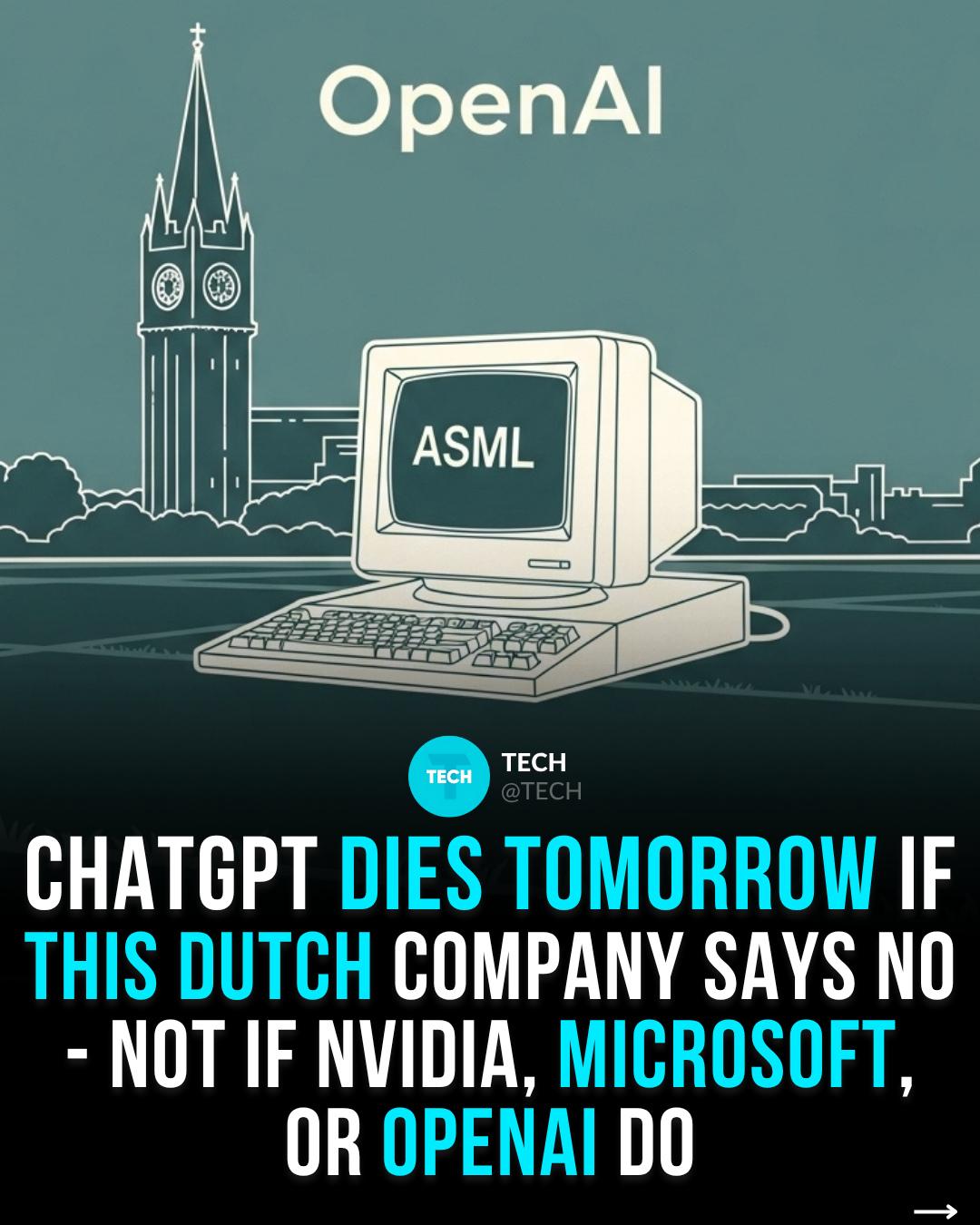
The Netherlands holds the ultimate power over AI development through ASML, a Dutch company that maintains a complete monopoly on the machines required to manufacture every advanced AI chip on Earth. While Nvidia designs the chips and TSMC builds them, ASML creates the €350 million extreme ultraviolet lithography machines that make chips at 7 nanometers and below physically possible—and no other company in the world can do this.
ASML's dominance is staggering: they control over 90% of the global lithography market and are the sole supplier of EUV systems that etch microscopic patterns onto silicon wafers using light with wavelengths of just 13.5 nanometers. These machines weigh as much as two Airbus A320 aircraft and use precise beams of light to create the intricate circuits that form modern AI processors. Without ASML's technology, companies like Nvidia, Intel, and AMD simply cannot manufacture the advanced chips that power ChatGPT, autonomous vehicles, and every other AI application we use daily.
The geopolitical implications are enormous. U.S. export controls have weaponized ASML's monopoly against China, with new restrictions in 2025 cutting Chinese access to these critical machines. China's share of ASML sales dropped from 47% in early 2024 to just 20% in 2025 as the Dutch government aligned with U.S. policies to control semiconductor technology. Even as China develops domestic alternatives, ASML CEO Christophe Fouquet projects the chip market will hit $1 trillion by 2030, with AI and memory chips comprising 40% of that total.
The company's €60 billion revenue projection by 2030 reflects AI's massive demand for advanced semiconductors, with ASML expecting 8-14% annual growth over the next five years. Every major AI breakthrough depends on ASML's Dutch-engineered precision, making the Netherlands the invisible kingmaker of the global AI revolution.
ASML's dominance is staggering: they control over 90% of the global lithography market and are the sole supplier of EUV systems that etch microscopic patterns onto silicon wafers using light with wavelengths of just 13.5 nanometers. These machines weigh as much as two Airbus A320 aircraft and use precise beams of light to create the intricate circuits that form modern AI processors. Without ASML's technology, companies like Nvidia, Intel, and AMD simply cannot manufacture the advanced chips that power ChatGPT, autonomous vehicles, and every other AI application we use daily.
The geopolitical implications are enormous. U.S. export controls have weaponized ASML's monopoly against China, with new restrictions in 2025 cutting Chinese access to these critical machines. China's share of ASML sales dropped from 47% in early 2024 to just 20% in 2025 as the Dutch government aligned with U.S. policies to control semiconductor technology. Even as China develops domestic alternatives, ASML CEO Christophe Fouquet projects the chip market will hit $1 trillion by 2030, with AI and memory chips comprising 40% of that total.
The company's €60 billion revenue projection by 2030 reflects AI's massive demand for advanced semiconductors, with ASML expecting 8-14% annual growth over the next five years. Every major AI breakthrough depends on ASML's Dutch-engineered precision, making the Netherlands the invisible kingmaker of the global AI revolution.
The Netherlands holds the ultimate power over AI development through ASML, a Dutch company that maintains a complete monopoly on the machines required to manufacture every advanced AI chip on Earth. While Nvidia designs the chips and TSMC builds them, ASML creates the €350 million extreme ultraviolet lithography machines that make chips at 7 nanometers and below physically possible—and no other company in the world can do this.
ASML's dominance is staggering: they control over 90% of the global lithography market and are the sole supplier of EUV systems that etch microscopic patterns onto silicon wafers using light with wavelengths of just 13.5 nanometers. These machines weigh as much as two Airbus A320 aircraft and use precise beams of light to create the intricate circuits that form modern AI processors. Without ASML's technology, companies like Nvidia, Intel, and AMD simply cannot manufacture the advanced chips that power ChatGPT, autonomous vehicles, and every other AI application we use daily.
The geopolitical implications are enormous. U.S. export controls have weaponized ASML's monopoly against China, with new restrictions in 2025 cutting Chinese access to these critical machines. China's share of ASML sales dropped from 47% in early 2024 to just 20% in 2025 as the Dutch government aligned with U.S. policies to control semiconductor technology. Even as China develops domestic alternatives, ASML CEO Christophe Fouquet projects the chip market will hit $1 trillion by 2030, with AI and memory chips comprising 40% of that total.
The company's €60 billion revenue projection by 2030 reflects AI's massive demand for advanced semiconductors, with ASML expecting 8-14% annual growth over the next five years. Every major AI breakthrough depends on ASML's Dutch-engineered precision, making the Netherlands the invisible kingmaker of the global AI revolution.
·288 Views
·0 Reviews
