


The Tech Interview Master Checklist: A Field-Tested Framework for Engineering Candidates
Navigating modern tech interview loops can feel overwhelming without a structured game plan. Whether you are aiming for a software engineer, systems architect, or engineering manager role, success relies on repeatable frameworks across each stage of the hiring loop.
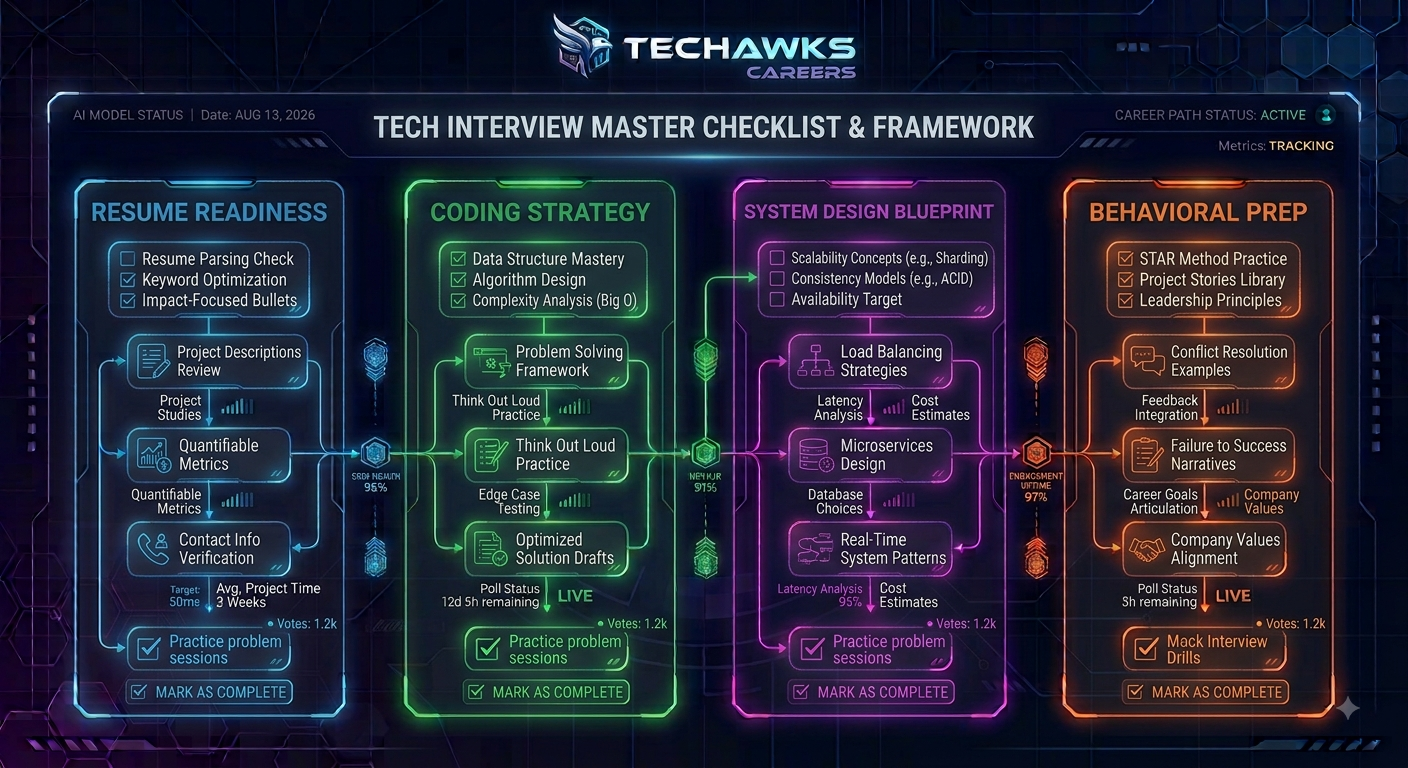
Bookmark this 4-step checklist to guide your preparation before your next interview round:
1. Resume & Application Readiness
Quantify Results: Ensure every bullet point follows the XYZ Pattern: "Accomplished [X], as measured by [Y], by doing [Z]."
Optimize for ATS: Use clean, single-column Markdown/PDF formats with standardized headers (Work Experience, Skills, Education) to avoid parsing glitches.
Link Proof of Work: Hyperlink your GitHub, personal blog, or live deployments directly in your header section.
2. Coding & Algorithmic Rounds
Clarify Constraints First: Never jump straight into writing code. Ask about input size, edge cases (e.g., null values, duplicates), and memory/time complexity targets.
Think Out Loud: Talk through your brute-force approach before optimizing. Interviewers grade your problem-solving process as much as your final solution.
Validate with Test Cases: Manually trace your code with sample inputs, boundary conditions, and edge cases before declaring completion.
3. System Design & Architecture
Define Requirements: Establish functional requirements (e.g., core features) and non-functional requirements (e.g., latency limits, availability target, throughput).
Estimate Scale: Do quick back-of-the-envelope calculations for read/write volume, bandwidth, and storage capacity.
Address Bottlenecks: Proactively discuss single points of failure, database sharding, caching strategies, and circuit breakers.
4. Behavioral & Leadership Execution
Use the STAR Method: Frame answers using Situation, Task, Action, and Result. Focus 70% of your time on your specific actions and measurable outcomes.Prepare Story Blocks:
Prepare 5–6 versatile stories covering technical failure, conflict resolution, project leadership, and handling tight deadlines.
key Takeaways
Structure Eliminates Stress: Standardized frameworks (STAR method, system design templates) keep you calm and articulate under time constraints.
Process Over Syntax: Demonstrating clear reasoning, active communication, and trade-off evaluation matters more than writing flawless code on the first attempt.
Measure and Iterate: Use post-interview debriefs to document questions you struggled with and refine your checklist for future rounds.
CTA
Preparing for upcoming technical interviews or looking for personalized portfolio reviews? Join Tech Jobs & Opportunities today to access mock interview groups, review system design blueprints, and land your next engineering role.
Navigating modern tech interview loops can feel overwhelming without a structured game plan. Whether you are aiming for a software engineer, systems architect, or engineering manager role, success relies on repeatable frameworks across each stage of the hiring loop.
Bookmark this 4-step checklist to guide your preparation before your next interview round:
1. Resume & Application Readiness
Quantify Results: Ensure every bullet point follows the XYZ Pattern: "Accomplished [X], as measured by [Y], by doing [Z]."
Optimize for ATS: Use clean, single-column Markdown/PDF formats with standardized headers (Work Experience, Skills, Education) to avoid parsing glitches.
Link Proof of Work: Hyperlink your GitHub, personal blog, or live deployments directly in your header section.
2. Coding & Algorithmic Rounds
Clarify Constraints First: Never jump straight into writing code. Ask about input size, edge cases (e.g., null values, duplicates), and memory/time complexity targets.
Think Out Loud: Talk through your brute-force approach before optimizing. Interviewers grade your problem-solving process as much as your final solution.
Validate with Test Cases: Manually trace your code with sample inputs, boundary conditions, and edge cases before declaring completion.
3. System Design & Architecture
Define Requirements: Establish functional requirements (e.g., core features) and non-functional requirements (e.g., latency limits, availability target, throughput).
Estimate Scale: Do quick back-of-the-envelope calculations for read/write volume, bandwidth, and storage capacity.
Address Bottlenecks: Proactively discuss single points of failure, database sharding, caching strategies, and circuit breakers.
4. Behavioral & Leadership Execution
Use the STAR Method: Frame answers using Situation, Task, Action, and Result. Focus 70% of your time on your specific actions and measurable outcomes.Prepare Story Blocks:
Prepare 5–6 versatile stories covering technical failure, conflict resolution, project leadership, and handling tight deadlines.
key Takeaways
Structure Eliminates Stress: Standardized frameworks (STAR method, system design templates) keep you calm and articulate under time constraints.
Process Over Syntax: Demonstrating clear reasoning, active communication, and trade-off evaluation matters more than writing flawless code on the first attempt.
Measure and Iterate: Use post-interview debriefs to document questions you struggled with and refine your checklist for future rounds.
CTA
Preparing for upcoming technical interviews or looking for personalized portfolio reviews? Join Tech Jobs & Opportunities today to access mock interview groups, review system design blueprints, and land your next engineering role.
The Tech Interview Master Checklist: A Field-Tested Framework for Engineering Candidates
Navigating modern tech interview loops can feel overwhelming without a structured game plan. Whether you are aiming for a software engineer, systems architect, or engineering manager role, success relies on repeatable frameworks across each stage of the hiring loop.
Bookmark this 4-step checklist to guide your preparation before your next interview round:
1. Resume & Application Readiness
Quantify Results: Ensure every bullet point follows the XYZ Pattern: "Accomplished [X], as measured by [Y], by doing [Z]."
Optimize for ATS: Use clean, single-column Markdown/PDF formats with standardized headers (Work Experience, Skills, Education) to avoid parsing glitches.
Link Proof of Work: Hyperlink your GitHub, personal blog, or live deployments directly in your header section.
2. Coding & Algorithmic Rounds
Clarify Constraints First: Never jump straight into writing code. Ask about input size, edge cases (e.g., null values, duplicates), and memory/time complexity targets.
Think Out Loud: Talk through your brute-force approach before optimizing. Interviewers grade your problem-solving process as much as your final solution.
Validate with Test Cases: Manually trace your code with sample inputs, boundary conditions, and edge cases before declaring completion.
3. System Design & Architecture
Define Requirements: Establish functional requirements (e.g., core features) and non-functional requirements (e.g., latency limits, availability target, throughput).
Estimate Scale: Do quick back-of-the-envelope calculations for read/write volume, bandwidth, and storage capacity.
Address Bottlenecks: Proactively discuss single points of failure, database sharding, caching strategies, and circuit breakers.
4. Behavioral & Leadership Execution
Use the STAR Method: Frame answers using Situation, Task, Action, and Result. Focus 70% of your time on your specific actions and measurable outcomes.Prepare Story Blocks:
Prepare 5–6 versatile stories covering technical failure, conflict resolution, project leadership, and handling tight deadlines.
key Takeaways
Structure Eliminates Stress: Standardized frameworks (STAR method, system design templates) keep you calm and articulate under time constraints.
Process Over Syntax: Demonstrating clear reasoning, active communication, and trade-off evaluation matters more than writing flawless code on the first attempt.
Measure and Iterate: Use post-interview debriefs to document questions you struggled with and refine your checklist for future rounds.
CTA
Preparing for upcoming technical interviews or looking for personalized portfolio reviews? Join Tech Jobs & Opportunities today to access mock interview groups, review system design blueprints, and land your next engineering role.

 English
 Arabic
 French
 Spanish
 Portuguese
 Turkish
 Dutch
Dutch
 Italiano
 Russian
 Romaian
 Portuguese (Brazil)
 Greek
Greek