


RAG Architecture Explained: How to Stop LLM Hallucinations with Retrieval-Augmented Generation
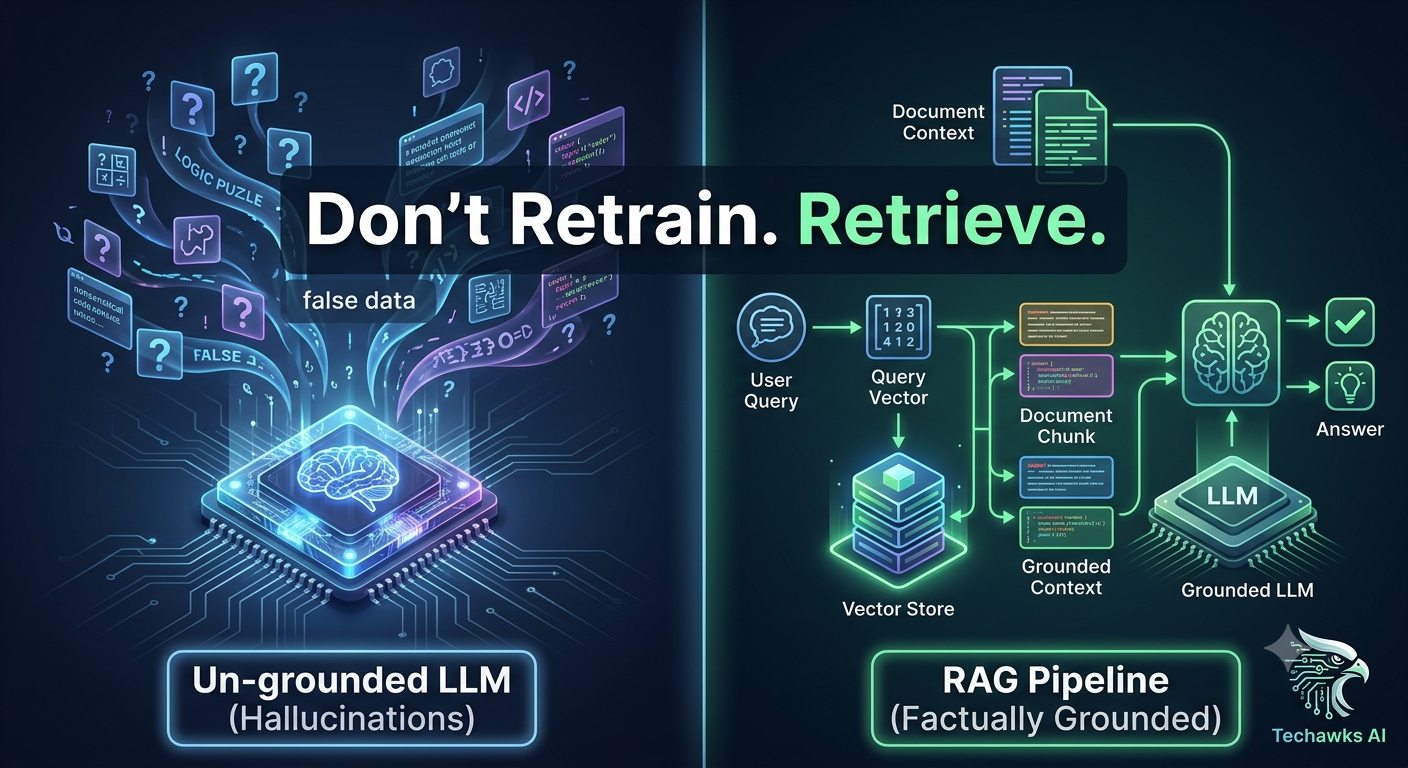
Fine-tuning an LLM to teach it custom knowledge is expensive, time-consuming, and hard to update. Retrieval-Augmented Generation (RAG) offers a far more practical solution: instead of retraining the model, you retrieve context from your own vector database and feed it directly into the prompt at runtime.If you are building LLM applications, here is the step-by-step pipeline to build an effective RAG system:
1. Document Ingestion & ChunkingThe Process:
Raw text documents (PDFs, docs, databases) are split into smaller text chunks.Actionable Tip: Keep chunks between 250 to 500 tokens with a 10–20% overlap. Chunks that are too large dilute semantic specificity, while chunks that are too small lose crucial context.
2. Vector Embedding & StorageThe Process:
A specialized embedding model converts text chunks into mathematical vectors (numerical arrays) that represent semantic meaning.Actionable Tip: Store these vectors in a dedicated vector database (e.g., Pinecone, Qdrant, Chroma, or pgvector). Ensure you use the exact same embedding model during both indexing and user querying.
3. Context Retrieval & Semantic SearchThe Process:
When a user asks a question, their prompt is converted into a vector. The database finds the top $K$ most similar text chunks using cosine similarity or Euclidean distance.Actionable Tip: Implement a hybrid search strategy (combining dense vector search with sparse keyword search like BM25) to catch both semantic intent and exact phrase matches.
4. Prompt Synthesis & GenerationThe Process:
The retrieved text chunks are injected into the system prompt as "context" alongside the user's original query.Actionable Tip: Frame your prompt strictly: "Answer the user's question using ONLY the provided context below. If the answer cannot be found in the context, state 'I do not have enough information'.
"Key Takeaways"
RAG vs. Fine-Tuning: RAG provides real-time data access and lower compute overhead; fine-tuning is best reserved for altering model tone or syntax style.Quality Depends on Chunking: Retrieval accuracy hinges on clean document preprocessing and strategic chunk size selection.Enforce Strict Guardrails: Always instruct the LLM to decline answering if the retrieved vector context lacks necessary facts.
CTA
Building your first RAG pipeline or optimizing vector search latency? Join AI Builders & Enthusiasts to exchange architectures, benchmark embedding models, and collaborate with AI developers worldwide.
Fine-tuning an LLM to teach it custom knowledge is expensive, time-consuming, and hard to update. Retrieval-Augmented Generation (RAG) offers a far more practical solution: instead of retraining the model, you retrieve context from your own vector database and feed it directly into the prompt at runtime.If you are building LLM applications, here is the step-by-step pipeline to build an effective RAG system:
1. Document Ingestion & ChunkingThe Process:
Raw text documents (PDFs, docs, databases) are split into smaller text chunks.Actionable Tip: Keep chunks between 250 to 500 tokens with a 10–20% overlap. Chunks that are too large dilute semantic specificity, while chunks that are too small lose crucial context.
2. Vector Embedding & StorageThe Process:
A specialized embedding model converts text chunks into mathematical vectors (numerical arrays) that represent semantic meaning.Actionable Tip: Store these vectors in a dedicated vector database (e.g., Pinecone, Qdrant, Chroma, or pgvector). Ensure you use the exact same embedding model during both indexing and user querying.
3. Context Retrieval & Semantic SearchThe Process:
When a user asks a question, their prompt is converted into a vector. The database finds the top $K$ most similar text chunks using cosine similarity or Euclidean distance.Actionable Tip: Implement a hybrid search strategy (combining dense vector search with sparse keyword search like BM25) to catch both semantic intent and exact phrase matches.
4. Prompt Synthesis & GenerationThe Process:
The retrieved text chunks are injected into the system prompt as "context" alongside the user's original query.Actionable Tip: Frame your prompt strictly: "Answer the user's question using ONLY the provided context below. If the answer cannot be found in the context, state 'I do not have enough information'.
"Key Takeaways"
RAG vs. Fine-Tuning: RAG provides real-time data access and lower compute overhead; fine-tuning is best reserved for altering model tone or syntax style.Quality Depends on Chunking: Retrieval accuracy hinges on clean document preprocessing and strategic chunk size selection.Enforce Strict Guardrails: Always instruct the LLM to decline answering if the retrieved vector context lacks necessary facts.
CTA
Building your first RAG pipeline or optimizing vector search latency? Join AI Builders & Enthusiasts to exchange architectures, benchmark embedding models, and collaborate with AI developers worldwide.
RAG Architecture Explained: How to Stop LLM Hallucinations with Retrieval-Augmented Generation
Fine-tuning an LLM to teach it custom knowledge is expensive, time-consuming, and hard to update. Retrieval-Augmented Generation (RAG) offers a far more practical solution: instead of retraining the model, you retrieve context from your own vector database and feed it directly into the prompt at runtime.If you are building LLM applications, here is the step-by-step pipeline to build an effective RAG system:
1. Document Ingestion & ChunkingThe Process:
Raw text documents (PDFs, docs, databases) are split into smaller text chunks.Actionable Tip: Keep chunks between 250 to 500 tokens with a 10–20% overlap. Chunks that are too large dilute semantic specificity, while chunks that are too small lose crucial context.
2. Vector Embedding & StorageThe Process:
A specialized embedding model converts text chunks into mathematical vectors (numerical arrays) that represent semantic meaning.Actionable Tip: Store these vectors in a dedicated vector database (e.g., Pinecone, Qdrant, Chroma, or pgvector). Ensure you use the exact same embedding model during both indexing and user querying.
3. Context Retrieval & Semantic SearchThe Process:
When a user asks a question, their prompt is converted into a vector. The database finds the top $K$ most similar text chunks using cosine similarity or Euclidean distance.Actionable Tip: Implement a hybrid search strategy (combining dense vector search with sparse keyword search like BM25) to catch both semantic intent and exact phrase matches.
4. Prompt Synthesis & GenerationThe Process:
The retrieved text chunks are injected into the system prompt as "context" alongside the user's original query.Actionable Tip: Frame your prompt strictly: "Answer the user's question using ONLY the provided context below. If the answer cannot be found in the context, state 'I do not have enough information'.
"Key Takeaways"
RAG vs. Fine-Tuning: RAG provides real-time data access and lower compute overhead; fine-tuning is best reserved for altering model tone or syntax style.Quality Depends on Chunking: Retrieval accuracy hinges on clean document preprocessing and strategic chunk size selection.Enforce Strict Guardrails: Always instruct the LLM to decline answering if the retrieved vector context lacks necessary facts.
CTA
Building your first RAG pipeline or optimizing vector search latency? Join AI Builders & Enthusiasts to exchange architectures, benchmark embedding models, and collaborate with AI developers worldwide.

 English
 Arabic
 French
 Spanish
 Portuguese
 Deutsch
 Turkish
 Dutch
Dutch
 Italiano
 Russian
 Portuguese (Brazil)
 Greek
Greek