


Mastering Function Calling: How to Turn LLMs into Reliable Backend Execution Engines
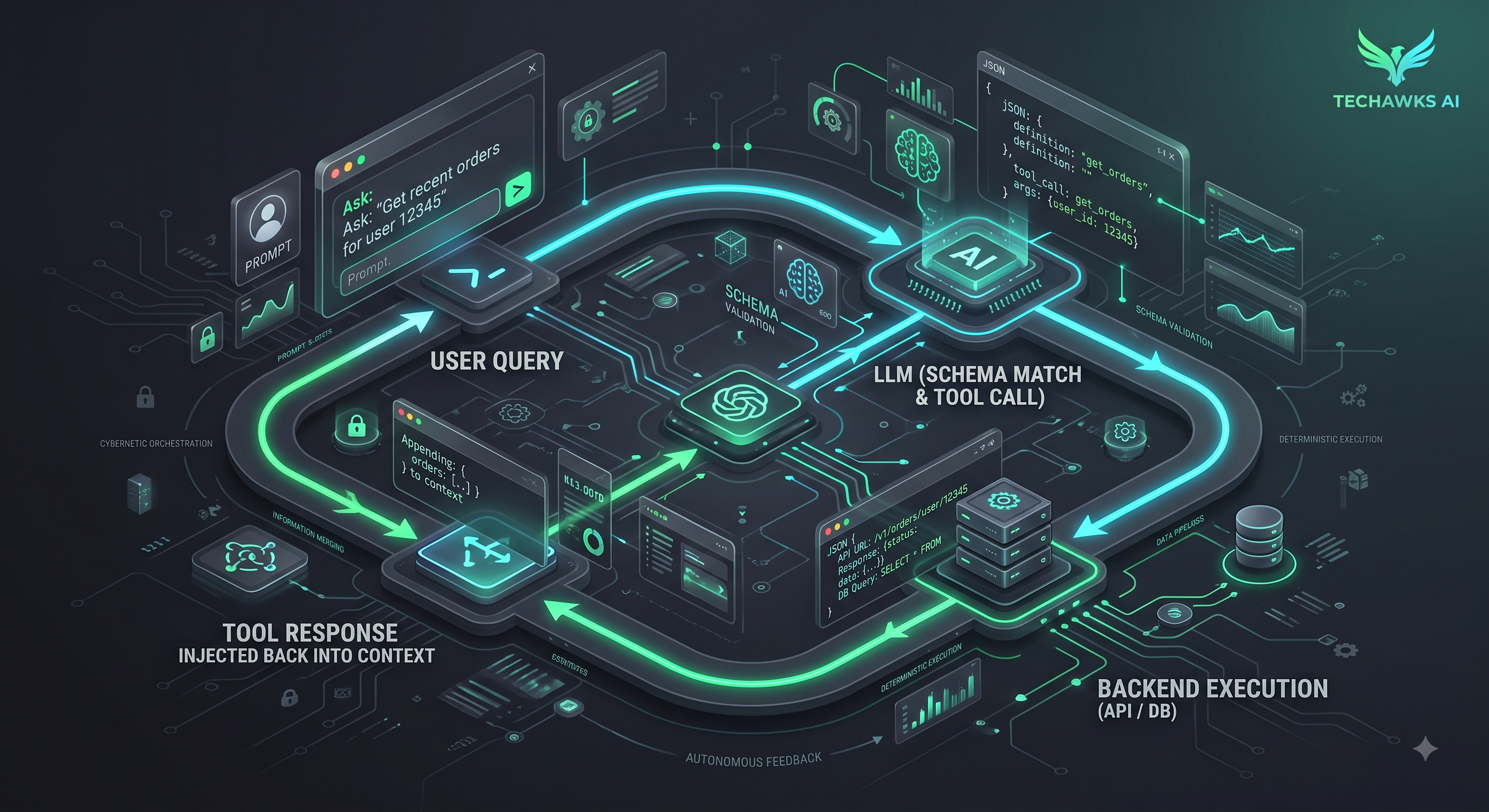
Function calling (or tool use) transforms language models from isolated text generators into deterministic orchestrators for your backend services. Instead of guessing data formats, the model natively structures its output to match your exact JSON schema.
Here is a 4-step blueprint to implement reliable, production-ready tool calling:
1. Define Strict JSON Schemas
Provide clear property descriptions, explicit data types, and mark critical parameters as required.
Be Descriptive: Include field constraints and intended formats directly in the parameter description (e.g., "date": {"type": "string", "description": "ISO-8601 date string, YYYY-MM-DD"}).
Enforce Strict Mode: Set strict: true (or the equivalent schema validation flag) to force the model to adhere strictly to your type definition without hallucinating extra keys.
2. Implement the Execution Handler & Dispatcher
The model does not execute code; it outputs the arguments it wants you to run.
Parse the structured tool_calls response object.
Route the extracted function name and argument dictionary into a verified execution map (e.g., Python dict or TypeScript switch statement).
Run the actual backend query, database transaction, or external API call.
3. Handle Errors and Inject Results Back to Context
Never drop a failed tool call. If the backend throws a validation or network error, convert the exception into a structured message:
Feed the response back using the role: "tool" (or role: "function") message type with the matching tool_call_id.
Let the model evaluate the result or error and generate a user-facing explanation or self-correct the parameters on the next turn.
4. Add Guardrails & Idempotency Keys
Because LLMs operate non-deterministically, guard against duplicate executions:
Read vs. Write Segregation: Always require human confirmation or explicit validation layers for destructive write actions (e.g., delete_account, charge_card).
Idempotency: Pass generated request IDs to backend endpoints so retried tool calls do not create duplicate side effects.
Key Takeaways
Deterministic Outputs: Schema-driven tool calling eliminates brittle regex parsing for backend actions.
Full Context Loop: Returning tool execution results (and errors) back into the conversation context enables native agentic self-correction.
Safety First: Pair tool execution with strict schema validation, least-privilege API keys, and idempotency controls.
CTA
Ready to build autonomous agents and production AI workflows with zero fluff? Join the Techawks AI Builders & Enthusiasts community to share code snippets, review architectures, and ship alongside AI developers worldwide.
Function calling (or tool use) transforms language models from isolated text generators into deterministic orchestrators for your backend services. Instead of guessing data formats, the model natively structures its output to match your exact JSON schema.
Here is a 4-step blueprint to implement reliable, production-ready tool calling:
1. Define Strict JSON Schemas
Provide clear property descriptions, explicit data types, and mark critical parameters as required.
Be Descriptive: Include field constraints and intended formats directly in the parameter description (e.g., "date": {"type": "string", "description": "ISO-8601 date string, YYYY-MM-DD"}).
Enforce Strict Mode: Set strict: true (or the equivalent schema validation flag) to force the model to adhere strictly to your type definition without hallucinating extra keys.
2. Implement the Execution Handler & Dispatcher
The model does not execute code; it outputs the arguments it wants you to run.
Parse the structured tool_calls response object.
Route the extracted function name and argument dictionary into a verified execution map (e.g., Python dict or TypeScript switch statement).
Run the actual backend query, database transaction, or external API call.
3. Handle Errors and Inject Results Back to Context
Never drop a failed tool call. If the backend throws a validation or network error, convert the exception into a structured message:
Feed the response back using the role: "tool" (or role: "function") message type with the matching tool_call_id.
Let the model evaluate the result or error and generate a user-facing explanation or self-correct the parameters on the next turn.
4. Add Guardrails & Idempotency Keys
Because LLMs operate non-deterministically, guard against duplicate executions:
Read vs. Write Segregation: Always require human confirmation or explicit validation layers for destructive write actions (e.g., delete_account, charge_card).
Idempotency: Pass generated request IDs to backend endpoints so retried tool calls do not create duplicate side effects.
Key Takeaways
Deterministic Outputs: Schema-driven tool calling eliminates brittle regex parsing for backend actions.
Full Context Loop: Returning tool execution results (and errors) back into the conversation context enables native agentic self-correction.
Safety First: Pair tool execution with strict schema validation, least-privilege API keys, and idempotency controls.
CTA
Ready to build autonomous agents and production AI workflows with zero fluff? Join the Techawks AI Builders & Enthusiasts community to share code snippets, review architectures, and ship alongside AI developers worldwide.
Mastering Function Calling: How to Turn LLMs into Reliable Backend Execution Engines
Function calling (or tool use) transforms language models from isolated text generators into deterministic orchestrators for your backend services. Instead of guessing data formats, the model natively structures its output to match your exact JSON schema.
Here is a 4-step blueprint to implement reliable, production-ready tool calling:
1. Define Strict JSON Schemas
Provide clear property descriptions, explicit data types, and mark critical parameters as required.
Be Descriptive: Include field constraints and intended formats directly in the parameter description (e.g., "date": {"type": "string", "description": "ISO-8601 date string, YYYY-MM-DD"}).
Enforce Strict Mode: Set strict: true (or the equivalent schema validation flag) to force the model to adhere strictly to your type definition without hallucinating extra keys.
2. Implement the Execution Handler & Dispatcher
The model does not execute code; it outputs the arguments it wants you to run.
Parse the structured tool_calls response object.
Route the extracted function name and argument dictionary into a verified execution map (e.g., Python dict or TypeScript switch statement).
Run the actual backend query, database transaction, or external API call.
3. Handle Errors and Inject Results Back to Context
Never drop a failed tool call. If the backend throws a validation or network error, convert the exception into a structured message:
Feed the response back using the role: "tool" (or role: "function") message type with the matching tool_call_id.
Let the model evaluate the result or error and generate a user-facing explanation or self-correct the parameters on the next turn.
4. Add Guardrails & Idempotency Keys
Because LLMs operate non-deterministically, guard against duplicate executions:
Read vs. Write Segregation: Always require human confirmation or explicit validation layers for destructive write actions (e.g., delete_account, charge_card).
Idempotency: Pass generated request IDs to backend endpoints so retried tool calls do not create duplicate side effects.
Key Takeaways
Deterministic Outputs: Schema-driven tool calling eliminates brittle regex parsing for backend actions.
Full Context Loop: Returning tool execution results (and errors) back into the conversation context enables native agentic self-correction.
Safety First: Pair tool execution with strict schema validation, least-privilege API keys, and idempotency controls.
CTA
Ready to build autonomous agents and production AI workflows with zero fluff? Join the Techawks AI Builders & Enthusiasts community to share code snippets, review architectures, and ship alongside AI developers worldwide.

 English
 Arabic
 French
 Spanish
 Portuguese
 Deutsch
 Turkish
 Dutch
Dutch
 Italiano
 Russian
 Portuguese (Brazil)
 Greek
Greek