


The Senior Developer's Pull Request Checklist: 10 Critical Checks Before You Click "Merge"
Great code reviews are not about nitpicking whitespace—they are the final defense line for system stability, performance, and long-term maintainability.
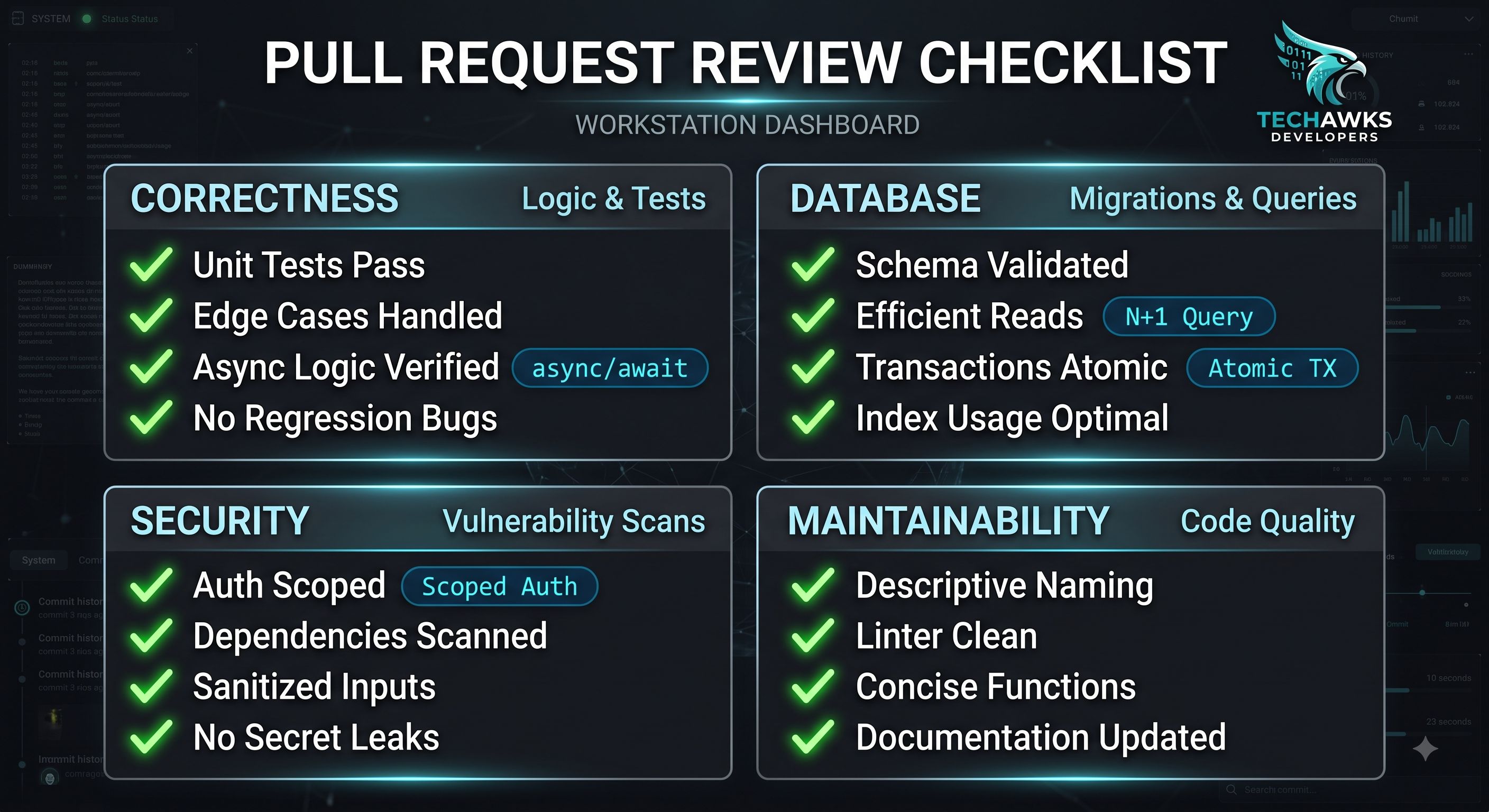
Use this 10-point checklist on every pull request to catch edge-case bugs before they reach production:
1. Correctness & Error Resilience
[ ] Edge Cases Covered: Empty arrays, null/undefined inputs, and extreme boundary values are tested and handled gracefully.
[ ] Fail-Safe Async Logic: Promises, threads, and goroutines handle errors explicitly—no unhandled rejections or silent background task crashes.
[ ] Deterministic Resource Teardown: Open database connections, file descriptors, and event listeners are properly closed in finally or defer blocks to prevent resource leaks.
2. Database & Data Integrity
[ ] No N+1 Query Traps: Relational data fetches use eager loading or batch lookups instead of executing inside loops.
[ ] Safe Schema Migrations: Database migrations are backward-compatible and do not perform locking table rewrites on live datasets.
[ ] Atomic Transactions: Multi-table mutations are wrapped in database transactions to avoid inconsistent, orphaned state during partial failures.
3. Security & Access Control
[ ] Strict Input Sanitization: User-provided inputs are validated and sanitized against SQL injection, XSS, and command injection attacks.
[ ] Scoped Authorization: Endpoint authorization verifies not just who the user is, but whether they own the specific resource ID being modified.
4. Maintainability & Observability
[ ] Actionable Logging Context: Error logs include structured key-value context (e.g., user_id, request_id, operation name) rather than generic string errors.
[ ] Single-Purpose Scope: The PR is focused on a single responsibility, avoiding unrelated "drive-by" refactors that complicate git-bisect and rollbacks.
Key Takeaways
Look Beyond the Syntax: Linters and formatters handle formatting; humans must review logic, race conditions, and architectural boundaries.
Protect the Database: Catching N+1 queries and unsafe schema migrations in PR review saves high-pressure database incident cleanups later.
Prioritize Small Diffs: Atomic, single-purpose PRs make thorough reviews fast and rollbacks painless.
CTA
Looking to sharpen your code review instincts, master system design patterns, and write production-grade code? Join the Techawks Developers & Coding community to share pull request patterns, review architectures, and level up with developers worldwide.
Great code reviews are not about nitpicking whitespace—they are the final defense line for system stability, performance, and long-term maintainability.
Use this 10-point checklist on every pull request to catch edge-case bugs before they reach production:
1. Correctness & Error Resilience
[ ] Edge Cases Covered: Empty arrays, null/undefined inputs, and extreme boundary values are tested and handled gracefully.
[ ] Fail-Safe Async Logic: Promises, threads, and goroutines handle errors explicitly—no unhandled rejections or silent background task crashes.
[ ] Deterministic Resource Teardown: Open database connections, file descriptors, and event listeners are properly closed in finally or defer blocks to prevent resource leaks.
2. Database & Data Integrity
[ ] No N+1 Query Traps: Relational data fetches use eager loading or batch lookups instead of executing inside loops.
[ ] Safe Schema Migrations: Database migrations are backward-compatible and do not perform locking table rewrites on live datasets.
[ ] Atomic Transactions: Multi-table mutations are wrapped in database transactions to avoid inconsistent, orphaned state during partial failures.
3. Security & Access Control
[ ] Strict Input Sanitization: User-provided inputs are validated and sanitized against SQL injection, XSS, and command injection attacks.
[ ] Scoped Authorization: Endpoint authorization verifies not just who the user is, but whether they own the specific resource ID being modified.
4. Maintainability & Observability
[ ] Actionable Logging Context: Error logs include structured key-value context (e.g., user_id, request_id, operation name) rather than generic string errors.
[ ] Single-Purpose Scope: The PR is focused on a single responsibility, avoiding unrelated "drive-by" refactors that complicate git-bisect and rollbacks.
Key Takeaways
Look Beyond the Syntax: Linters and formatters handle formatting; humans must review logic, race conditions, and architectural boundaries.
Protect the Database: Catching N+1 queries and unsafe schema migrations in PR review saves high-pressure database incident cleanups later.
Prioritize Small Diffs: Atomic, single-purpose PRs make thorough reviews fast and rollbacks painless.
CTA
Looking to sharpen your code review instincts, master system design patterns, and write production-grade code? Join the Techawks Developers & Coding community to share pull request patterns, review architectures, and level up with developers worldwide.
The Senior Developer's Pull Request Checklist: 10 Critical Checks Before You Click "Merge"
Great code reviews are not about nitpicking whitespace—they are the final defense line for system stability, performance, and long-term maintainability.
Use this 10-point checklist on every pull request to catch edge-case bugs before they reach production:
1. Correctness & Error Resilience
[ ] Edge Cases Covered: Empty arrays, null/undefined inputs, and extreme boundary values are tested and handled gracefully.
[ ] Fail-Safe Async Logic: Promises, threads, and goroutines handle errors explicitly—no unhandled rejections or silent background task crashes.
[ ] Deterministic Resource Teardown: Open database connections, file descriptors, and event listeners are properly closed in finally or defer blocks to prevent resource leaks.
2. Database & Data Integrity
[ ] No N+1 Query Traps: Relational data fetches use eager loading or batch lookups instead of executing inside loops.
[ ] Safe Schema Migrations: Database migrations are backward-compatible and do not perform locking table rewrites on live datasets.
[ ] Atomic Transactions: Multi-table mutations are wrapped in database transactions to avoid inconsistent, orphaned state during partial failures.
3. Security & Access Control
[ ] Strict Input Sanitization: User-provided inputs are validated and sanitized against SQL injection, XSS, and command injection attacks.
[ ] Scoped Authorization: Endpoint authorization verifies not just who the user is, but whether they own the specific resource ID being modified.
4. Maintainability & Observability
[ ] Actionable Logging Context: Error logs include structured key-value context (e.g., user_id, request_id, operation name) rather than generic string errors.
[ ] Single-Purpose Scope: The PR is focused on a single responsibility, avoiding unrelated "drive-by" refactors that complicate git-bisect and rollbacks.
Key Takeaways
Look Beyond the Syntax: Linters and formatters handle formatting; humans must review logic, race conditions, and architectural boundaries.
Protect the Database: Catching N+1 queries and unsafe schema migrations in PR review saves high-pressure database incident cleanups later.
Prioritize Small Diffs: Atomic, single-purpose PRs make thorough reviews fast and rollbacks painless.
CTA
Looking to sharpen your code review instincts, master system design patterns, and write production-grade code? Join the Techawks Developers & Coding community to share pull request patterns, review architectures, and level up with developers worldwide.

 English
 Arabic
 French
 Spanish
 Portuguese
 Deutsch
 Turkish
 Dutch
Dutch
 Russian
 Romaian
 Portuguese (Brazil)
 Greek
Greek