


The Specialist vs. Generalist Dilemma: Which Career Path Actually Survives Tech Shifts?
Every tech professional hits a fork in their career journey: do you specialize deeply in a single niche (like distributed database internals, iOS performance, or ML infrastructure), or do you cultivate broad expertise across the full stack as a high-adaptability generalist?
Both paths offer distinct advantages and trade-offs in today's hiring landscape:
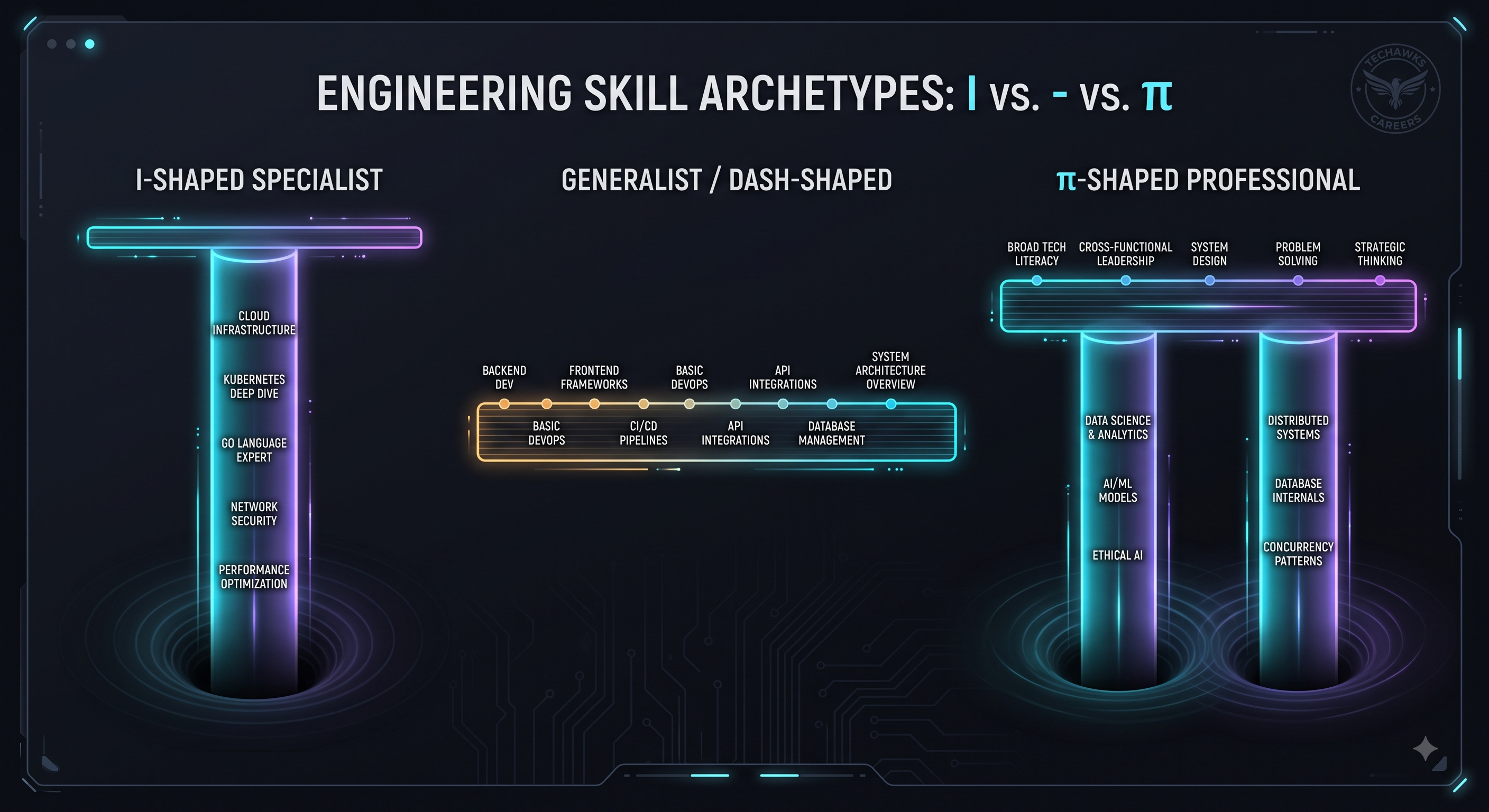
1. The Deep Specialist (The "I-Shaped" Engineer)
The Advantage: High leverage, premium compensation for niche domain expertise, and rapid hiring when companies face complex, specialized bottlenecks.
The Risk: Vulnerability to shifts in tooling, vendor consolidation, or commoditization of specific frameworks.
Best For: Engineers who love deep problem spaces, low-level optimizations, and targeted R&D roles.
2. The Versatile Generalist (The "T-Shaped" Engineer)
The Advantage: Extreme adaptability. You can glue services together, build MVPs end-to-end, communicate across cross-functional teams, and pivot quickly as priorities shift.
The Risk: Can be misjudged as a "jack of all trades, master of none" by rigid keyword-screening filters.
Best For: Early-stage startup environments, product engineering, technical leadership, and solutions architecture.
The Modern Compromise: The "Pi-Shaped" Model
Rather than picking a single extreme, resilient tech careers often follow the pishaped model: broad foundational context across software systems, anchored by two distinct deep specializations (e.g., Backend Systems + Data Engineering, or Frontend UX + Cloud Architecture).
Let's Open the Floor:Have you built your career as a deep specialist or a broad generalist?
If you had to advise someone entering the tech market today, which path would you recommend prioritizing in their first three years?
Key Takeaways
Context Drives Value: Early-stage startups prize generalist velocity; scale-ups and enterprise teams hire specialist depth to solve precise bottlenecks.
Cultivate pi Shaped Skills: Pair broad software engineering literacy with two complementary core strengths to stay versatile yet high-impact
Decouple Principles from Tools: Master fundamental system concepts (networking, concurrency, data structures) so your expertise survives framework turnover.
CTA
Navigating your next career transition, evaluating job offers, or sharpening your interview strategy?
Join the Techawks Tech Jobs & Opportunities community to connect with mentors, discuss career trajectories, and explore curated tech openings worldwide.
Every tech professional hits a fork in their career journey: do you specialize deeply in a single niche (like distributed database internals, iOS performance, or ML infrastructure), or do you cultivate broad expertise across the full stack as a high-adaptability generalist?
Both paths offer distinct advantages and trade-offs in today's hiring landscape:
1. The Deep Specialist (The "I-Shaped" Engineer)
The Advantage: High leverage, premium compensation for niche domain expertise, and rapid hiring when companies face complex, specialized bottlenecks.
The Risk: Vulnerability to shifts in tooling, vendor consolidation, or commoditization of specific frameworks.
Best For: Engineers who love deep problem spaces, low-level optimizations, and targeted R&D roles.
2. The Versatile Generalist (The "T-Shaped" Engineer)
The Advantage: Extreme adaptability. You can glue services together, build MVPs end-to-end, communicate across cross-functional teams, and pivot quickly as priorities shift.
The Risk: Can be misjudged as a "jack of all trades, master of none" by rigid keyword-screening filters.
Best For: Early-stage startup environments, product engineering, technical leadership, and solutions architecture.
The Modern Compromise: The "Pi-Shaped" Model
Rather than picking a single extreme, resilient tech careers often follow the pishaped model: broad foundational context across software systems, anchored by two distinct deep specializations (e.g., Backend Systems + Data Engineering, or Frontend UX + Cloud Architecture).
Let's Open the Floor:Have you built your career as a deep specialist or a broad generalist?
If you had to advise someone entering the tech market today, which path would you recommend prioritizing in their first three years?
Key Takeaways
Context Drives Value: Early-stage startups prize generalist velocity; scale-ups and enterprise teams hire specialist depth to solve precise bottlenecks.
Cultivate pi Shaped Skills: Pair broad software engineering literacy with two complementary core strengths to stay versatile yet high-impact
Decouple Principles from Tools: Master fundamental system concepts (networking, concurrency, data structures) so your expertise survives framework turnover.
CTA
Navigating your next career transition, evaluating job offers, or sharpening your interview strategy?
Join the Techawks Tech Jobs & Opportunities community to connect with mentors, discuss career trajectories, and explore curated tech openings worldwide.
The Specialist vs. Generalist Dilemma: Which Career Path Actually Survives Tech Shifts?
Every tech professional hits a fork in their career journey: do you specialize deeply in a single niche (like distributed database internals, iOS performance, or ML infrastructure), or do you cultivate broad expertise across the full stack as a high-adaptability generalist?
Both paths offer distinct advantages and trade-offs in today's hiring landscape:
1. The Deep Specialist (The "I-Shaped" Engineer)
The Advantage: High leverage, premium compensation for niche domain expertise, and rapid hiring when companies face complex, specialized bottlenecks.
The Risk: Vulnerability to shifts in tooling, vendor consolidation, or commoditization of specific frameworks.
Best For: Engineers who love deep problem spaces, low-level optimizations, and targeted R&D roles.
2. The Versatile Generalist (The "T-Shaped" Engineer)
The Advantage: Extreme adaptability. You can glue services together, build MVPs end-to-end, communicate across cross-functional teams, and pivot quickly as priorities shift.
The Risk: Can be misjudged as a "jack of all trades, master of none" by rigid keyword-screening filters.
Best For: Early-stage startup environments, product engineering, technical leadership, and solutions architecture.
The Modern Compromise: The "Pi-Shaped" Model
Rather than picking a single extreme, resilient tech careers often follow the pishaped model: broad foundational context across software systems, anchored by two distinct deep specializations (e.g., Backend Systems + Data Engineering, or Frontend UX + Cloud Architecture).
Let's Open the Floor:Have you built your career as a deep specialist or a broad generalist?
If you had to advise someone entering the tech market today, which path would you recommend prioritizing in their first three years?
Key Takeaways
Context Drives Value: Early-stage startups prize generalist velocity; scale-ups and enterprise teams hire specialist depth to solve precise bottlenecks.
Cultivate pi Shaped Skills: Pair broad software engineering literacy with two complementary core strengths to stay versatile yet high-impact
Decouple Principles from Tools: Master fundamental system concepts (networking, concurrency, data structures) so your expertise survives framework turnover.
CTA
Navigating your next career transition, evaluating job offers, or sharpening your interview strategy?
Join the Techawks Tech Jobs & Opportunities community to connect with mentors, discuss career trajectories, and explore curated tech openings worldwide.

 English
 Arabic
 French
 Spanish
 Portuguese
 Deutsch
 Turkish
 Italiano
 Russian
 Romaian
 Portuguese (Brazil)
 Greek
Greek