


How to Build an AI Agent Evaluator: Step-by-Step Benchmarking for Production LLMs
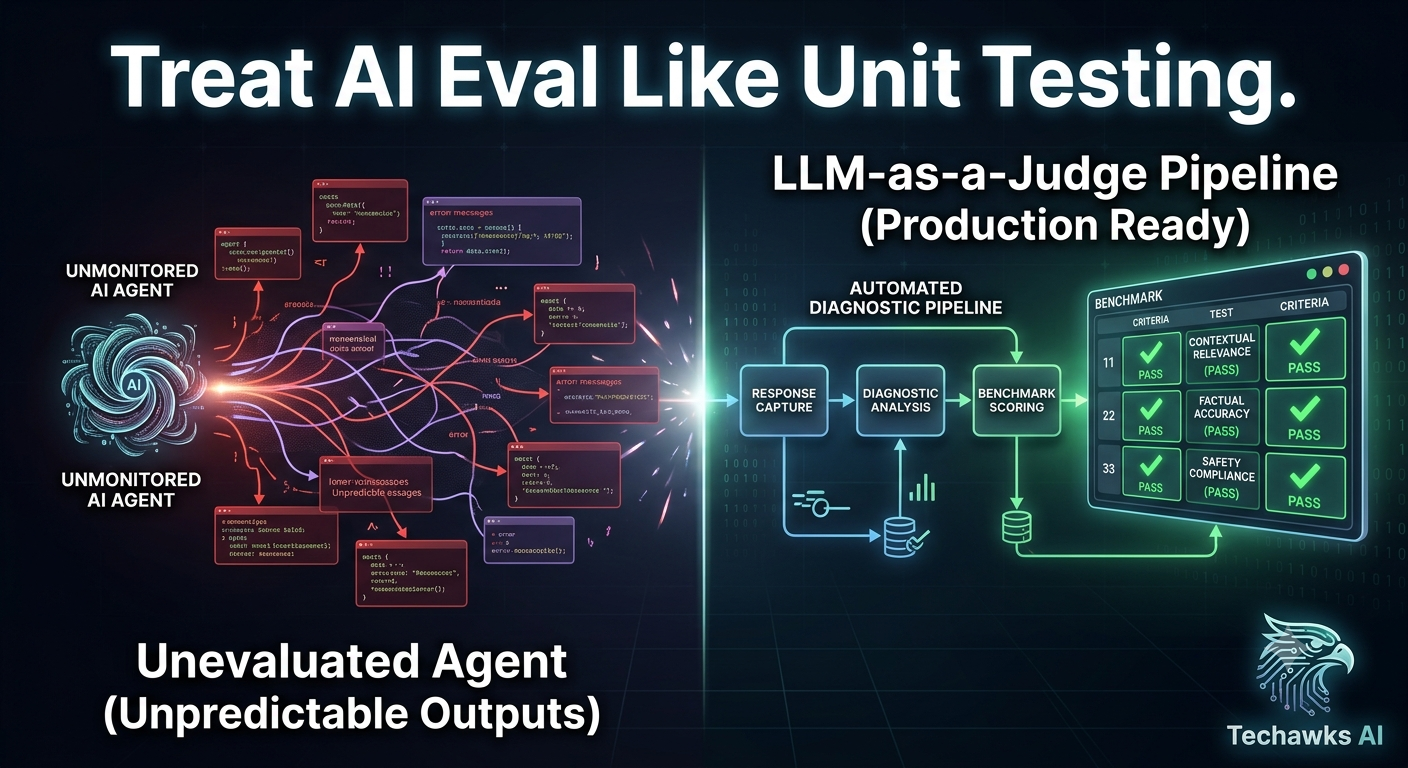
Evaluating AI agents manually does not scale. To ensure your AI application maintains quality across updates, you need automated benchmarks that score agent outputs on consistency, relevance, and safety.Follow this step-by-step tutorial to implement an LLM-as-a-Judge evaluation pipeline:
Step 1:
Define Your Evaluation Criteria & RubricInstead of asking an evaluator LLM "Is this response good?", define explicit numerical scoring metrics with precise pass/fail rules:
Groundedness (1–5): Does the response rely strictly on provided context without introducing hallucinations?Answer Relevance (1–5): Does the output directly answer every part of the user query?Tone & Safety (Pass/Fail): Does the output follow corporate guidelines and avoid sensitive topic violations?
Step 2:
Actionable Tip: Use JSON mode or schema enforcement (Pydantic/Zod) to prevent parsing errors during automated test runs.
Step 3:
Run Batch Evaluations in ParallelDo not evaluate responses synchronously during user sessions. Store prompt-response pairs in a queue and process evaluations asynchronously in batches using a faster inference model.
Step 4:
Track Metrics & Set CI/CD Quality GatesIntegrate evaluation scores into your deployment pipeline. If a prompt tweak or fine-tuned model checkpoint causes the average Groundedness Score to drop below $4.2 / 5.0$, automatically fail the CI build and block deployment.
Key Takeaways
Automate Quality Control: LLM-as-a-Judge provides fast, reproducible feedback loops for agent performance.Require Structured Reasoning: Mandate that evaluator models output explicit reasoning alongside numerical scores for easier debugging.Set Hard CI/CD Thresholds: Prevent regression by gating production releases on automated evaluation benchmarks.
CTA
How are you testing and benchmarking your AI agents before deployment? Join AI Builders & Enthusiasts to exchange prompt evaluation rubrics, share framework comparisons, and build reliable AI systems with engineers worldwide.
Evaluating AI agents manually does not scale. To ensure your AI application maintains quality across updates, you need automated benchmarks that score agent outputs on consistency, relevance, and safety.Follow this step-by-step tutorial to implement an LLM-as-a-Judge evaluation pipeline:
Step 1:
Define Your Evaluation Criteria & RubricInstead of asking an evaluator LLM "Is this response good?", define explicit numerical scoring metrics with precise pass/fail rules:
Groundedness (1–5): Does the response rely strictly on provided context without introducing hallucinations?Answer Relevance (1–5): Does the output directly answer every part of the user query?Tone & Safety (Pass/Fail): Does the output follow corporate guidelines and avoid sensitive topic violations?
Step 2:
Actionable Tip: Use JSON mode or schema enforcement (Pydantic/Zod) to prevent parsing errors during automated test runs.
Step 3:
Run Batch Evaluations in ParallelDo not evaluate responses synchronously during user sessions. Store prompt-response pairs in a queue and process evaluations asynchronously in batches using a faster inference model.
Step 4:
Track Metrics & Set CI/CD Quality GatesIntegrate evaluation scores into your deployment pipeline. If a prompt tweak or fine-tuned model checkpoint causes the average Groundedness Score to drop below $4.2 / 5.0$, automatically fail the CI build and block deployment.
Key Takeaways
Automate Quality Control: LLM-as-a-Judge provides fast, reproducible feedback loops for agent performance.Require Structured Reasoning: Mandate that evaluator models output explicit reasoning alongside numerical scores for easier debugging.Set Hard CI/CD Thresholds: Prevent regression by gating production releases on automated evaluation benchmarks.
CTA
How are you testing and benchmarking your AI agents before deployment? Join AI Builders & Enthusiasts to exchange prompt evaluation rubrics, share framework comparisons, and build reliable AI systems with engineers worldwide.
How to Build an AI Agent Evaluator: Step-by-Step Benchmarking for Production LLMs
Evaluating AI agents manually does not scale. To ensure your AI application maintains quality across updates, you need automated benchmarks that score agent outputs on consistency, relevance, and safety.Follow this step-by-step tutorial to implement an LLM-as-a-Judge evaluation pipeline:
Step 1:
Define Your Evaluation Criteria & RubricInstead of asking an evaluator LLM "Is this response good?", define explicit numerical scoring metrics with precise pass/fail rules:
Groundedness (1–5): Does the response rely strictly on provided context without introducing hallucinations?Answer Relevance (1–5): Does the output directly answer every part of the user query?Tone & Safety (Pass/Fail): Does the output follow corporate guidelines and avoid sensitive topic violations?
Step 2:
Actionable Tip: Use JSON mode or schema enforcement (Pydantic/Zod) to prevent parsing errors during automated test runs.
Step 3:
Run Batch Evaluations in ParallelDo not evaluate responses synchronously during user sessions. Store prompt-response pairs in a queue and process evaluations asynchronously in batches using a faster inference model.
Step 4:
Track Metrics & Set CI/CD Quality GatesIntegrate evaluation scores into your deployment pipeline. If a prompt tweak or fine-tuned model checkpoint causes the average Groundedness Score to drop below $4.2 / 5.0$, automatically fail the CI build and block deployment.
Key Takeaways
Automate Quality Control: LLM-as-a-Judge provides fast, reproducible feedback loops for agent performance.Require Structured Reasoning: Mandate that evaluator models output explicit reasoning alongside numerical scores for easier debugging.Set Hard CI/CD Thresholds: Prevent regression by gating production releases on automated evaluation benchmarks.
CTA
How are you testing and benchmarking your AI agents before deployment? Join AI Builders & Enthusiasts to exchange prompt evaluation rubrics, share framework comparisons, and build reliable AI systems with engineers worldwide.

 English
 Arabic
 Spanish
 Portuguese
 Deutsch
 Turkish
 Dutch
Dutch
 Italiano
 Russian
 Romaian
 Portuguese (Brazil)
 Greek
Greek