


The Ultimate Technical Interview Preparation Checklist: 10 Critical Steps to Land Your Next Role
A successful technical interview loop evaluates far more than just raw coding speed. Top engineering teams look for problem-solving communication, system scalability intuition, and past behavioral ownership.
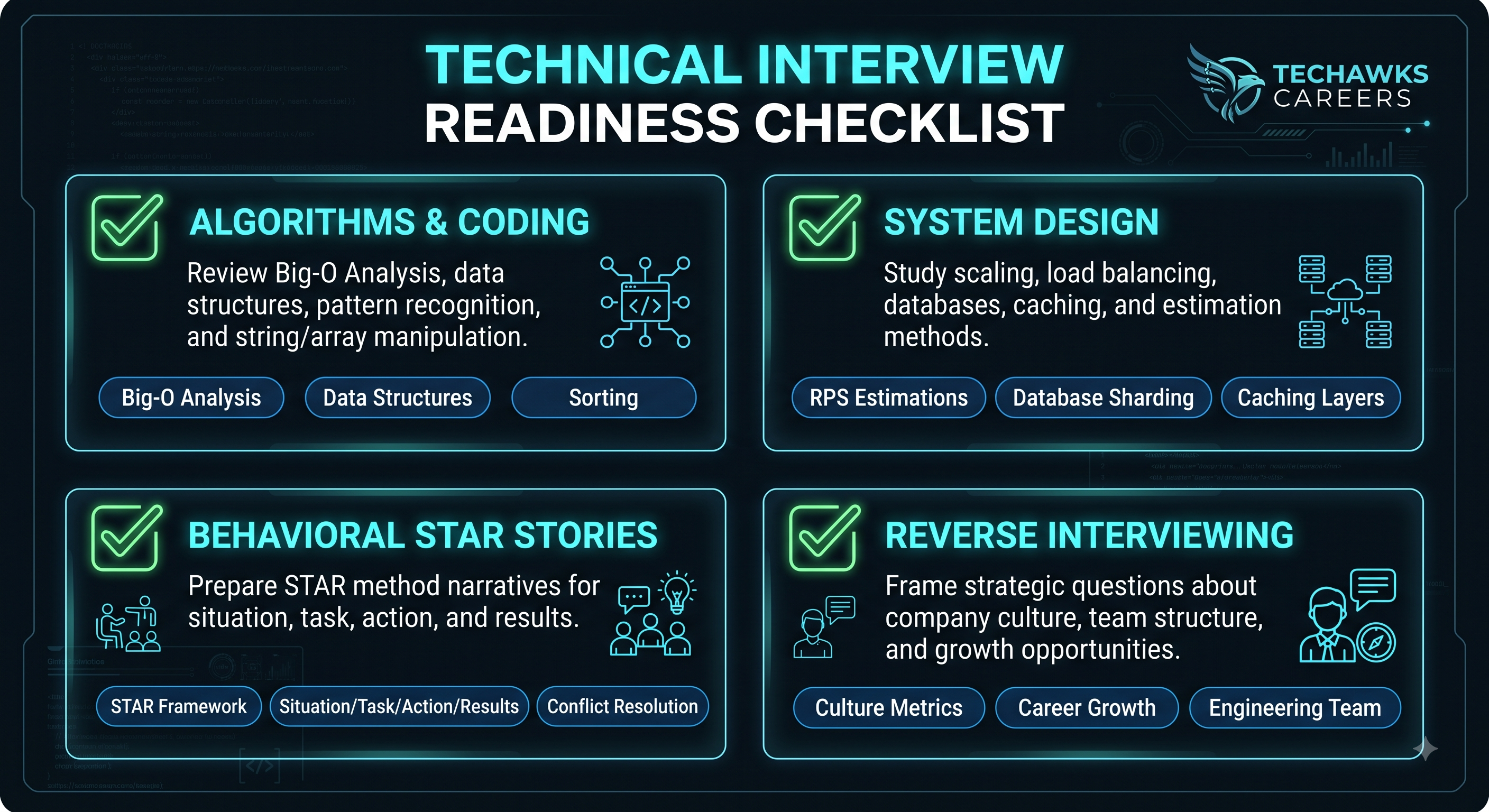
Use this 10-point checklist across your preparation phases to walk into every technical interview loop with complete confidence:
1. Data Structures & Algorithms (Coding Rounds)
[ ] Core Pattern Recognition: Master top algorithmic patterns (Two Pointers, Sliding Window, Fast & Slow Pointers, BFS/DFS, Dynamic Programming) rather than memorizing individual solutions.
[ ] Think Aloud Communication: Practice verbalizing your thought process, stating edge cases, and clarifying constraints before writing code on the whiteboard or live editor.
[ ] Big-O Trade-off Mastery: Confidently analyze and articulate the Time and Space complexity (O(n), O(\log n), O(1)) for every proposed approach.
2. System Design & Architecture (Senior / Mid-Level Rounds)
[ ] Back-of-the-Envelope Estimation: Practice calculating rough Read/Write RPS, bandwidth requirements, and 5-year storage growth within the first 5 minutes.
[ ] Core Building Blocks Ready: Know when and why to select specific technologies (SQL vs. NoSQL, Redis caching strategies, Kafka/RabbitMQ message streams, CDN edge caching).
[ ] Failure Mode Analysis: Proactively identify bottlenecks, single points of failure (SPOF), and database replication/failover trade-offs.
3. Behavioral & Culture Fit (The STAR Method)
[ ] Curated Story Matrix: Prepare 4–6 concrete career stories structured around the STAR method (Situation, Task, Action, Result) covering conflict resolution, tight deadlines, and technical failures.
[ ] Ownership & Impact Focus: Frame accomplishments around measurable technical outcomes and business metrics rather than passive team tasks.
4. Reverse Interviewing (Questions for the Team)
[ ] Engineering Culture Queries: Prepare high-signal questions about on-call rotation health, technical debt management, and CI/CD deployment cadence.
[ ] Role Expectation Clarity: Ask how success is measured during the first 90 days to demonstrate immediate alignment.
Key Takeaways
Patterns Over Memorization: Focus on fundamental patterns to adapt seamlessly to novel coding problems.
Communicate Continuously: Interviewers score collaboration and thought clarity just as heavily as clean syntax.
Treat Design as a Discussion: Lead the conversation, establish traffic constraints early, and justify every database and queue choice.
CTA
Ready to sharpen your interview readiness, review resume feedback, and land high-paying engineering roles? Join the Techawks Tech Jobs & Opportunities community to participate in mock technical interviews, share salary insights, and connect with hiring managers worldwide.
A successful technical interview loop evaluates far more than just raw coding speed. Top engineering teams look for problem-solving communication, system scalability intuition, and past behavioral ownership.
Use this 10-point checklist across your preparation phases to walk into every technical interview loop with complete confidence:
1. Data Structures & Algorithms (Coding Rounds)
[ ] Core Pattern Recognition: Master top algorithmic patterns (Two Pointers, Sliding Window, Fast & Slow Pointers, BFS/DFS, Dynamic Programming) rather than memorizing individual solutions.
[ ] Think Aloud Communication: Practice verbalizing your thought process, stating edge cases, and clarifying constraints before writing code on the whiteboard or live editor.
[ ] Big-O Trade-off Mastery: Confidently analyze and articulate the Time and Space complexity (O(n), O(\log n), O(1)) for every proposed approach.
2. System Design & Architecture (Senior / Mid-Level Rounds)
[ ] Back-of-the-Envelope Estimation: Practice calculating rough Read/Write RPS, bandwidth requirements, and 5-year storage growth within the first 5 minutes.
[ ] Core Building Blocks Ready: Know when and why to select specific technologies (SQL vs. NoSQL, Redis caching strategies, Kafka/RabbitMQ message streams, CDN edge caching).
[ ] Failure Mode Analysis: Proactively identify bottlenecks, single points of failure (SPOF), and database replication/failover trade-offs.
3. Behavioral & Culture Fit (The STAR Method)
[ ] Curated Story Matrix: Prepare 4–6 concrete career stories structured around the STAR method (Situation, Task, Action, Result) covering conflict resolution, tight deadlines, and technical failures.
[ ] Ownership & Impact Focus: Frame accomplishments around measurable technical outcomes and business metrics rather than passive team tasks.
4. Reverse Interviewing (Questions for the Team)
[ ] Engineering Culture Queries: Prepare high-signal questions about on-call rotation health, technical debt management, and CI/CD deployment cadence.
[ ] Role Expectation Clarity: Ask how success is measured during the first 90 days to demonstrate immediate alignment.
Key Takeaways
Patterns Over Memorization: Focus on fundamental patterns to adapt seamlessly to novel coding problems.
Communicate Continuously: Interviewers score collaboration and thought clarity just as heavily as clean syntax.
Treat Design as a Discussion: Lead the conversation, establish traffic constraints early, and justify every database and queue choice.
CTA
Ready to sharpen your interview readiness, review resume feedback, and land high-paying engineering roles? Join the Techawks Tech Jobs & Opportunities community to participate in mock technical interviews, share salary insights, and connect with hiring managers worldwide.
The Ultimate Technical Interview Preparation Checklist: 10 Critical Steps to Land Your Next Role
A successful technical interview loop evaluates far more than just raw coding speed. Top engineering teams look for problem-solving communication, system scalability intuition, and past behavioral ownership.
Use this 10-point checklist across your preparation phases to walk into every technical interview loop with complete confidence:
1. Data Structures & Algorithms (Coding Rounds)
[ ] Core Pattern Recognition: Master top algorithmic patterns (Two Pointers, Sliding Window, Fast & Slow Pointers, BFS/DFS, Dynamic Programming) rather than memorizing individual solutions.
[ ] Think Aloud Communication: Practice verbalizing your thought process, stating edge cases, and clarifying constraints before writing code on the whiteboard or live editor.
[ ] Big-O Trade-off Mastery: Confidently analyze and articulate the Time and Space complexity (O(n), O(\log n), O(1)) for every proposed approach.
2. System Design & Architecture (Senior / Mid-Level Rounds)
[ ] Back-of-the-Envelope Estimation: Practice calculating rough Read/Write RPS, bandwidth requirements, and 5-year storage growth within the first 5 minutes.
[ ] Core Building Blocks Ready: Know when and why to select specific technologies (SQL vs. NoSQL, Redis caching strategies, Kafka/RabbitMQ message streams, CDN edge caching).
[ ] Failure Mode Analysis: Proactively identify bottlenecks, single points of failure (SPOF), and database replication/failover trade-offs.
3. Behavioral & Culture Fit (The STAR Method)
[ ] Curated Story Matrix: Prepare 4–6 concrete career stories structured around the STAR method (Situation, Task, Action, Result) covering conflict resolution, tight deadlines, and technical failures.
[ ] Ownership & Impact Focus: Frame accomplishments around measurable technical outcomes and business metrics rather than passive team tasks.
4. Reverse Interviewing (Questions for the Team)
[ ] Engineering Culture Queries: Prepare high-signal questions about on-call rotation health, technical debt management, and CI/CD deployment cadence.
[ ] Role Expectation Clarity: Ask how success is measured during the first 90 days to demonstrate immediate alignment.
Key Takeaways
Patterns Over Memorization: Focus on fundamental patterns to adapt seamlessly to novel coding problems.
Communicate Continuously: Interviewers score collaboration and thought clarity just as heavily as clean syntax.
Treat Design as a Discussion: Lead the conversation, establish traffic constraints early, and justify every database and queue choice.
CTA
Ready to sharpen your interview readiness, review resume feedback, and land high-paying engineering roles? Join the Techawks Tech Jobs & Opportunities community to participate in mock technical interviews, share salary insights, and connect with hiring managers worldwide.

 Arabic
 French
 Spanish
 Portuguese
 Deutsch
 Turkish
 Dutch
Dutch
 Italiano
 Russian
 Romaian
 Portuguese (Brazil)
 Greek
Greek